

Quantum computing risks are weighing on Bitcoin’s (BTC) relative valuation against gold, according to analyst Willy Woo.
The development of quantum computing has spread concerns across the tech and financial sectors, as future breakthroughs could potentially undermine current encryption standards. Although such capabilities are not considered imminent, the long-term threat has raised questions about Bitcoin’s security model and how markets price that uncertainty.
Has Quantum Computing Entered the Bitcoin Valuation Equation?
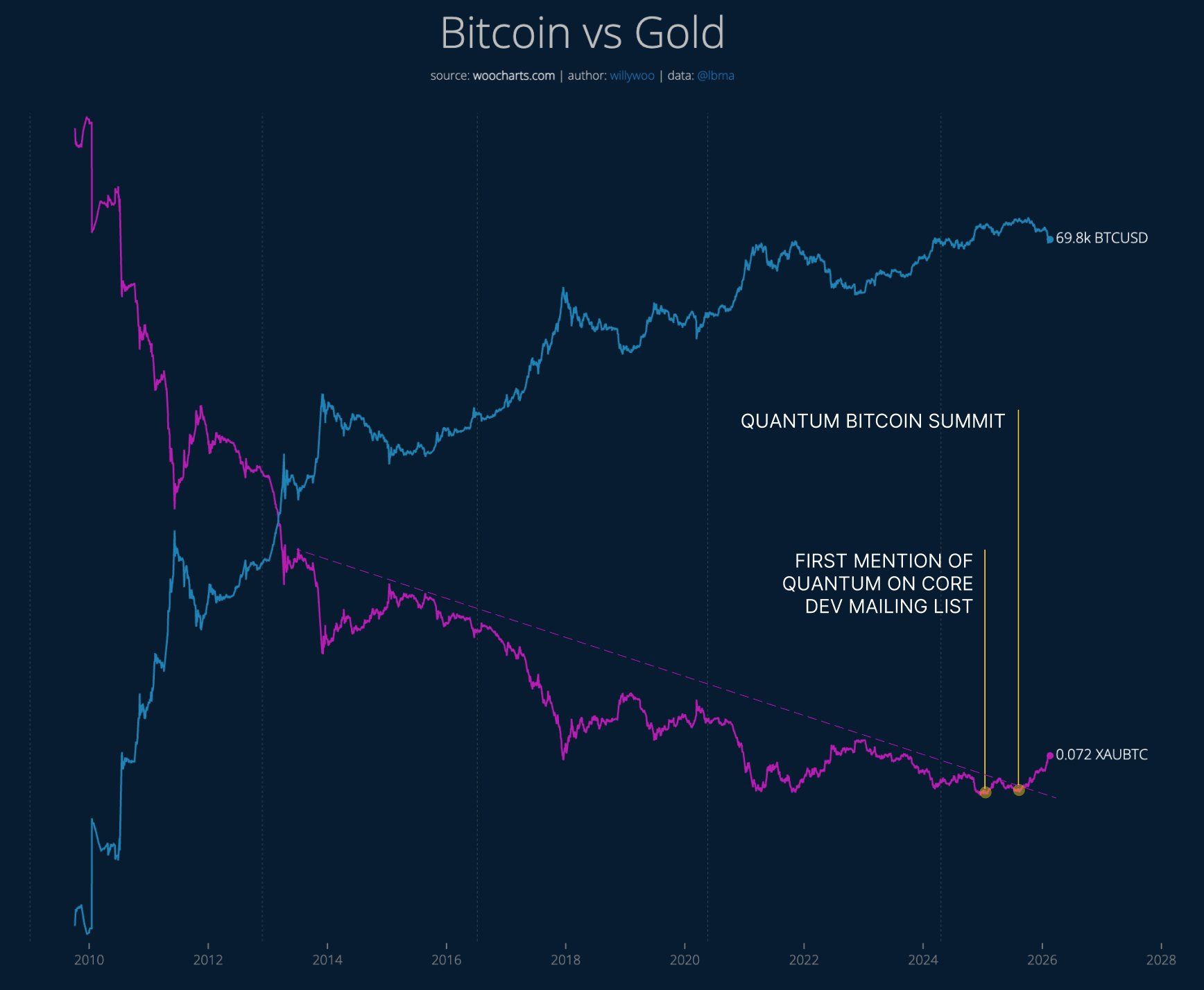
Woo argued that Bitcoin’s 12-year outperformance relative to gold has broken, marking a significant structural shift. He pointed to the rising market awareness of quantum computing risks as a reason behind this shift.
“12 YR TREND BROKEN. BTC should be a valued a LOT HIGHER relative to gold. Should be. IT’S NOT. The valuation trend broke down once QUANTUM came into awareness,” Woo said.
Bitcoin’s security relies on elliptic curve cryptography (ECDSA over secp256k1). A sufficiently advanced, fault-tolerant quantum computer running Shor’s algorithm could theoretically derive private keys from exposed public keys and compromise funds associated with those on-chain addresses.
Such technology is not yet capable of breaking Bitcoin’s encryption. Nonetheless, a key concern, Woo argues, is the potential reactivation of an estimated 4 million “lost” BTC. If quantum breakthroughs made those coins accessible, they could re-enter circulation, effectively increasing supply.
To illustrate the scale, Woo explained that corporations following MicroStrategy’s 2020 playbook and spot Bitcoin ETFs have accumulated approximately 2.8 million BTC. The possible return of 4 million lost coins would exceed that total, equivalent to roughly eight years of enterprise-level accumulation at recent rates.
“The market has started pricing in the return of these lost coins ahead of time. This process completes once the Q-Day risk is off the table. Until then, BTCUSD will price in this risk. Q-Day is 5 to 15 years away… that’s a long time trading with a cloud over its head,” he emphasized.
He acknowledged that Bitcoin would likely adopt quantum-resistant signatures before any credible attack becomes feasible. However, upgrading cryptography would not automatically resolve the status of these coins.
“I’d say it’s 75% chance that lost coins will not be frozen by a protocol hard fork,” the analyst remarked. “Unfortunately the next 10 years is when BTC is most needed. It’s the end of the long term debt cycle, it’s where macro investors and sovereigns run to hard assets like gold to shelter from global debt deleveraging. Hence gold moons without BTC.”
Woo’s analysis does not suggest that quantum attacks are imminent. Instead, it positions quantum computing as a long-term variable factored into Bitcoin’s relative valuation, particularly in comparison to gold.
Meanwhile, Charles Edwards, founder of Capriole Investments, offered a complementary perspective on how quantum risk may be influencing market behavior. According to Edwards, concerns surrounding the quantum threat were likely a key factor that drove Bitcoin’s price lower.
The quantum threat is also shaping real portfolio moves. Jefferies strategist Christopher Wood reduced a 10% Bitcoin allocation in favor of gold and mining stocks, citing quantum concerns. This highlights that institutional investors see quantum computing as a significant risk, not a remote one.
