

For much of its history, the crypto market moved largely independent of traditional finance. Token launches, exchange listings, on-chain liquidity, and risk appetite often drove price action more than anything else. However, that status quo has changed now. Crypto today responds to the same macro inputs, such as earnings, inflation data, central bank decisions, and geopolitics, that influence traditional markets.
Despite this “evolution”, however, the way traders access these markets still remains fragmented. After all, crypto, stocks, and commodities often operate on separate platforms, each with its own accounts, balances, and trading hours. This is where crypto futures introduced a meaningful change by showing that round-the-clock trading can work smoothly in a crypto-native setup.
That change has now reset expectations for a large section of active traders, which in turn, has caused a surge in demand for the same always-on access to traditional assets. This is precisely why more crypto exchanges are now offering TradFi futures that track stocks and precious metals without requiring asset ownership.
This article outlines how crypto exchanges are extending futures infrastructure to traditional assets, explains how TradFi futures enable continuous trading without ownership transfer, and uses Phemex TradFi as a case study to illustrate how this model works in practice.
KEY TAKEAWAYS
➤ Crypto and traditional markets now respond to the same macroeconomic forces.
➤ Crypto exchanges are increasingly offering futures tied to traditional assets like stocks and gold.
➤ TradFi futures enable continuous price exposure without requiring ownership of underlying assets
➤ Futures contracts can be traded 24/7 because they operate independently of traditional market infrastructure
➤ Platforms such as Phemex let traders access TradFi futures using familiar crypto futures mechanics
- How can traditional assets trade 24/7 even when the markets are closed?
- What are TradFi futures?
- How crypto exchanges offer TradFi futures using existing infrastructure
- How TradFi futures trade 24/7 in practice
- Case study: trading TradFi futures on Phemex
- How to trade TradFi futures step by step
- Are TradFi futures the right choice for you?
- Frequently asked questions
How can traditional assets trade 24/7 even when the markets are closed?
At first glance, the idea of trading stocks or gold around the clock may sound unusual. For instance, traditional stock exchanges operate on fixed schedules, which limit when shares can be bought or sold. This does not happen because the asset itself stops having value after certain hours or on weekends.
In other words, assets do not “sleep.” Only the infrastructure that handles ownership transfer operates within specific hours.
Stock trading involves custody systems, clearing houses, and regulatory oversight. These systems must confirm ownership, process settlements, and maintain records. Because these processes follow structured schedules, spot stock markets open and close at specific times.
Futures contracts follow a different structure because they do not transfer ownership of shares or physical assets. Instead, they provide price exposure. When trading a futures contract, the position reflects price movements, and settlement happens in cash, using margin as collateral.
Because futures do not rely on traditional settlement infrastructure, they can operate independently of regular market hours. This model has existed for decades in equity index and commodity futures markets. Crypto exchanges now use the same structure to extend continuous access to traditional asset prices.
This distinction between ownership and price exposure explains how continuous trading becomes possible.
Next, let’s have a quick look at what TradFi futures are (and what they are not).
What are TradFi futures?
TradFi futures are derivative contracts linked to traditional financial assets such as stocks, gold, or silver. Their value follows the price of the underlying asset, but the contract itself is a separate instrument. Put simply, when you open a position for a certain asset, the goal is to gain exposure to its price movement, not to acquire ownership.
On crypto exchanges such as Phemex, these contracts settle in USDT and use the same margin and leverage mechanics as crypto futures.
This structure makes TradFi futures useful for active trading and risk management. Positions can be opened in either direction. A long position benefits from rising prices, while a short position benefits from falling prices. This flexibility allows traders to respond to changing market conditions without needing to buy or sell the asset itself.
It is equally important to understand what TradFi futures do not provide. They do not grant ownership of company shares or physical commodities.
There are no dividends, voting rights, or direct claims on the underlying asset. These contracts exist purely to reflect price movement.
This distinction is crucial because TradFi futures serve a different purpose than traditional investing. They allow traders to manage exposure, react quickly to market developments, and operate within a continuous trading environment.
So, with these basics out of the way, the next step is to understand why crypto exchanges are able to offer this type of access in the first place.
How crypto exchanges offer TradFi futures using existing infrastructure
For starters, TradFi futures did not require crypto exchanges to build an entirely new system.
Most of the necessary components already exist because crypto exchanges have supported futures trading for years. The same infrastructure that powers Bitcoin and Ethereum futures can also support contracts linked to traditional assets.
At the core of this system is the futures matching engine that processes buy and sell orders, matches counterparties, and keeps trading active at all times. This engine operates continuously, which allows positions to be opened or closed without waiting for traditional market hours.
The same order types — such as Market, Limit, and Conditional orders — apply across both crypto and TradFi futures.
Margin and liquidation systems also play an important role. For instance, traders post collateral and gain price exposure through leverage instead of paying the full value of a position.
If the market moves against a position and the margin falls below the required level, the system closes the position automatically. This risk management framework works the same way regardless of whether the contract tracks Bitcoin, gold, or a stock.
Another important component is the unified collateral model. The same balance can support multiple futures positions across different asset classes. There is no need to move funds between separate accounts to switch between crypto and traditional exposure.
Because this infrastructure already supports continuous futures trading, crypto exchanges can extend it to traditional assets by listing new contracts that track their prices. This makes continuous access possible without relying on traditional stock exchange systems.
How TradFi futures trade 24/7 in practice
While you can continue trading TradFi futures even when stock exchanges and commodity markets are closed, trading conditions during these “ off periods” are usually different from regular market hours.
A TradFi platform has several mechanisms helping keep futures prices aligned with the underlying asset:
- Reference pricing: Contracts track the underlying asset using composite price feeds, recent spot prices, and related market data.
- Funding rates: Periodic payments between long and short positions help keep perpetual contract prices close to the underlying asset’s value.
- Global price discovery: Markets in different regions and related financial instruments continue to reflect new information even when a specific stock exchange is closed. Even with these mechanisms, trading conditions can differ outside traditional market hours. Traders should expect structural differences during these periods.
- Lower liquidity: Fewer participants may be active, which can reduce order book depth.
- Wider spreads: The difference between the buy price and sell price may increase, which can make entries and exits slightly more expensive.
- Temporary price divergence: Futures prices may move ahead of spot markets and later realign when traditional markets reopen.
We will use Phemex to demonstrate how this works in practice in the next section.
Having 24/7 access to the broader market allows you to respond immediately to earnings reports, macroeconomic releases, or geopolitical events. Risk exposure can be adjusted as conditions change, instead of waiting for the market to open the next business day.
Case study: trading TradFi futures on Phemex
The same overall structure (the one explained above) applies when trading TradFi futures on crypto exchanges such as Phemex.
Phemex lists futures contracts that track the prices of selected traditional assets. These contracts allow price exposure using the same futures system already used for crypto.
TradFi futures on Phemex cover a focused set of traditional markets. These include selected equity futures and precious metals such as gold and silver. All contracts settle in USDT, which means profit and loss calculations happen in the same balance used for crypto futures. There is no need to convert funds or move assets between different accounts.
The trading process follows the same core mechanics familiar to crypto futures traders:
➤ Same margin system: Positions open using collateral rather than full asset value.
➤ Same leverage controls: Position size can increase using leverage, with corresponding risk.
➤ Same order types: Market, Limit, and Conditional orders work the same way.
➤ Same risk framework: Margin levels and liquidation rules apply consistently across all futures contracts.
This consistency significantly reduces the learning curve. Traders who already understand crypto perpetual futures can apply the same execution logic when trading contracts linked to stocks or precious metals.
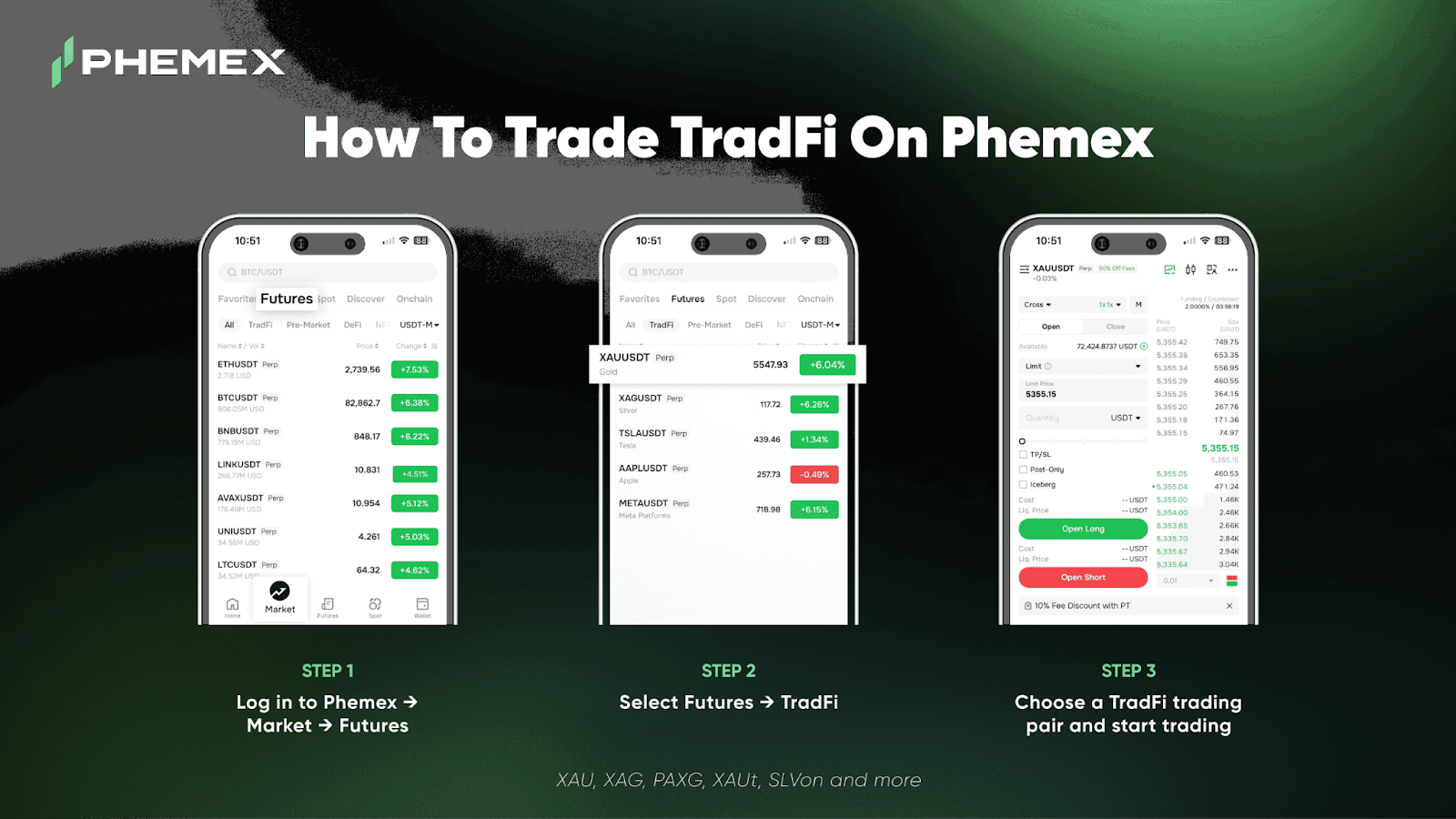
How to trade TradFi futures step by step
The overall process is pretty much the same as trading crypto perpetual contracts, barring perhaps minor differences here and there depending on the platform you use.
The same order types, margin system, and risk controls apply.
The basic process works as follows:
1. Select the TradFi futures market: Go to the futures trading section and choose a TradFi contract linked to the asset of interest, such as an equity or a precious metal.
2. Choose position direction: Futures allow exposure in both directions. Open a long position if you expect the price to increase, or a short position if you are expecting a price decline
3. Set leverage and margin parameters: Define how much collateral to allocate and select the desired leverage level. Higher leverage increases exposure but also raises liquidation risk.
4. Choose the order type and position size: Place a Market order for immediate execution, or use Limit and Conditional orders to define specific entry conditions and price levels.
5. Apply risk management controls: Set stop-loss and take-profit levels to manage potential losses and secure gains. Don’t forget that position sizing and margin management play a critical role in controlling overall risk.
6. Monitor and manage the position: Positions can be adjusted at any time. Margin can be added or reduced, and positions can be closed based on changing market conditions.
Note that leverage and liquidation mechanics operate the same way as crypto futures. If losses reduce the margin below required levels, the system closes the position automatically.
Are TradFi futures the right choice for you?
To cut a long story short, TradFi futures serve a very specific role — they are designed for active traders who want price exposure to traditional assets without leaving their familiar crypto-native trading ecosystem.
So, this structure may be suitable for you if you are:
- A crypto futures trader looking for broader exposure.
- A trader who actively manages positions.
- Familiar with margin and leverage mechanics.
On the other hand, TradFi futures may not be ideal for you if you are a long-term investor who wants actual ownership of stocks or commodities, including shareholder rights, dividends, or physical asset claims.
To support early adoption, Phemex is introducing a 0-Fee TradFi Futures Carnival, featuring three months of zero trading fees, a $100,000 incentive pool designed to encourage structured and risk-aware participation, and a first-trade protection mechanism that reimburses eligible users with a trading bonus if their initial TradFi futures trade results in a loss.
