


Oil and gas stocks are back on investors’ radar in 2026. As of Apr. 24, 2026, the S&P 500 Energy sector was up 26.59% year to date, compared with a 4.67% gain for the broader S&P 500.
Higher crude prices, Middle East supply risks, and renewed interest in dividend-paying energy companies have made the sector hard to ignore. That said, buying oil and gas stocks is not the same as buying oil itself because you are also buying into a company’s business model. A producer, pipeline company, refiner, and integrated major can all react differently to the same oil-price move.
This guide explains how to invest in oil and gas stocks, how the main stock types work, what metrics to check, and when ETFs may make more sense than individual shares. It also covers key risks, tax points, and market factors in 2026 you should understand before you buy.
KEY TAKEAWAYS
➤ Oil and gas stocks fall into five subsectors, each with different risk and return profiles.
➤ ETFs offer diversified oil exposure with lower risk than picking individual company stocks.
➤ Tokenized oil on blockchain platforms provides 24/7 trading and fractional commodity access.
➤ Energy is the best-performing S&P 500 sector in 2026, driven by geopolitical supply disruption.
➤ Tax benefits like depletion deductions can reduce the effective cost of oil and gas investments.
- How to invest in oil and gas stocks: In a nutshell
- What are oil and gas stocks?
- Why are oil and gas stocks gaining attention in 2026?
- 5 ways to invest in oil and gas stocks
- What are the top oil and gas stocks and ETFs to watch in 2026?
- How to start investing in oil and gas stocks
- What are the risks of investing in oil and gas stocks?
- Tax Considerations for Oil and Gas Investors
- So, which method is best for you in 2026?
- Frequently Asked Questions
How to invest in oil and gas stocks: In a nutshell
Let’s quickly highlight the most common routes before we get into the details:
| Method | Min. Investment | Risk Level | Liquidity | Best For |
| Individual stocks | Price of one share (~$40-$190) | High | High (market hours) | Experienced investors who can research companies |
| Oil & gas ETFs | Price of one share (~$20-$100) | Moderate | High (market hours) | Beginners seeking diversified exposure |
| Mutual funds | Varies ($500-$3,000 typical) | Moderate | Moderate (end-of-day pricing) | Long-term, hands-off investors |
| Futures & options | $5,000+ margin typical | Very high | High | Experienced traders comfortable with leverage |
| Tokenized oil (blockchain) | As low as $1 | Moderate to high | High (24/7) | Crypto-native investors seeking commodity access |
What are oil and gas stocks?
Oil and gas stocks are shares in companies that explore, extract, transport, refine, or sell petroleum and natural gas products. They represent ownership in businesses that are directly or indirectly tied to the prices of crude oil and natural gas.
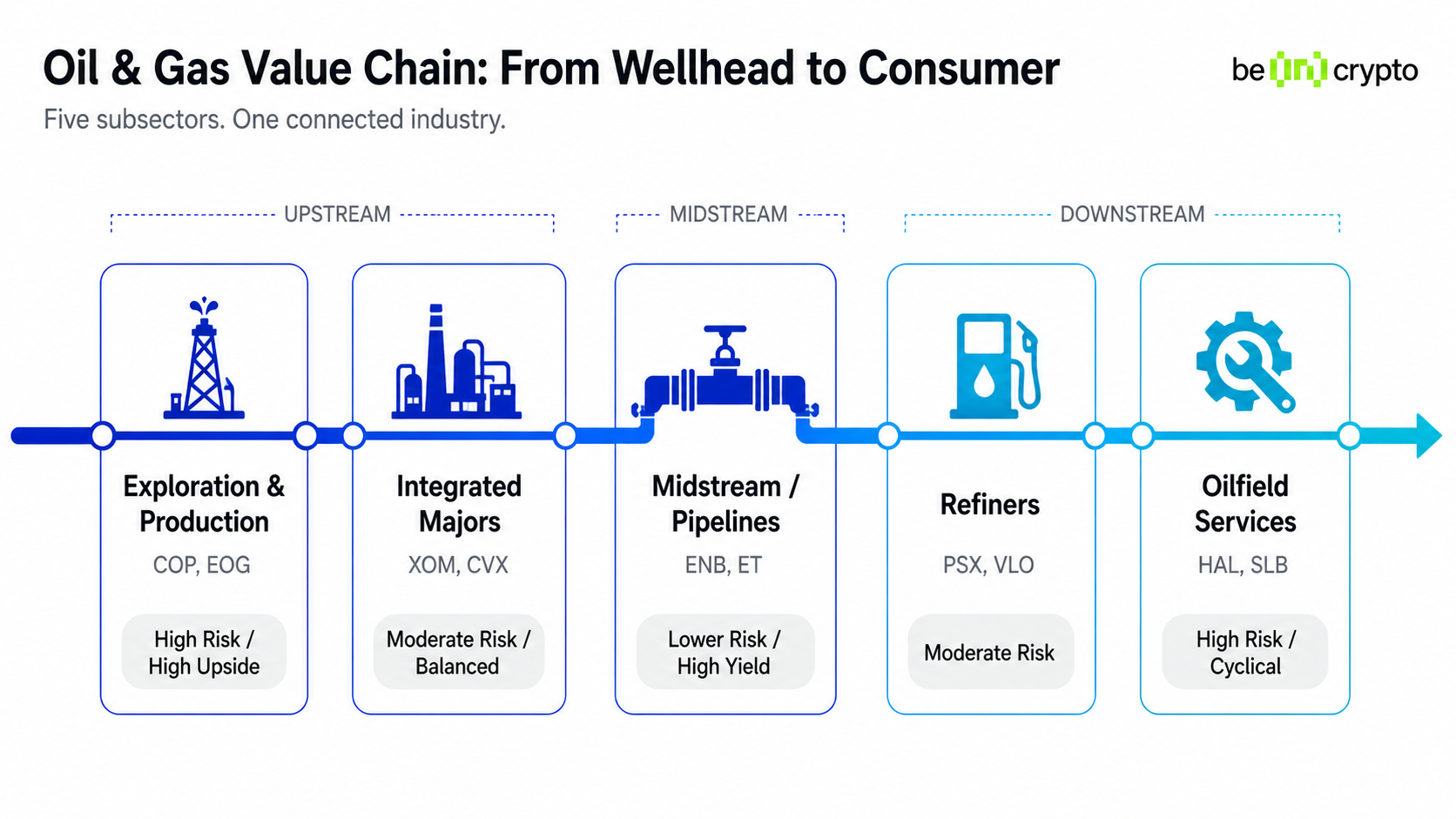
The oil and gas industry is not a single business. It spans a value chain from the wellhead to the gas pump, and each segment responds differently to price swings. Understanding these segments helps you choose the right type of stock for your risk tolerance.
| Subsector | What they do | Example companies | Risk level | Dividend potential |
|---|---|---|---|---|
| Exploration & production (E&P) | Find and extract oil and gas | ConocoPhillips (COP), EOG Resources (EOG) | High | Moderate to high |
| Integrated majors | Operate across the full value chain | ExxonMobil (XOM), Chevron (CVX) | Moderate | High |
| Midstream / pipelines | Transport and store oil and gas | Enbridge (ENB), Energy Transfer (ET) | Low to moderate | Very high |
| Refiners | Process crude into fuels | Phillips 66 (PSX), Valero (VLO) | Moderate | Moderate |
| Oilfield services | Provide equipment and services | Halliburton (HAL), Schlumberger (SLB) | High | Low to moderate |
Note that each category behaves differently when oil prices move:
➤ E&P companies usually track oil prices most closely
➤ Midstream firms rely more on transport fees than price swings
➤ Integrated majors balance production, refining, and distribution
➤ Refiners depend on fuel margins, not just crude prices
➤ Services firms depend on drilling activity and company spending
The distinction between these categories can be crucial for portfolio construction. For instance, a rise in crude prices may boost producers quickly, while pipeline operators may show steadier, slower gains driven by contract revenue.
Why are oil and gas stocks gaining attention in 2026?
Several converging factors have made oil and gas stocks the standout equity sector this year.
For instance, tensions involving the United States and Iran disrupted shipping routes through the Strait of Hormuz early in the year. That disruption pushed West Texas Intermediate (WTI) crude above $114 per barrel by April 2026, based on recent data. Prices at that level are roughly double late-2025 averages, which have supported strong profit growth for low-cost producers.
At the same time, OPEC and its partners increased output by about 206,000 barrels per day starting in April 2026. The added supply has not fully offset the earlier disruption, which has kept crude prices elevated.
The conflict between the United States and Iran disrupted shipping through the Strait of Hormuz in early 2026, pushing West Texas Intermediate (WTI) crude above $114 per barrel by April, according to FactSet. That is roughly double the Q4 2025 baseline. Energy companies with low production costs have seen profits accelerate sharply.
OPEC+ responded by increasing output by 206,000 barrels per day starting April 2026, according to OPEC. Yet the supply increase has not matched the demand shock, keeping prices elevated.
| 2026 Market Snapshot | Data |
| WTI crude price (April 2026) | ~$114/barrel |
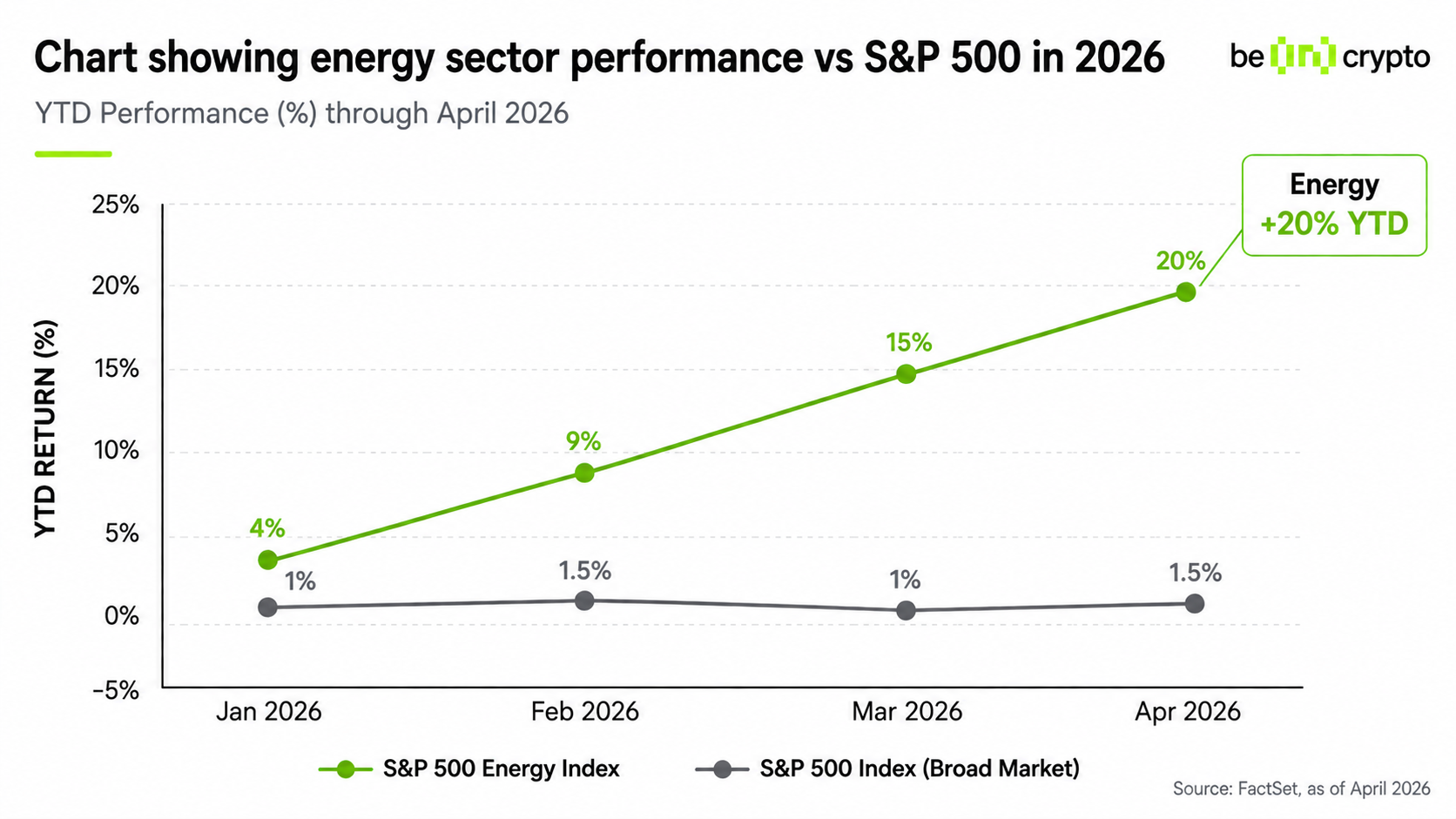
| Energy sector S&P 500 YTD return | ~20% |
| S&P 500 broad index YTD return | ~1.5% |
| OPEC+ April output increase | 206,000 bpd |
| Analyst projected energy earnings growth (next 4 quarters) | 35%+ |
Wall Street analysts project energy sector earnings growth exceeding 35% over the next four quarters, according to FactSet. That outlook has drawn capital away from flat-performing tech stocks and into energy equities.
BeInCrypto previously covered three US stocks that rise and fall with oil prices, which underlines a crucial correlation between crude and equity returns.
5 ways to invest in oil and gas stocks
There is no single method to gain oil exposure. Each approach carries different costs, risks, and levels of complexit:
Individual stocks
Buying shares in a specific oil company gives you direct exposure to that firm’s performance. If the company earns more when oil prices rise, your shares typically appreciate. Many oil companies also pay quarterly dividends, providing passive income.
The trade-off is concentration risk. A single company can underperform even when the broader sector does well. Weak management decisions, regulatory pressure, or a failed acquisition can drag the stock down regardless of oil prices.
Oil and gas ETFs
Exchange-traded funds (ETFs) hold baskets of oil and gas stocks, which helps you to spread your investment across multiple companies. You buy a single ticker and gain exposure to the broader energy sector. ETFs trade on exchanges just like stocks, and most charge annual fees below 0.5%.
The main benefit is diversification. A weak performance from one company usually has a relatively small impact on your overall position. The trade-off is less control, since you cannot choose individual holdings or weightings within the fund.
For most beginners, an oil ETF like XLE or VDE is a simpler starting point than researching individual E&P companies. You get sector exposure without betting on one firm.
Mutual funds
Oil-focused mutual funds work similarly to ETFs but are actively managed and priced once per day at market close. They may suit investors with retirement accounts who prefer a set-and-forget approach. Fees tend to be higher than ETFs.
Futures and options
Oil futures contracts let you agree to buy crude at a set price on a future date. They are highly leveraged, meaning small price moves create large gains or losses. Options give you the right, but not the obligation, to buy or sell at a set price. Note that both these instruments are suited to experienced traders, not beginners.
Tokenized oil on blockchain
This is the newest entry point. Tokenized oil refers to blockchain-based tokens pegged to the price of physical crude oil or oil futures. Projects like Litro are building tokens backed 1:1 by verified physical reserves with IoT sensor verification, while commodity perpetuals on platforms like Hyperliquid saw weekly volumes expand from $38 million to $25 billion in Q1 2026.
Tokenized oil trades 24/7, allows fractional ownership starting at $1, and settles near-instantly compared to the T+2 or T+3 settlement of traditional commodities markets. However, this market is still maturing, and smart contract risk remains a factor.
What are the top oil and gas stocks and ETFs to watch in 2026?
The following tables list major oil and gas equities and ETFs. (Note: These are not recommendations. Make sure to conduct your own research before making any financial decisions.)
Stocks
| Company | Ticker | Market Cap | Dividend Yield | Subsector |
| ExxonMobil | XOM | ~$630B | ~2.8% | Integrated major |
| Chevron | CVX | ~$374B | ~3.8% | Integrated major |
| ConocoPhillips | COP | ~$134B | ~2.2% | E&P |
| Devon Energy | DVN | ~$27B | ~2.2% | E&P |
| EOG Resources | EOG | ~$65B | ~3.3% | E&P |
| Enbridge | ENB | ~$112B | ~5.3% | Midstream |
| Phillips 66 | PSX | ~$64B | ~3.0% | Refining |
Data approximate as of April 2026: Motley Fool
ETFs
| ETF Name | Ticker | Expense Ratio | Holdings Focus |
| Energy Select Sector SPDR Fund | XLE | 0.09% | Top 22 S&P 500 energy stocks |
| Vanguard Energy ETF | VDE | 0.10% | Broad US energy sector |
| SPDR S&P Oil & Gas Exploration ETF | XOP | 0.35% | E&P and refining companies |
| Alerian MLP ETF | AMLP | 0.85% | Midstream MLPs (pipeline income) |
Source: Fund provider websites, as of April 2026.
XLE is the most widely held energy ETF. Its top three holdings, ExxonMobil, Chevron, and ConocoPhillips, make up about 48% of total assets. If you want broader, more equal-weight exposure, XOP distributes capital more evenly across smaller E&P firms.
How to start investing in oil and gas stocks
Follow these five steps to move from research to execution.
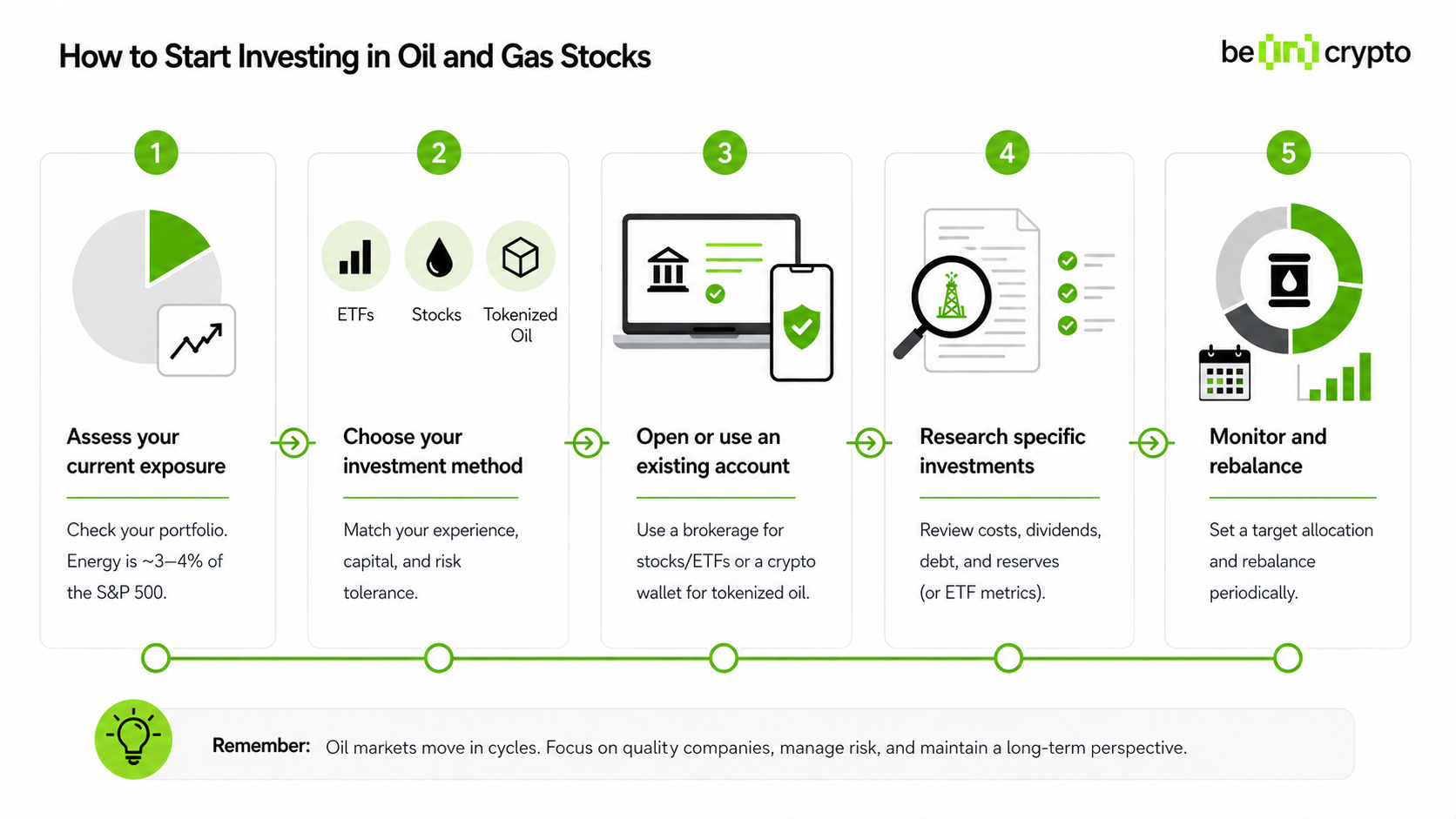
- Choose your investment method. Use the comparison table above to match your experience, capital, and risk tolerance to the right vehicle. Beginners may start with a single ETF. Crypto-native investors may find tokenized oil more accessible.
- Open or use an existing brokerage account. Most online brokers (Fidelity, Schwab, Interactive Brokers) offer commission-free stock and ETF trading. For tokenized oil, you will need a crypto wallet and access to a compatible decentralized exchange.
- Research specific investments. Look at production costs, dividend history, debt levels, and reserve estimates for individual stocks. For ETFs, compare expense ratios, holdings concentration, and tracking methodology.
- Monitor and rebalance. Oil is cyclical. Set a target allocation for energy and rebalance quarterly or when your position drifts beyond your threshold. Avoid panic selling during commodity downturns or overbuying during price spikes.
- Assess your current portfolio exposure. Check how much of your existing holdings are in energy. If you hold a broad index fund like the S&P 500, roughly 3-4% of it already sits in energy stocks. Adding oil-specific positions increases that concentration intentionally.
What are the risks of investing in oil and gas stocks?
Oil and gas equities carry sector-specific risks beyond standard stock market volatility.
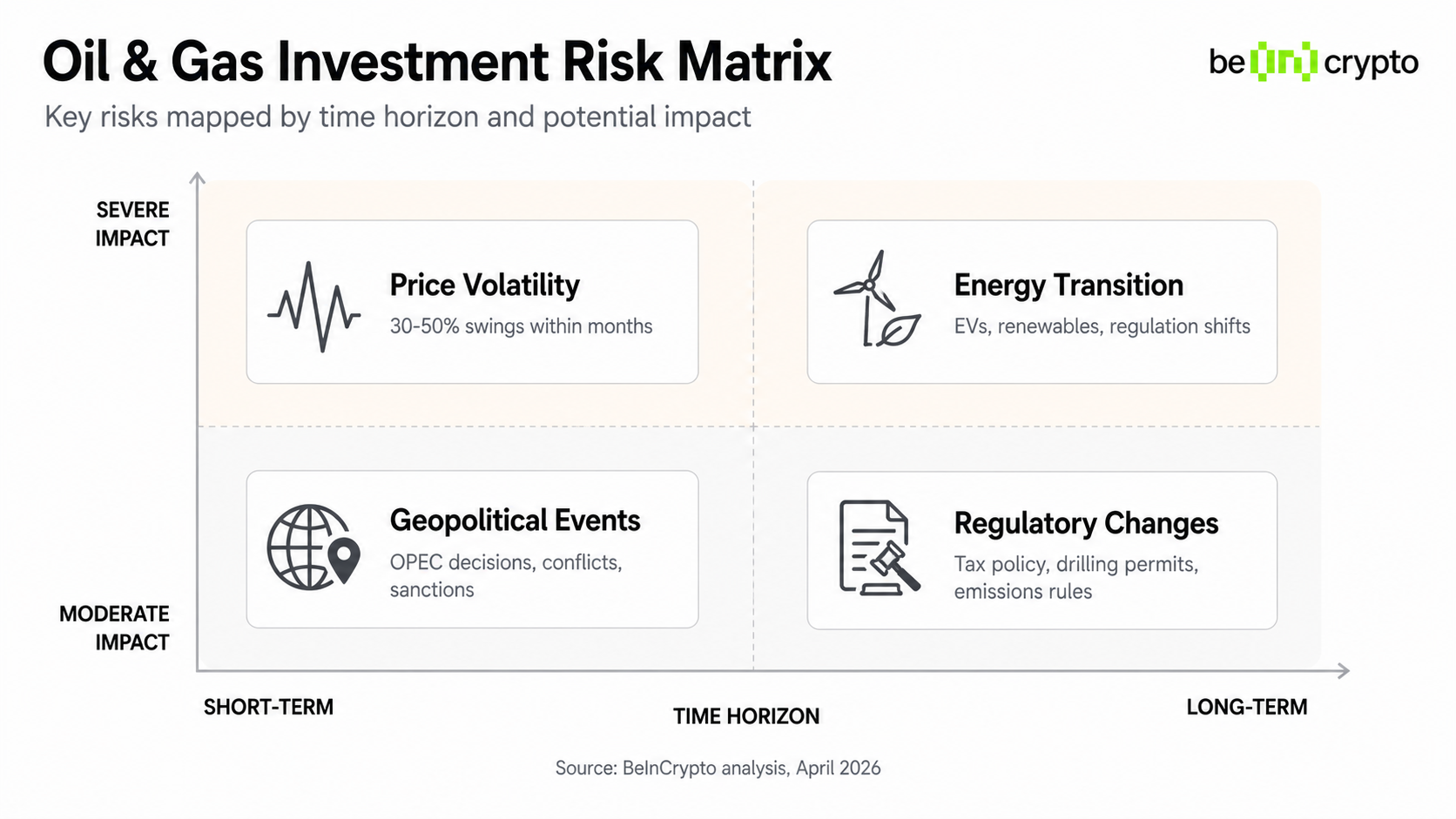
- Price volatility remains the most obvious danger. Oil prices can swing 30-50% within months. The move from roughly $67/barrel in late 2025 to $114 in April 2026 illustrates how quickly supply shocks can reprice the entire sector. Those same forces work in reverse when demand contracts or supply normalizes.
- Geopolitical exposure adds another layer of unpredictability. OPEC production decisions, Middle East conflicts, and trade sanctions can all move prices overnight. The Hormuz Strait disruption in early 2026 created a $34 gap between paper and physical oil prices, showing how fragile supply chains can be.
- Energy transition risk is a longer-term concern. Government subsidies for renewables, tightening emissions regulations, and growing electric vehicle adoption could reduce long-term oil demand. Several major oil companies are investing in clean energy, but the pace and profitability of that transition remain uncertain.
- Regulatory risk varies by geography and political administration. Tax policy, drilling permits, pipeline approvals, and environmental regulations can significantly affect operating costs and profit margins.
A common mistake is buying oil stocks only after a price spike. By the time headlines announce record crude prices, much of the move is already priced into equities. A disciplined, long-term allocation strategy tends to outperform reactive timing.
Tax Considerations for Oil and Gas Investors
Tax treatment varies by investment vehicle. This section provides general information and is not tax advice. It is highly recommended that you consult a qualified tax professional for your specific situation.
| Investment type | Key tax feature |
|---|---|
| Oil stocks (dividends) | Qualified dividends taxed at 0%–20% based on income |
| Oil and gas ETFs | Capital gains and dividends taxed similar to stocks |
| MLPs (e.g., AMLP holdings) | Issue K-1 forms; distributions may reduce cost basis |
| Futures contracts | Taxed under the 60/40 rule (60% long-term, 40% short-term) |
| Mineral rights / royalties | Eligible for depletion deductions (up to 15% of gross income) |
| Mineral rights/royalties | Treated as property in many jurisdictions; capital gains apply |
Depletion deductions allow mineral rights owners to write off a portion of royalty income each year. Intangible drilling costs (IDCs), which cover labor, fuel, and supplies used in drilling, can be deducted in the year incurred for direct well investors. These benefits are not available to stock or ETF investors.
Similarly, MLPs deserve special attention. They avoid corporate-level taxation by passing income directly to unitholders, often producing higher yields. However, the annual K-1 tax form they generate adds complexity and may delay tax filing.
So, which method is best for you in 2026?
Oil and gas stocks can offer income, diversification, and exposure to the energy cycle, but they do not all behave the same way. As we have discussed earlier, a producer, pipeline operator, and integrated major each respond differently to oil prices, margins, and demand.
So, ultimately, your approach depends on what you want. If you prefer simplicity, ETFs can spread risk. If you want control, individual stocks may fit better. In both cases, balance sheet strength, cash flow, and sector positioning matter more than short-term price moves.