Pre-IPO tokens are blockchain-based digital assets designed to give retail investors exposure to private companies before they go public through an Initial Public Offering (IPO).
Until recently, investing in companies like OpenAI, Anthropic, or — until its June 2026 Nasdaq listing — SpaceX before their stock market debut was limited to venture capitalists and accredited investors willing to commit six-figure minimums. Pre-IPO tokens change that equation by using tokenization to break private equity exposure into small, tradable units available to anyone with a crypto wallet.
This guide explains how pre-IPO tokens work, the different models available, the platforms that offer them, and the significant risks every investor should understand before participating.
KEY TAKEAWAYS
➤ Pre-IPO tokens provide economic exposure to private company valuations but do not grant ownership, voting rights, or dividends.
➤ Three main models exist for pre-IPO tokens, each with different backing structures, risk profiles, and regulatory considerations.
➤ As of April 2026, platforms like PreStocks, Jarsy, and Bitget IPO Prime allow fractional participation starting from as little as $10.
➤ Pre-IPO token holders face counterparty risk, regulatory uncertainty, and the possibility that underlying companies may challenge tokenization of their equity.
➤ SpaceX’s June 2026 listing was the category’s first large-scale settlement test: tokens rebased, converted, or entered lock-ups strictly per issuer terms.
- What are pre-IPO tokens?
- How do pre-IPO tokens work?
- What are the different types of pre-IPO token models?
- Pre-IPO tokens vs. traditional pre-IPO investing
- Where to access pre-IPO tokens?
- What are the risks and limitations of pre-IPO tokens?
- How are pre-IPO tokens regulated?
- How to buy pre-IPO tokens?
- What happens to pre-IPO tokens after an IPO?
- Who pre-IPO tokens are for (and not for)
- Frequently asked questions
What are pre-IPO tokens?
Pre-IPO tokens are blockchain-based tokens that track the value of private companies before they go public. Their price moves with the company’s estimated valuation, so you gain or lose as that valuation changes. However, they do not represent actual shares.
In other words, holders receive no ownership stake, no voting rights, no dividend payments, and no information rights from the underlying company. The tokens carry no endorsement from the companies they reference.
| Feature | Pre-IPO tokens |
| What they track | Private company valuations before IPO |
| Legal ownership | None u2014 economic exposure only |
| Voting or dividend rights | None |
| Who issues them | Third-party platforms, not the companies themselves |
| Primary blockchain | Solana (most platforms) |
| Market size context | Part of the $26.4B RWA tokenization market (March 2026) |
Put simply, pre-IPO tokens use Real-World Asset (RWA) tokenization to package private company exposure into something tradable. Companies like OpenAI and Anthropic have raised billions without going public, locking most investors out of early-stage returns. SpaceX did the same for two decades before finally listing on Nasdaq as SPCX in June 2026 — at a roughly $1.77 trillion valuation.
Pre-IPO tokens should not be confused with ICO tokens (Initial Coin Offerings), security tokens (STOs), or crypto presale tokens. ICOs fund new blockchain projects. STOs represent regulated securities on-chain. Crypto presales sell tokens for unreleased protocols.
Pre-IPO tokens specifically track private company valuations in the traditional equity market.
How do pre-IPO tokens work?
The most common structure uses three layers: a Special Purpose Vehicle (SPV) acquires actual shares, mints tokens at a 1:1 ratio on a blockchain, and lists those tokens for trading on decentralized exchanges.
Here is a simplified breakdown of the process.
- Step 1: The platform acquires pre-IPO shares through private secondary market transactions or deals with existing shareholders.
- Step 2: Shares are deposited into a regulated SPV that holds equity on behalf of all token holders.
- Step 3: The platform mints one token per share on a blockchain, most commonly Solana.
- Step 4: Investors swap stablecoins (USDC or USDT) for tokens on DEXs like Jupiter or Raydium. Trading is available 24/7.
- Step 5: To exit, holders sell tokens back to stablecoins on the same DEX. Large holders can initiate redemption through the SPV directly.
Token prices fluctuate based on supply, demand, company news, and private valuation changes. Since valuations update only during funding rounds, prices between those events often reflect market sentiment rather than verified financial data.

What are the different types of pre-IPO token models?
Pre-IPO token products vary widely. As of 2026, four main models have emerged:
- Asset-backed models hold real shares in SPVs and mint tokens against them. The tradeoff: every new token requires acquiring an actual share, which limits scalability.
- Perpetual futures models offer derivative contracts tracking private valuations. These are faster to list new companies, but depend on opaque valuation oracles.
- Exchange pre-market contracts function as prediction markets for IPO pricing. Traders speculate using USDT-settled contracts with optional leverage.
- Structured note models issue regulated debt instruments tied to IPO performance. More formal legal framework, but less trading flexibility. Bitget’s IPO Prime uses this model via Republic.
Here’s how they compare:
| Feature | Asset-Backed (PreStocks, Jarsy) | Perpetual Futures (Ventuals) | Exchange Pre-Market (Gate) | Structured Notes (Bitget/Republic) |
| Backing | 1:1 SPV holding actual shares | No underlying asset | No underlying asset | Debt instrument linked to IPO performance |
| Blockchain | Solana | Hyperliquid (testnet) | Centralized exchange | Centralized exchange |
| Leverage available | No | Yes (planned) | Yes (1-10x) | No |
| Shareholder rights | None | None | None | None |
| Minimum investment | $0.01 (PreStocks), $10 (Jarsy) | TBD | Varies | Tiered by VIP level |
| U.S. access | No | TBD | No | No |
| Regulatory framework | SPV under Regulation S | Unregulated derivatives | Exchange-governed | Regulated notes under Regulation S |
| Trading availability | 24/7 on DEXs | Not yet live | Exchange hours | Subscription periods |

The SEC’s January 2026 statement on tokenized securities classified third-party tokenization into two categories:
➤ Custodial models (like PreStocks and Jarsy) create tokenized security entitlements.
➤ Synthetic models create linked securities or security-based swaps that provide exposure without holding the actual asset. This distinction affects which regulations apply.
Pre-IPO tokens vs. traditional pre-IPO investing
Before tokenization, access to private company equity was mostly limited to institutions and high-net-worth investors. Platforms like EquityZen and Forge Global opened secondary markets, but high minimums and accreditation rules still kept most retail investors out.
Pre-IPO tokens attempt to lower those barriers — but they do so with a different set of trade-offs. Here’s a comparison between the two models:
| Factor | Pre-IPO Tokens (Crypto) | Traditional Pre-IPO Investing |
| Minimum investment | As low as ~$10 (varies; some DEX-based setups allow smaller amounts) | Typically $100,000-$250,000 |
| Accreditation required | No (most platforms) | Yes (U.S. platforms) |
| Liquidity | 24/7 trading on DEXs | Illiquid; may wait months or years to sell |
| Settlement time | Instant (on-chain) | Days to weeks |
| Trading hours | 24/7 | Business hours only |
| Management fees | None to minimal | 1-2% management + performance fees |
| Ownership rights | No legal ownership | Varies; some grant limited economic rights |
| Regulatory clarity | Unclear; mostly unregulated | Established SEC-regulated frameworks |
| Geographic access | Global (excluding U.S. on most platforms) | Primarily U.S. and select jurisdictions |
As you can see, the key trade-off here is access versus protection.
Pre-IPO tokens lower entry barriers and offer faster, more flexible trading. In return, you give up ownership rights, regulatory safeguards, and often rely on offshore or loosely structured setups.
Where to access pre-IPO tokens?
Pre-IPO token products are available on several platforms. Here are some of the most active ones as of April 2026:
(Note: These are illustrative examples of different models, not recommendations. Other platforms offer comparable pre-IPO token products. So, make sure you verify all important aspects, such as the issuer structure, rights, and risks, carefully before using any platform.)
| Platform | Model | Blockchain | Min. Investment | KYC Required | Key Feature |
| PreStocks | Asset-backed (SPV) | Solana | No minimum | No | 22+ companies; tradable on Jupiter/Raydium |
| Jarsy | Asset-backed (SPV) | Solana | $10 | Yes | Proof of Reserve verification page |
| Bitget IPO Prime | Structured notes | Centralized | VIP-tiered | Yes | Republic partnership; Regulation S compliant |
| Binance Wallet | Portal to PreStocks | Solana | No minimum | No | Access via Binance ecosystem |
| Gate | Pre-market contracts | Centralized | Varies | Yes | 1-10x leverage; USDT-settled derivatives |
As of April 2026, none of these platforms are available to U.S. residents or U.S. persons. That’s because most of these platforms operate under Regulation S, which explicitly exempts them from SEC registration requirements only for offerings made outside the United States.
What are the risks and limitations of pre-IPO tokens?
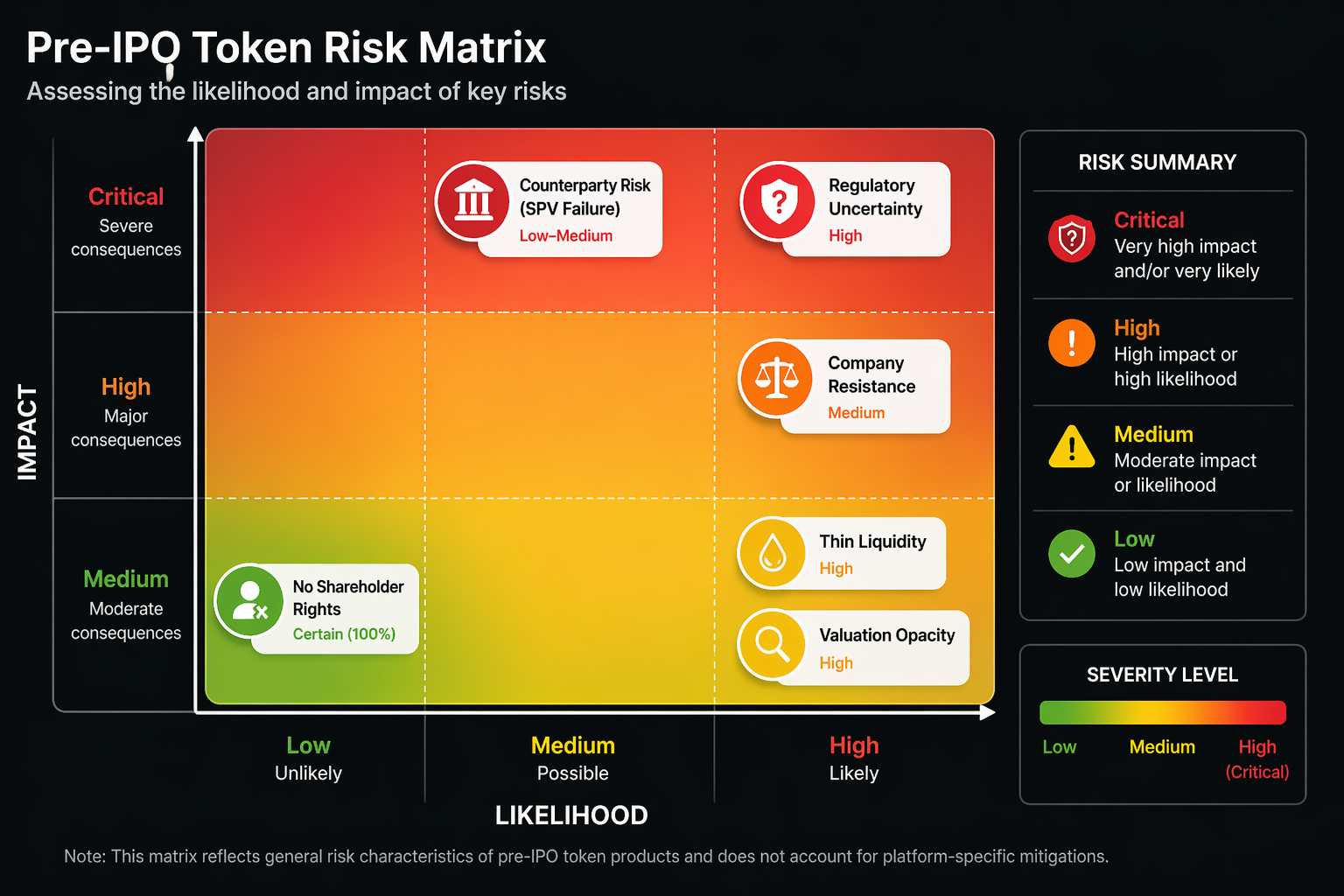
Pre-IPO tokens carry substantial risks beyond typical cryptocurrency volatility, so it is highly recommended that you get a grip of these risks before allocating any capital:
➤ Counterparty risk (high severity): The structure depends on intermediaries such as SPVs and platform operators. If the SPV manager misuses funds, faces legal action, or becomes insolvent, your tokens can lose all value regardless of the company’s performance.
➤ Company resistance (medium-high severity): Private companies can oppose third-party tokenization of their shares or valuation. For example, OpenAI publicly rejected any link to Robinhood’s tokenized exposure in June 2025, highlighting the lack of issuer involvement in many cases.
➤ Regulatory uncertainty (high severity): Regulation is still evolving. In January 2026, the SEC clarified that tokenized securities remain subject to existing securities laws. Future enforcement or rule changes could force platforms to restructure or shut down.
➤ Thin liquidity (medium severity): Trading activity is often limited. Some markets have been as small as roughly $350K–$670K per company, which means even moderate trades can move prices significantly.
➤ Valuation opacity (medium severity): Private company valuations update only during funding rounds. Between those events, token prices are largely driven by market sentiment rather than verified financial data.
How are pre-IPO tokens regulated?
Regulation of pre-IPO tokens is evolving fast. Here is a brief timeline of the most significant regulatory developments, as of press time:
| Date | Event | Significance |
| June 2025 | OpenAI objects to Robinhood tokenized exposure | First major company pushback against third-party tokenization |
| Jan. 28, 2026 | SEC issues joint statement on tokenized securities | Established that tokenizing a security does not change its legal nature; distinguished issuer-sponsored vs. third-party models |
| Jan. 28, 2026 | SEC defines custodial vs. synthetic categories | Custodial = tokens backed by actual shares in custody; Synthetic = linked securities or swaps without holding the asset |
| Mar. 17, 2026 | SEC-CFTC joint interpretation | Confirmed “digital securities” (tokenized traditional securities) remain under full SEC oversight |
| June 11–12, 2026 | SpaceX prices its IPO and lists on Nasdaq as SPCX | First trillion-dollar listing settled across pre-IPO token products: perps rebased and converted, RWA tokens entered lock-ups, xStocks began tracking the listed stock |
The SEC’s January 2026 statement is the most important regulatory document for pre-IPO tokens. It established that a stock remains a stock whether it exists as a paper certificate, a brokerage entry, or a blockchain token. All existing securities laws continue to apply.
The SEC distinguished issuer-sponsored tokenized securities (created by the company itself) from third-party-sponsored ones (created by unaffiliated parties like PreStocks and Jarsy). Most pre-IPO token platforms fall into the third-party category.
Most platforms operate under Regulation S, which exempts securities offerings made entirely outside the United States from SEC registration. This is why nearly all platforms block U.S. users.
How to buy pre-IPO tokens?
If you understand the risks, here is a step-by-step process for buying pre-IPO tokens on Solana-based platforms like PreStocks:
➤ Step 1: Set up a Solana wallet
Download Phantom or a similar wallet. Store your seed phrase offline in a secure place.
➤ Step 2: Fund it with stablecoins
Transfer USDC or USDT to your wallet. Keep a small amount of SOL in the wallet to cover network fees.
➤ Step 3: Visit the platform
Open PreStocks through Jupiter’s Stocks tab or go to prestocks.com directly.
➤ Step 4: Purchase a token
Swap your stablecoins for a pre-IPO token such as OPENAI or ANTHRP. PreStocks does not require a minimum purchase. Note that SpaceX-linked tokens now reference a listed company after the June 2026 IPO, so their behavior follows each product’s post-IPO settlement terms rather than a private valuation.
➤ Step 5: Monitor your position
Check your holdings through your wallet or DEX tools. You can sell back into stablecoins at any time on the same DEX.
Always verify the token contract address before purchasing. Only use verified tokens. The pre-IPO token space is susceptible to fake tokens that mimic legitimate products.
Note that for centralized platforms like Bitget IPO Prime, the process may involve creating an exchange account, completing KYC verification, and participating during designated subscription periods using stablecoins.
Refer to our guide on the top 10 pre-IPO tokens to watch in 2026 to compare which tokens to focus on.
What happens to pre-IPO tokens after an IPO?
What happens after an IPO depends on the platform, issuer, and product structure.
Some tokens may settle against the IPO price, some may convert into a post-IPO market product, and some may require redemption through the issuer’s own process. Others may not convert at all if the product only provides synthetic exposure or a pre-market contract.
This is why you should carefully read and assess the fine print before you buy. Start by checking whether the token has a clear settlement date, redemption process, fee schedule, lockup period, and post-IPO conversion rule. Also, confirm whether the product gives direct share exposure or only tracks the company’s value indirectly.
The SpaceX listing: a live settlement case study
SpaceX’s June 12, 2026, Nasdaq debut as SPCX turned these hypotheticals into the category’s first major real-world test, and every product followed its own issuer terms rather than a common standard:
- OKX rebased its pre-market perpetual on June 2, once the public S-1 disclosed the actual share count, and renamed it SPCXUSDT; it converts into a standard stock perpetual.
- Coinbase rebased its SPCX-PERP to the final share count on June 11 and transitions it automatically into a standard SpaceX perpetual.
- Bitget/Republic’s preSPAX entered its liquidity-event payout phase under the note’s offering terms.
- BingX RWA tokens entered a lock-up, typically six months, after which the platform says it sells in batches and credits holders in USDT.
- xStocks SPCXx (Kraken/Bybit) now tracks the listed stock 24/7 under its issuer’s terms.
For the product-by-product breakdown, see our guide to tokenized SpaceX products after the IPO.
Settlement is not standard across platforms, and redemption may depend on liquidity, issuer approval, or market demand.
Who pre-IPO tokens are for (and not for)
Pre-IPO tokens are not for everyone. The structure, risks, and lack of ownership rights mean they suit a narrow type of user.
They may make sense for you if you:
- Want early exposure to private companies without six-figure capital
- Understand that most tokens do not give shareholder rights
- Feel comfortable with issuer, liquidity, and regulatory ris
- You prefer flexible entry and exit over long lock-up periods
They may not be suitable if you:
- Expect direct ownership of shares or voting rights
- Need strong legal protections or clear regulatory oversight
- Are not comfortable with offshore structures or platform risk
- Prefer long-term, low-risk exposure