The best pre-IPO tokens in 2026 include assets that track high-demand private companies such as Anthropic, OpenAI, Anduril, and xAI — plus SpaceX, which graduated to a Nasdaq listing in June 2026 and now serves as the category’s first big settlement test. Tokenized exposure to these companies is already available across on-chain platforms, centralized exchanges, and wallet marketplaces.
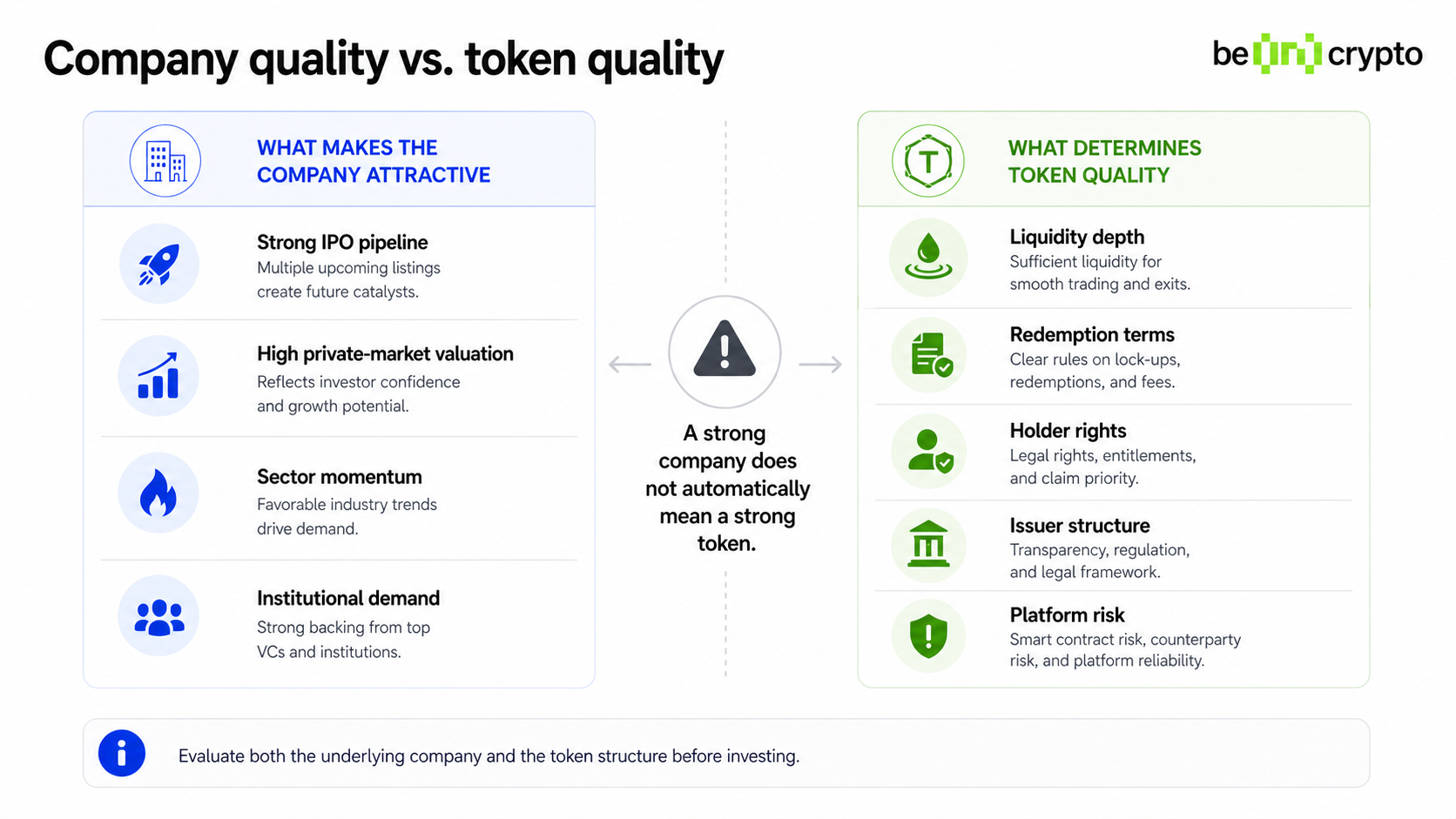
Their prices may move based on how markets perceive the underlying company’s valuation, but these tokens are not official company shares and do not come with shareholder rights. Also, a strong company name on the label does not automatically translate into a strong token. Liquidity, redemption rules, legal rights, issuer structure, and platform risk all play a role in determining what a token is actually worth. The company name is only one part of the picture.
This guide evaluates some of the best pre-IPO tokens in 2026 by demand, liquidity, structure, valuation transparency, and holder rights. For a primer on how these products work, see BeInCrypto’s guide to pre-IPO tokens.
KEY TAKEAWAYS
➤ Most pre-IPO tokens provide indirect exposure, not ownership, which limits rights like voting, dividends, and company information access.
➤ A single company can have multiple token versions, each with different structures, rights, pricing models, and risk profiles.
➤ Regulatory and company-approval risks can affect token legitimacy, especially when issuers operate without consent from the referenced company.
➤ Token prices may diverge from actual private-market valuations, so implied pricing should always be compared with verified funding data.
➤ Understanding how each token works is more important than the company it references when evaluating risk and potential usability.
➤ SpaceX’s June 2026 listing was the category’s first major settlement test: tokens settled, rebased, or converted strictly according to issuer terms, not the SpaceX name.
What to consider before adding a pre-IPO token to your watchlist
The best pre-IPO tokens are not just the ones tied to the biggest names. For instance, a SpaceX-linked token with thin liquidity and unclear redemption terms may deserve more caution than a less famous name with transparent structure and verifiable backing.
Before evaluating any pre-IPO token, consider five areas that affect a token holder’s real-world outcome.
This watchlist evaluates each token across five consideration areas. The table below summarizes what each one measures and why it matters.
| Consideration area | What it measures | Why it matters |
| Company demand | Private-market interest, public search volume, IPO timeline credibility | High demand draws attention to tokens but does not determine token quality |
| Token liquidity | Order-book depth, realistic entry and exit conditions | Thin books can make it difficult to sell without significant slippage |
| Structure clarity | Whether the token is SPV-backed, custodial, synthetic, a pre-market contract, or a perpetual future | The product model determines what rights you hold and what risks you face |
| Valuation clarity | Gap between token-implied valuation and latest private-market round | A large premium may reflect speculation rather than fundamentals |
| Rights and issuer risk | Legal ownership, voting, dividends, or only economic exposure | Most pre-IPO tokens provide only economic exposure through an intermediary |
What are the best pre-IPO tokens in 2026?
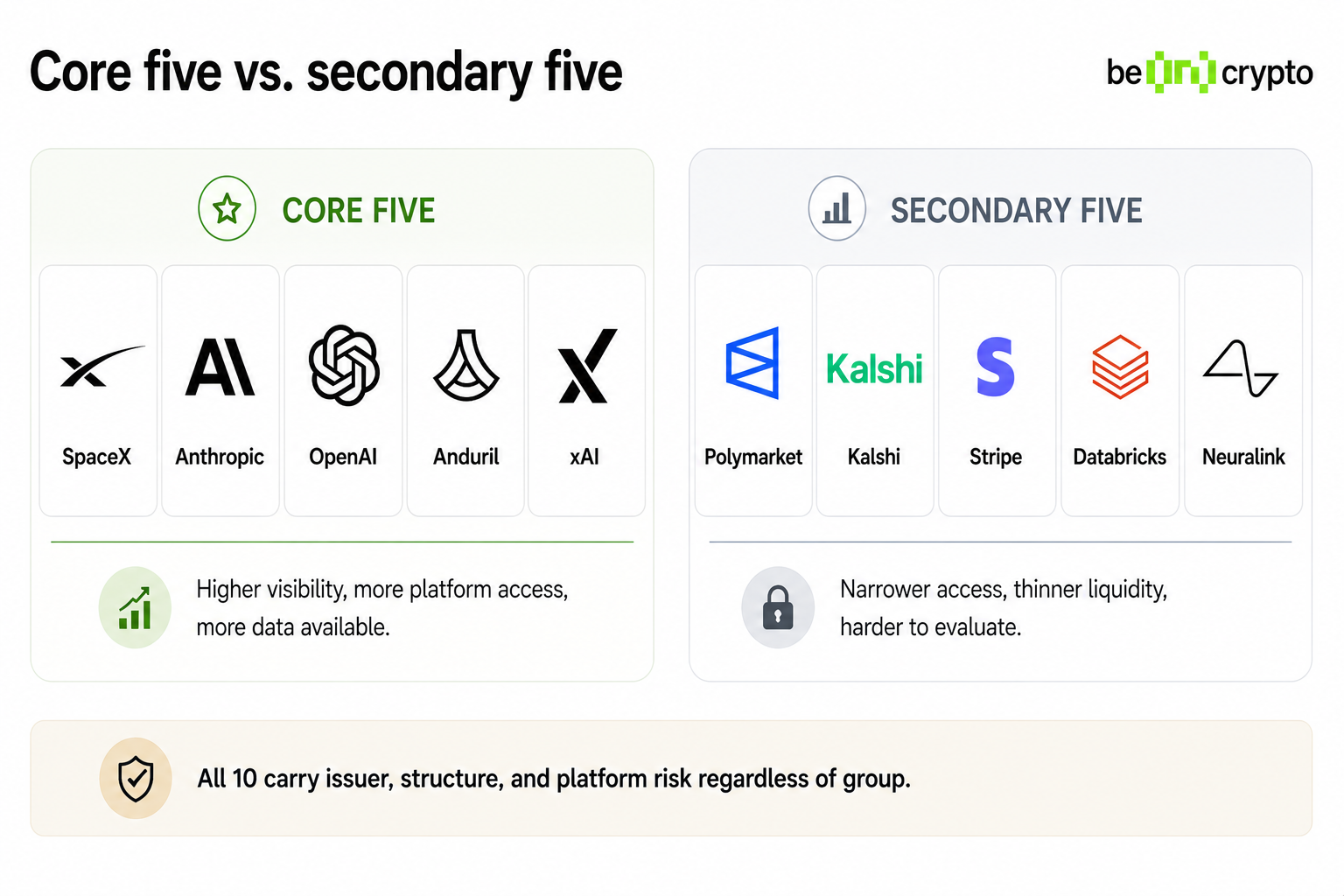
The table below compares all 10 names by sector, access route, product model, catalyst, and the primary risk to watch. Live category data for these tokens is available on CoinGecko. Note that the strongest names are not always the safest tokens, so each one should be checked by structure, liquidity, holder rights, and valuation risk.
| Exposure (referenced company) | Sector | Main access routes | Model type | Main 2026 catalyst | Key risk to consider |
| SpaceX | Space, satellites, AI-adjacent | PreStocks, Bitget preSPAX, Jarsy, BingX | Mixed | Listed on Nasdaq as SPCX on June 12, 2026; products now settle or track per issuer terms | Product structures differ across platforms |
| Anthropic | AI | PreStocks, Binance Wallet, DEX routes | SPV-style exposure | Confidential S-1 confirmed June 1, 2026 | Exit liquidity risk |
| OpenAI | AI | PreStocks, Binance Wallet | SPV-style exposure | Confidential S-1 confirmed June 8, 2026 | Company-disapproval risk |
| Anduril | Defense tech | PreStocks, Binance Wallet | SPV-style exposure | Defense-tech demand and $60B valuation | Lower retail awareness |
| xAI | AI | PreStocks, Binance Wallet | SPV-style exposure | Elon Musk-linked AI demand | Narrative-driven demand |
| Polymarket | Prediction markets | PreStocks, Binance-style access | SPV-style exposure | Prediction-market demand | Regulatory and liquidity risk |
| Kalshi | Prediction markets | PreStocks, Binance-style access | SPV-style exposure | Regulated prediction-market angle | Market-size uncertainty |
| Stripe | Fintech | Platform-dependent | Platform-dependent | Private-market activity | Token availability and liquidity |
| Databricks | Data and AI infra | Platform-dependent | Platform-dependent | AI infrastructure demand | Token availability |
| Neuralink | Neurotech | Platform-dependent | Platform-dependent | Public curiosity | High uncertainty across all factors |
In this next section, we break down each token in detail.
SpaceX (listed June 2026: a live case study)
What it is: Tokenized exposure to SpaceX, the aerospace and satellite company that completed the largest IPO on record, pricing at $135 per share on June 11, 2026, and listing on Nasdaq as SPCX on June 12 at a roughly $1.77 trillion valuation. SpaceX is no longer a pre-IPO name, but its tokens remain on this list because the listing turned them into the category’s first real settlement case study. Several versions of “SpaceX tokens” exist across platforms. These include SPACEX PreStocks on Jupiter, Bitget’s preSPAX subscription product, Jarsy’s economic-rights model, and VNTL-style perpetual futures on Ventuals. Each one tracks SpaceX differently, and none should be treated as identical.
Strengths: SpaceX remains the most in-demand private company name in these markets. It ranks at the top of private-market demand trackers such as Augment’s Power 20 index, which measures investor interest in late-stage companies. That demand carries over into tokenized products, where SpaceX-linked assets often attract the highest attention and liquidity among pre-IPO tokens. The expected IPO acted as the main catalyst right up to the June 12 listing, which delivered it.
The offering raised roughly $75 billion; demand reportedly topped $250 billion, and the retail allocation was cut to the low-20% range from the 30% discussed earlier.
Weaknesses: A SpaceX-linked token can mean different things depending on the platform. SPACEX PreStocks, Jarsy’s SpaceX exposure, Bitget’s preSPAX, and VNTL-style perps may use different structures, rights, fees, and redemption terms. Always check the product model before you compare prices. Bitget’s preSPAX offered 94,000 tokens at $650 each, implying a $1.5 trillion SpaceX valuation at subscription, while the IPO ultimately priced at about $1.77 trillion — a live example of how token-implied valuations and actual listing terms can diverge. Jarsy states that redemption settlement is not guaranteed and depends on liquidity and market demand.
SpaceX has the most product fragmentation of any pre-IPO token name. Before comparing prices across platforms, confirm whether you are looking at an SPV-backed token, a structured note, or a perpetual future. Each carries different rights and risks.
What to consider: With SPCX now listed, each SpaceX-linked product follows its own settlement path: xStocks SPCXx tracks the listed stock, Bitget’s preSPAX entered its post-IPO payout phase, BingX RWA tokens entered a lock-up before batch settlement, and exchange perps rebased into stock perpetuals. The variety of structures still makes due diligence essential — see our post-IPO breakdown of tokenized SpaceX products.
Here’s BeInCrypto’s detailed guide on how to invest in SpaceX now that it trades as SPCX.
Anthropic
What it is: Tokenized exposure to Anthropic, the AI-focused company behind Claude, valued at $965 billion post-money after a $65 billion Series H round in early June 2026, according to CNBC. These products are available across platforms such as PreStocks, Binance Wallet, and decentralized exchange routes. Like other pre-IPO tokens, they track Anthropic’s private-market value rather than offering direct ownership.
Strengths: Anthropic appears among the largest pre-IPO tokenized stock names by category data on major exchanges and aggregators. Demand for Anthropic private shares has been significant, with buyers indicating $2 billion in ready capital on secondary markets. The company confirmed a confidential draft S-1 with the SEC on June 1, 2026, days after the Series H round, putting it firmly in the 2026 IPO pipeline, though no date, ticker, or price range has been set.
Weaknesses: Liquidity remains the biggest issue. Secondary-market access for Anthropic private shares involves high minimums and limited liquidity, and tokenized versions on Jupiter have traded at implied valuations far from the official mark in both directions — above $850 billion when the official post-money round was still $380 billion. With the June Series H now at $965 billion, always compare implied pricing against the latest verified round. Pre-IPO tokens may be locked for six to 12 months, and resale depends on available buyers.
What to consider: Anthropic stands out for its strong AI-sector demand and clear market interest, which supports its place on most watchlists. At the same time, liquidity risk is harder to ignore here than with most other names. Check trading volume and depth before you assume you can exit at a favorable price.
OpenAI
What it is: Tokenized exposure to OpenAI, the AI company behind ChatGPT, which confirmed a confidential draft S-1 with the SEC on June 8, 2026; reports point to a potential listing valuation around $1 trillion, though no date or ticker is set. Available through PreStocks and Binance Wallet access routes, with tokenized shares trading at implied market capitalizations exceeding $1 trillion on Jupiter.
Strengths: OpenAI carries some of the highest demand across both AI and crypto markets. Strong search interest, continued product adoption, and ongoing AI-sector momentum keep OpenAI-linked tokens firmly on most watchlists. Any credible IPO timeline or valuation update can quickly drive attention back into these products.
Weaknesses: Company-disapproval risk is the key issue here. OpenAI publicly stated that Robinhood’s “OpenAI tokens” were not OpenAI equity, that OpenAI did not partner with Robinhood, was not involved, and does not endorse the product. Any transfer of OpenAI equity requires the company’s approval, and OpenAI did not approve any transfer. This precedent applies to other tokenized OpenAI products as well.
OpenAI’s public rejection of Robinhood’s tokenized offering sets a precedent for company-disapproval risk. If the referenced company does not endorse the token, holders may face reputational, legal, or structural consequences that affect the product’s viability.
What to consider: OpenAI has enormous brand recognition and AI-sector demand, but the company-disapproval risk is a serious factor that other pre-IPO tokens do not share as visibly.
(If you are specifically interested in AI IPOs, check our guide to the top AI IPOs to watch in 2026.)
Anduril
What it is: Tokenized exposure to Anduril Industries, the defense-technology company building AI-powered drones and military systems, valued at approximately $60 billion after its latest funding discussions. Available through PreStocks and Binance Wallet.
Strengths: Augment lists Anduril among its top six private-market demand names, and the company doubled its valuation from $30.5 billion to $60 billion within nine months. Revenue reportedly crossed $500 million in 2025, with projections pointing toward over $1 billion in 2026. Defense-tech spending continues to grow, and Anduril’s AI-driven military products attract significant government contract interest.
Weaknesses: Lower retail awareness compared to SpaceX, OpenAI, and Anthropic affects token attention and liquidity. Prediction markets have shown fluctuating confidence in a 2026 IPO, and contract-related delays could push the timeline further out.
What to consider: Anduril offers the strongest defense-tech exposure in the pre-IPO token space, but limited retail awareness creates liquidity risk that buyers should monitor.
xAI
What it is: Tokenized exposure to xAI, the artificial intelligence company founded by Elon Musk. These products show up across PreStocks-style platforms and wallet-based access routes, offering indirect exposure to the company’s private-market expectations rather than ownership.
Strengths: xAI draws strong attention for one simple reason: Musk. That alone can drive interest faster than fundamentals in this category. Combined with continued momentum in the AI sector, any funding update, product release, or public statement can quickly pull attention back into xAI-linked tokens.
Weaknesses: This is the most narrative-driven name on the list. Demand tends to follow headlines rather than consistent trading activity, which makes liquidity less predictable. Compared to SpaceX, Anthropic, or OpenAI, there is less reliable data around valuation benchmarks and sustained volume.
What to consider: xAI earns its place on the watchlist because of attention, not stability. Treat it as sentiment-driven exposure, and confirm liquidity before assuming you can enter or exit without friction.
Polymarket
What it is: Tokenized exposure to Polymarket, a prediction-market platform that has seen rising usage around political, economic, and real-world event markets. These tokens are available through PreStocks-style platforms and wallet-based access routes, offering indirect exposure to the platform’s private-market valuation.
Strengths: Polymarket stands out as one of the few platforms with clear real-world usage in this category. Activity has remained strong beyond major event cycles, with continued interest across political, macro, and event-driven markets. Private-market signals also show sustained investor attention, which helps support its presence on pre-IPO watchlists.
Weaknesses: Regulatory risk remains the main concern. Prediction markets operate in a legally sensitive area, and jurisdictional rules can change quickly. That uncertainty can affect both platform growth and token demand.
Liquidity is the second issue. Compared to larger names like SpaceX or OpenAI, trading activity in Polymarket-linked tokens can be thinner, which affects pricing and exit conditions.
What to consider: Polymarket stands out for actual product usage, not just narrative interest. That gives it a different profile from most pre-IPO tokens. At the same time, regulatory exposure and uneven liquidity make it a more situational watchlist candidate rather than a core name.
Kalshi
What it is: Tokenized exposure to Kalshi, a U.S.-based prediction-market exchange that operates under regulatory oversight. These products appear through PreStocks-style platforms and wallet-based access routes, offering indirect exposure to Kalshi’s private-market positioning rather than ownership.
Strengths: Kalshi’s regulated status sets it apart from most prediction-market platforms. That alone gives it a different risk profile compared to peers that operate in less defined legal environments. For some investors, that compliance angle can matter more than raw usage or attention.
Weaknesses: Market-size uncertainty and limited token trading data make it difficult to assess the product’s depth and reliability.
What to consider: The regulated angle is noteworthy, but limited trading data means buyers should verify current availability and liquidity before engaging.
Stripe
What it is: Tokenized exposure to Stripe, the global payments company that processes transactions for businesses across online commerce, SaaS, and digital platforms. These products appear on selected platforms offering pre-IPO access, with availability varying by issuer and marketplace.
Strengths: Stripe stands out for its underlying business model. Unlike many pre-IPO names driven by narrative or future potential, Stripe generates large-scale transaction revenue and operates at near public-company maturity. That gives it a different type of demand — one tied more to fundamentals than momentum.
Weaknesses: Token availability and liquidity are limited compared to the core five names. Access depends on which platform currently supports a Stripe-linked product.
What to consider: Stripe’s company-level demand is clear, but the tokenized access layer is thinner than for the top five names. Verify product availability before evaluating further.
Databricks
What it is: Tokenized exposure to Databricks, a data and AI infrastructure company that provides tools for data processing, machine learning, and large-scale analytics. These products appear on select platforms offering pre-IPO access, with availability varying across issuers.
Strengths: Databricks benefits from its position deeper in the AI stack. While consumer-facing AI companies draw more attention, infrastructure providers like Databricks sit closer to the core of enterprise adoption. That gives it steady private-market demand tied to long-term usage rather than short-term narrative.
Its recurring presence in IPO discussions also keeps it relevant, especially for investors looking beyond headline AI names.
Weaknesses: Token access remains limited. Compared to higher-profile names, Databricks-linked products appear less frequently across platforms, which reduces visibility and trading activity.
Data transparency is also weaker. Pricing, volume, and participation are harder to track, which makes it more difficult to assess fair value or liquidity conditions.
What to consider: Databricks offers exposure to the infrastructure side of AI rather than the front-facing narrative. That makes it a more subtle watchlist candidate, but also a harder one to evaluate. Confirm both availability and trading depth before treating it as a meaningful position.
Neuralink
What it is. Tokenized exposure to Neuralink, the neurotechnology company founded by Elon Musk. CoinRanking lists Neuralink among PreStocks examples.
Strengths: Neuralink attracts attention for reasons that go beyond typical market drivers. Brain-computer interfaces remain one of the most closely watched areas in emerging technology, and Musk’s involvement keeps the company in constant public view. That visibility alone is enough to place it on many watchlists.
Weaknesses: Uncertainty is high across the board. There is no clear IPO timeline, and verifiable private-market data is limited compared to other names in this category. Tokenized versions reflect that gap, with thin trading activity and little consistency in pricing or volume.
Demand is also more curiosity-driven than data-driven. Unlike infrastructure or revenue-heavy companies, Neuralink’s appeal comes largely from long-term potential rather than current market traction.
What to consider: Neuralink is the most speculative name on this watchlist. The company is fascinating, but the tokenized product has the least verifiable data of any entry here.
Why token structure matters more than the company name
This distinction is not just technical. It sits at the center of how tokenized securities are treated legally. In its January 2026
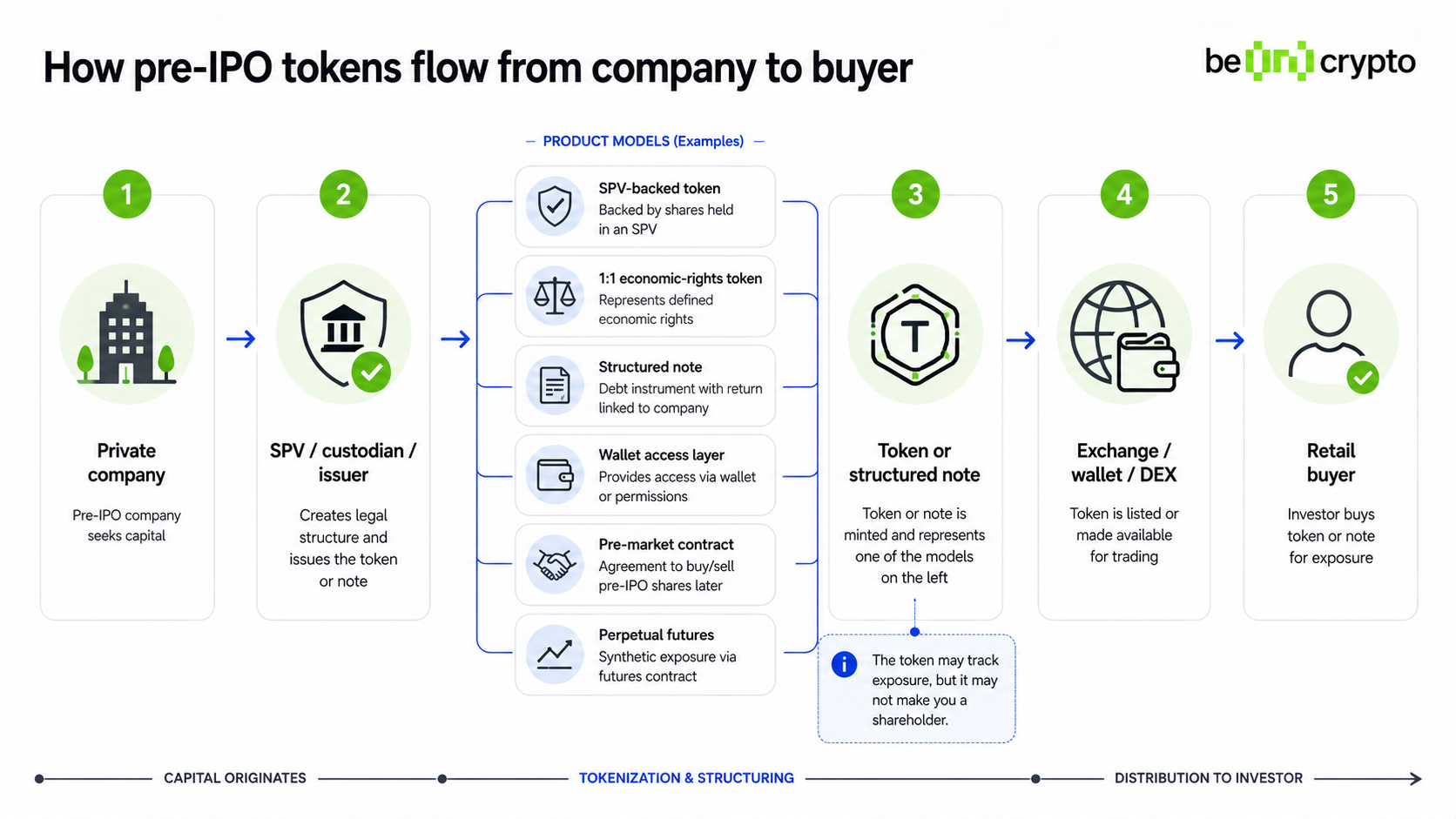
A “SpaceX token” on one platform may give you SPV-backed economic exposure. On another, it may give you a structured note. On a third, it may give you a leveraged perpetual future. These are fundamentally different products, and each one comes with its own set of rights and risks.
This distinction is not just technical. It sits right there at the center of how tokenized securities are treated legally.
The SEC’s January 2026 statement on tokenized securities establishes the legal framework for this distinction. The Commission separates third-party tokenized securities into two models:
- Custodial tokenized securities involve a third party holding the underlying security in custody, with the crypto asset evidencing the holder’s ownership interest.
- Synthetic tokenized securities involve a third party issuing its own security that provides synthetic exposure to the referenced asset, such as a linked security or a security-based swap, without conveying ownership rights in the referenced company.
Once you move beyond those two categories, things start to fragment. Different platforms use different structures, which is where most of the confusion begins. These differences are easier to understand when you separate them by structure:
| Model | What it means | Example | Main risk |
| SPV-backed token | Token gives economic exposure through a vehicle that claims to hold or reference private shares | PreStocks-style products | Off-chain manager, custody, redemption, and rights risk |
| 1:1 economic-rights token | Platform claims each token has backing through economic rights tied to shares | Jarsy-style products | Settlement may depend on liquidity and market demand |
| Structured note or mirror token | Token tracks future financial performance without direct shareholder rights | Republic/Bitget preSPAX-style products | No direct equity, issuer risk, payoff terms |
| Wallet access layer | Wallet provides access to third-party issued assets | Binance Wallet + PreStocks | User may confuse interface provider with issuer |
| Pre-market contract | Bilateral contract settling at a future event price, often peer-to-peer | Whales Market or AEVO-style products | Counterparty risk, settlement delay, illiquidity |
| Perpetual futures | Derivative-style product tied to valuation, often with leverage | Ventuals or VNTL-style products | Liquidation, leverage, funding, and price-basis risk |
Note that these differences are not theoretical. Platforms define these products in very different ways.
For instance, PreStocks states that its tokens do not confer ownership, voting, dividend, information, or other legal rights. Jarsy claims 1:1 backing through economic rights held in Delaware LLCs, but its own SpaceX page says redemption settlement is not guaranteed.
Meanwhile, Ventuals offers perpetual futures with up to 20x leverage, which means liquidation risk exists even if the referenced company performs well.
Understanding these distinctions is essential before you compare any of the names on this list. Structure is not a minor detail — it is often the deciding factor between a manageable risk and a hidden one.
For more on how tokenization works across asset classes, see BeInCrypto’s guide to real-world asset tokenization.
What are the main risks of buying any pre-IPO token?
Most pre-IPO tokens do not give you direct shares in the referenced company. Instead, they provide economic exposure through an issuer, SPV, structured product, or derivative-style market. That distinction matters, because it affects what you actually own — and what you don’t.
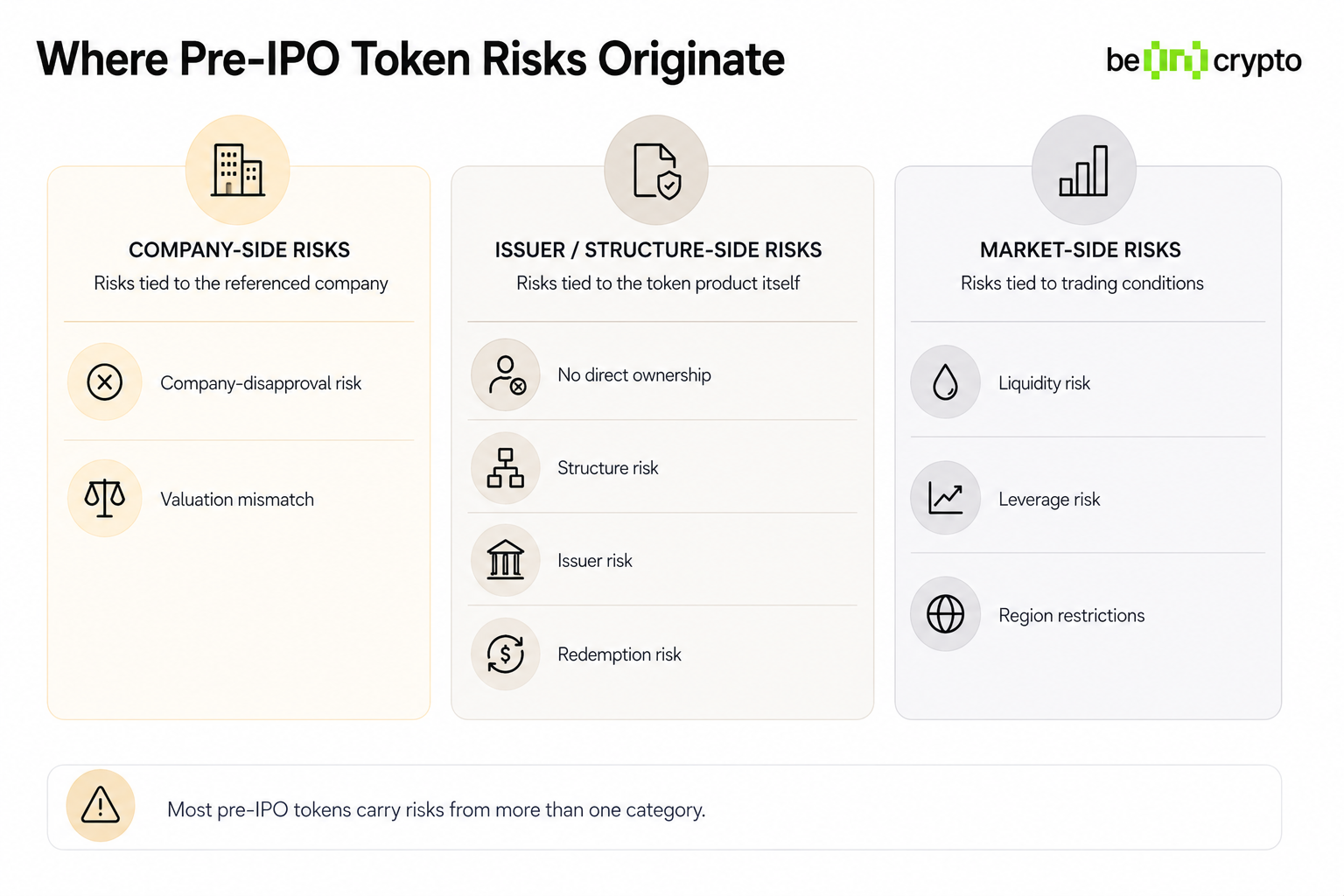
Before adding any pre-IPO token to a watchlist, check these risk areas carefully:
- No direct ownership: Most platforms state this clearly. Pre-IPO tokens do not grant legal ownership, voting rights, dividends, or shareholder status. They represent exposure, not equity.
- Company-disapproval risk: Some companies do not recognize or approve these products. OpenAI, for example, rejected third-party tokenized offerings and stated they do not represent equity or carry company endorsement. This risk applies whenever tokens operate without issuer consent.
- Liquidity risk: Thin order books can make exits difficult. A position may show gains on paper but still be hard to sell without slippage.
- Structure risk: Token structure determines your rights. The U.S. Securities and Exchange Commission distinguishes between custodial and synthetic models, and many pre-IPO tokens fall into the synthetic category with no ownership rights.
- Issuer risk: Exposure often depends on an off-chain entity such as an SPV, custodian, or platform. These entities operate independently of the referenced company.
- Valuation mismatch: Token prices can imply valuations that differ from the latest private-market data. Always compare implied valuation against known funding rounds before assuming the price is fair.
- Redemption risk: Exit terms are not always guaranteed. Some platforms note that settlement depends on liquidity and market demand at the time of redemption.
- Region restrictions: Access may be limited by jurisdiction. Some platforms restrict U.S. users or apply other regional controls.
- Leverage risk: Derivative-style products can amplify losses. Leveraged tokens or perpetual futures may lead to liquidation even if the underlying company remains attractive.
A practical due-diligence checklist before evaluating any pre-IPO token includes five steps:
- Check the issuer.
- Check whether the token has actual backing or only synthetic exposure.
- Check volume before you assume you can exit.
- Check whether redemption exists and under what rules.
- Check whether the company endorses the product.
(Note: This article is for education and market research only. Pre-IPO tokens can carry issuer, liquidity, valuation, redemption, and regulatory risks. They do not always provide direct ownership in the referenced company.)
So, which pre-IPO token is best for you?
There is no single “best” token across all categories. The stronger choice depends on what you prioritize — demand, structure, liquidity, or clarity of rights.
If you are looking for:
- Strongest company demand: SpaceX-linked products, though after the June 12 listing they now track or settle against listed SPCX rather than a pre-IPO valuation.
- Strongest AI-sector demand: Anthropic and OpenAI, backed by sustained investor attention and ongoing IPO expectations.
- Best defense-tech angle: Anduril, the only defense-focused name on this list with a distinct sector profile.
- Highest narrative risk: xAI, where demand tends to follow headlines more than consistent market data.
- Most structure-sensitive product: Bitget’s preSPAX, a structured subscription model without direct equity exposure.
- Highest liquidity concern: Anthropic-linked tokens, where trading depth has been inconsistent and exits can be difficult.
- Best prediction-market angle: Polymarket and Kalshi, depending on current availability and platform activity.
- Broadest public curiosity: Neuralink, driven more by long-term interest than verifiable market data.
Note that you should use these categories as a starting point, not as a conclusion. The information in this article, including the list above, is not a substitute for due diligence. Always review structure, liquidity, and platform terms before engaging with any pre-IPO token.