

A new OKX survey shows Americans increasingly find financial literacy and digital asset knowledge attractive in a partner, with 21% saying crypto as a Valentine’s Day gift would be a “turn-on.”
The findings suggest that in today’s dating landscape, financial know-how has become a clear advantage.
Millennials and Gen Z Redefine Attraction Around Money Management
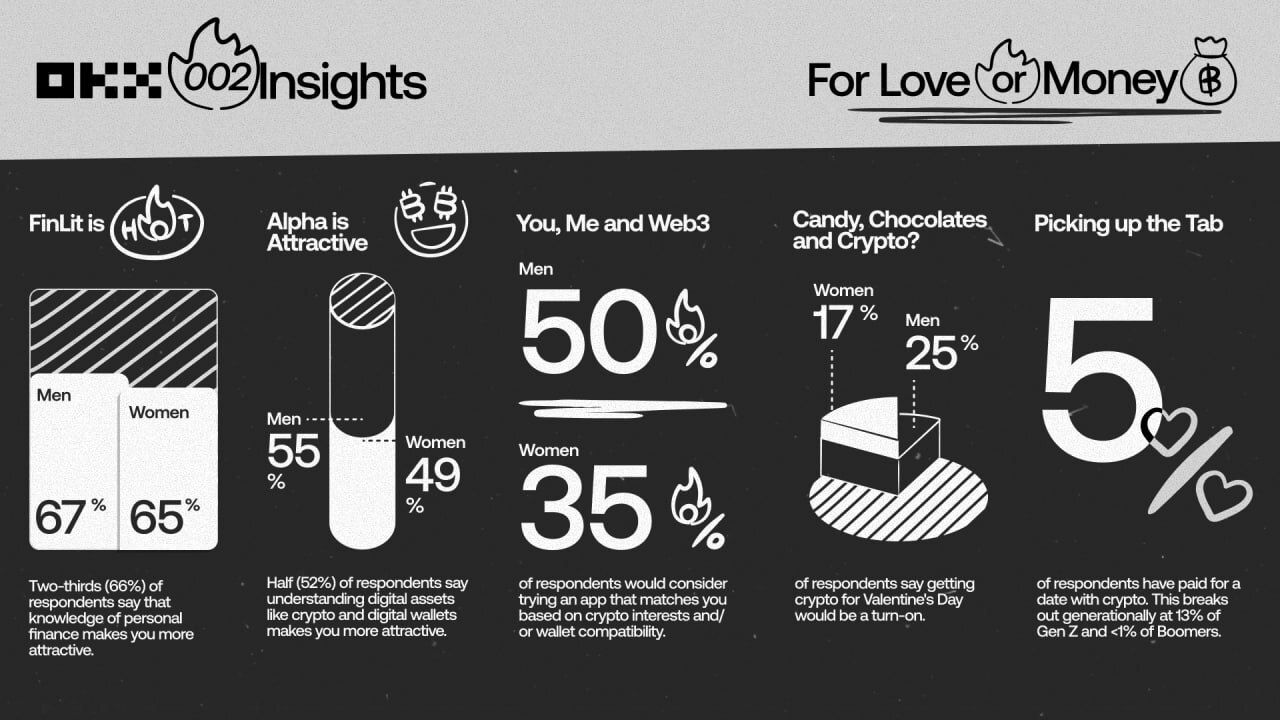
The survey of 1,000 Americans found that 66% believe knowledge of personal finance makes someone more attractive. The trend is strongest among younger generations: 76% of Gen Z and 75% of Millennials find financial literacy attractive in a partner.
Millennial women and Gen Z men were the most likely to prioritize financial knowledge, both at 77%. The findings suggest that, regardless of gender, for younger daters, understanding money is not just practical, but part of personal appeal.
“The data suggests this actually goes deeper than just recent economic shifts. For example, among Gen Z, 76% find financial literacy attractive; that cohort has been shaped by a decade-plus of economic uncertainty, including pandemic disruptions, student debt, and housing affordability. For them, financial competence is foundational,” an OKX spokesperson told BeInCrypto.
Owning Crypto Is Neutral, But Understanding It Is Attractive
Beyond traditional financial literacy, familiarity with digital assets such as crypto and digital wallets is also viewed positively. More than half of men, between 52% and 55%, and 49% of women said that understanding digital assets makes someone more attractive.
The trend raises a broader question: Is financial literacy becoming more attractive because it signals stability in uncertain times, or because Americans are genuinely more engaged with financial topics?
The spokesperson mentioned that stability matters, but what younger generations consider “stable” is shifting.
“It’s less about a single steady paycheck and more about adaptability, understanding how markets work, being comfortable with new financial tools, and making informed decisions. The fact that 52% of Americans find knowledge of digital assets attractive suggests they value someone who stays curious and engaged with how money is changing,” the spokesperson noted.
Among Millennials, 66% shared that view, followed closely by 65% of Gen Z. In contrast, only 37% of Baby Boomers said the same.
Actually holding digital assets remains a more neutral factor. Overall, 17% of Americans said owning crypto makes someone more attractive.
That figure rises to 30% among Millennials and 28% among Gen Z. However, 64% of respondents said they feel neutral.
The exchange’s spokesperson noted that people evaluate competence and ownership differently. They added:
“It’s important to highlight that there wasn’t a negative sentiment toward ownership. The majority (64%) were neutral on holding crypto. So most people aren’t penalizing ownership; they just don’t treat it as a bonus the way they treat knowledge.”
Would Crypto Make a Good Valentine’s Day Gift?
If financial knowledge boosts dating appeal, the next logical question is whether digital assets translate into romance. For most Americans, crypto may not be a guaranteed win as a Valentine’s Day gift, though younger generations appear more receptive.
Overall, 21% of Americans, including 25% of men and 17% of women, said receiving crypto for Valentine’s Day would be a “turn-on.” Meanwhile, 35% would prefer something more traditional, and 44% said they feel neutral.
Among Millennials, the figure rises to 34%. Gen Z follows closely at 31%, with Gen Z men the most enthusiastic at 39%.
“The takeaway? Crypto gifting may not be mainstream yet, but it’s gaining traction among digital-natives,” OKX wrote.
Access, Not Demand, Slows Crypto Use in Dating Transactions
Despite growing interest, actual use of crypto in dating transactions remains limited. Only 5% of Americans said they have paid for a date using crypto. Among Gen Z, the figure climbs to 13%, compared with less than 1% among Boomers.
An additional 6% of respondents said they have contributed by sending crypto after a bill was paid through traditional means, a number that rises to 14% among Gen Z.
Barriers differ by age group. Among Gen Z respondents who have not used crypto to pay for a date, 37% cited a lack of access as the reason. For Boomers, reluctance was more cultural than logistical, with 65% saying they would not feel comfortable paying that way.
“The data tells us this is an access problem rather than a demand problem,” the spokesperson remarked. “What’s still being built is payment infrastructure at the point of sale, like the ability to tap and pay the same way you would with a card or mobile.”
OKX concluded that while crypto may not yet be a universal dating advantage, financial literacy clearly is. As younger generations embrace both traditional money management skills and emerging digital assets, the message for modern daters is clear: a grasp of money management, whether traditional or digital, appears to resonate more than “showing off what you have.”
