

One of the five largest Ethereum treasury firms has sold a large portion of its ETH holdings. This has triggered fresh debate over whether institutional players are turning bearish on Ethereum — or simply managing balance-sheet risk.
ETHZilla disclosed that it sold 24,291 ETH for approximately $74.5 million as part of the early redemption of its senior secured convertible notes.
ETHZilla Sells Ethereum to Repay Debt
The company said it will use all, or a significant portion, of the proceeds to repay the outstanding debt, with redemptions scheduled before New Year’s Eve.
In simple terms, ETHZilla sold Ether to pay back loans, not because it expects Ethereum’s price to fall. Senior secured convertible notes rank high in repayment priority and often require cash settlement.
Selling liquid assets like ETH is a common way to close such obligations.
The company also announced it will discontinue its mNAV dashboard, which previously tracked its Ethereum holdings and net asset value.
ETHZilla said future valuation should focus on revenue and cash flow from its real-world asset (RWA) tokenization business, rather than its crypto treasury alone.
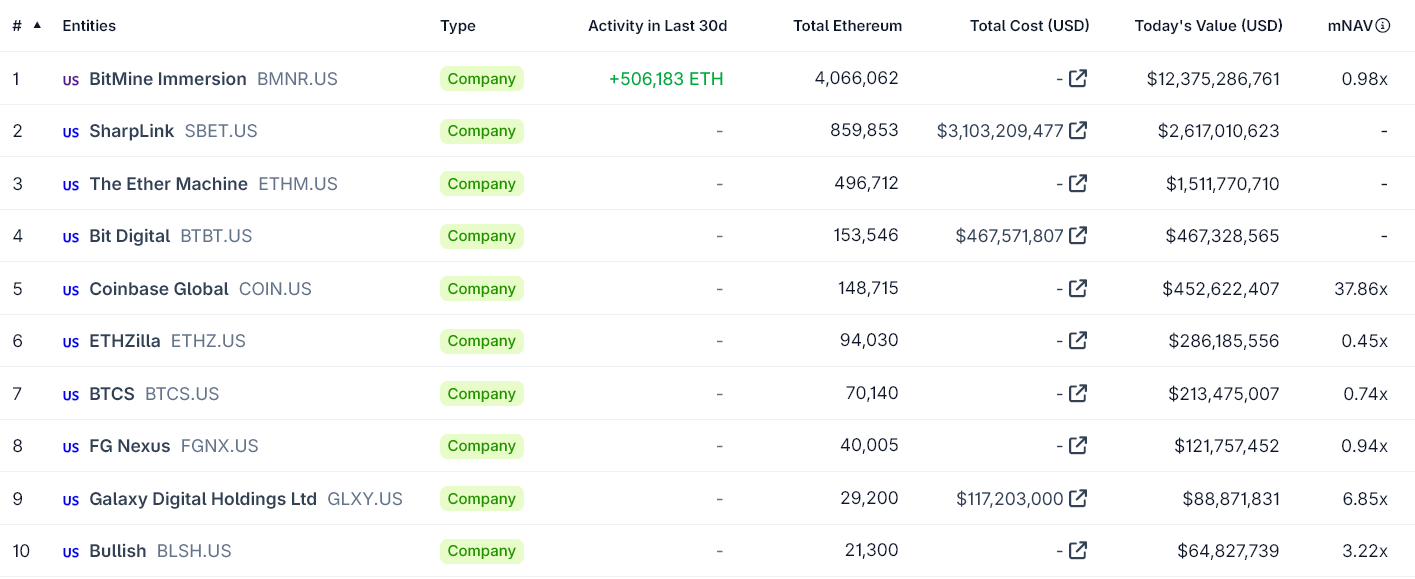
ETHZilla No Longer Just an Ethereum Treasury Business
The move signals a strategic shift, not capitulation. ETHZilla is repositioning itself from a crypto-treasury-driven narrative toward an operating business model centered on RWA tokenization.
Ethereum remains part of its balance sheet, but no longer the core investment thesis.
From a market perspective, the sale represents mechanical, one-off sell pressure, tied to debt repayment. It does not reflect a broader institutional exit from Ethereum.
Regardless, the company’s stock price has suffered significantly after today’s announcement.
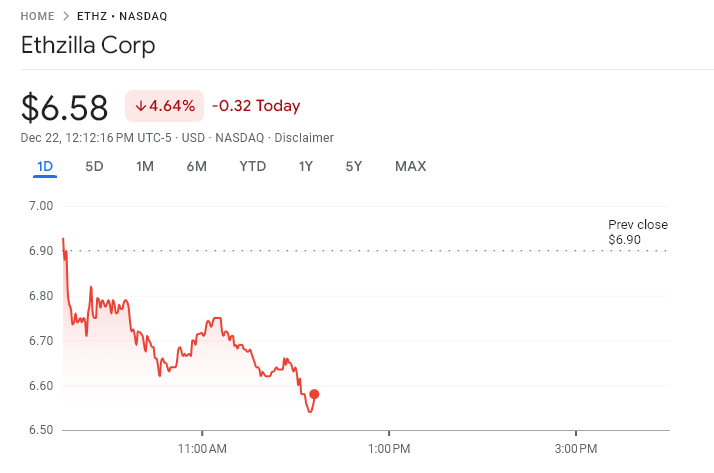
ETHZilla Stock Nosedives Nearly 5% After Selling Announcement. Source: Google Finance
Ethereum has traded near the $3,000 level in recent sessions, rebounding from mid-December lows around $2,900 after weeks of sideways and choppy action.
Broader risk-asset uncertainty, thin year-end liquidity, and mixed institutional flows have kept ETH range-bound.
Against that backdrop, isolated treasury sales tend to have limited lasting impact, unless they reflect a wider trend — which, so far, they do not.
Recent Buying and Selling Elsewhere
Other high-profile moves reinforce that institutional behavior around Ethereum remains mixed rather than one-sided.
Earlier this month, on-chain data showed Arthur Hayes moving several million dollars’ worth of ETH to institutional and centralized venues.
While widely interpreted as selling, Hayes has publicly framed the activity as portfolio rotation into selective DeFi positions, not an exit from Ethereum.
By contrast, BitMine Immersion Technologies, associated with Tom Lee, has continued to accumulate ETH aggressively throughout December.
BitMine’s latest reported purchase occurred on December 22, adding to a growing treasury built during market pullbacks.
Overall, ETHZilla’s sale was driven by debt obligations and corporate restructuring, not a bearish Ethereum outlook.
Recent activity across treasury firms shows a market defined by rebalancing, selective accumulation, and balance-sheet discipline, rather than wholesale institutional selling.
