


Tokenized real-world assets (RWA) have bucked the broader market downturn. The total on-chain distributed RWA value has nearly quadrupled over the past year.
Despite growing competition from Solana (SOL), Ethereum (ETH) continues to dominate the sector, accounting for more than half the market share.
RWA Growth Accelerates Despite Market Downturn
According to data from RWA.xyz, the value of distributed RWAs reached an all-time high of $26.7 billion in March. At the time of writing, the figure stood slightly lower at $26.6 billion, up 309% from $6.5 billion a year ago.
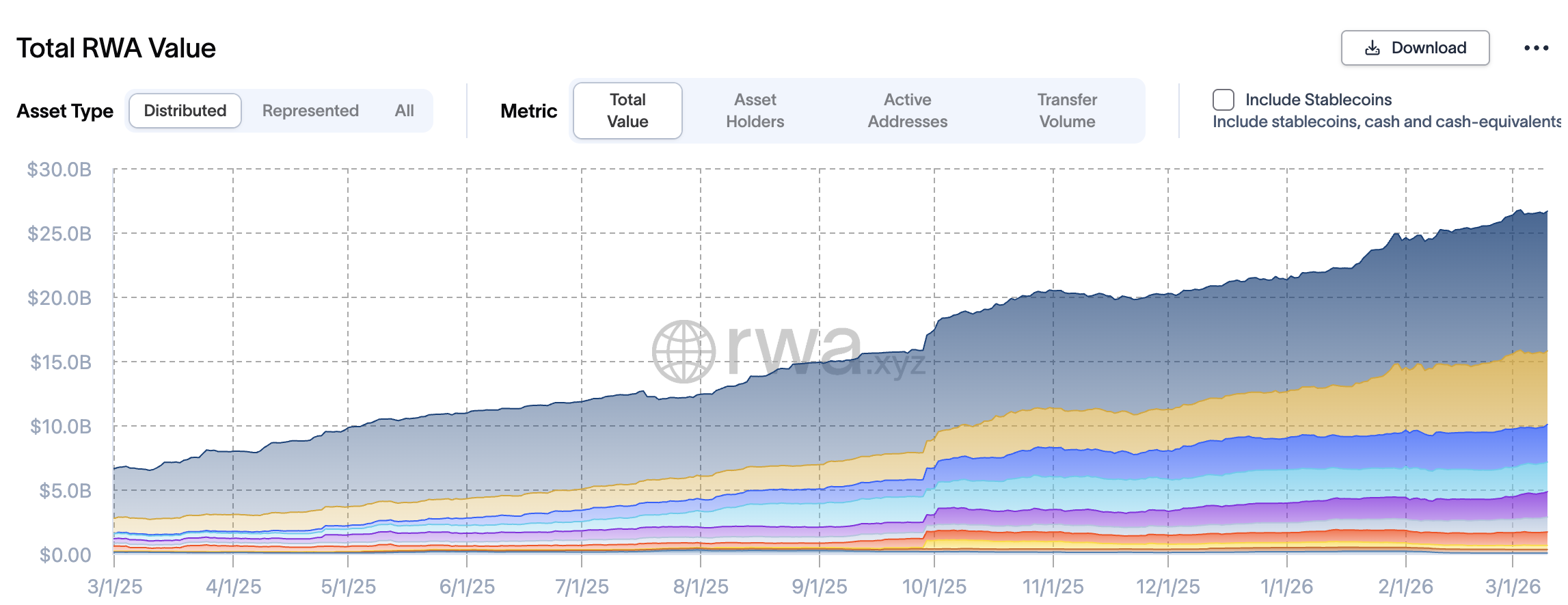
This sharp expansion is particularly notable given the broader market environment. The cryptocurrency market has recently been characterized by extreme fear.
Yet, the continued rise in tokenized RWAs suggests that investors are increasingly turning to these assets.
Holder counts have also climbed sharply in early 2026 across Ethereum, Solana, Arbitrum, BNB Chain, and more. In fact, a previous report by BeInCrypto highlighted that Solana surpassed Ethereum for the first time in terms of RWA holders.
According to the latest data, Solana hosts around 157,682 RWA holders, slightly ahead of Ethereum. Despite this shift in user activity, Ethereum continues to dominate the broader RWA ecosystem.
The network currently accounts for more than 57% of the distributed RWA market share and supports around 675 tokenization projects, reinforcing its position as the leading infrastructure for institutional-grade tokenization.
Institutional interest in Ethereum has been reinforced by high-profile initiatives. For instance, in December, JPMorgan launched its first tokenized money-market fund on Ethereum.
Why Wall Street Still Picks Ethereum for Tokenization
But why do institutions prefer Ethereum? Insights from BeInCrypto’s Expert Council, which included representatives from Standard Chartered and Bitwise, suggest that this is less about ideology and more about institutional risk management, comfort, and defensibility.
Geoff Kendrick, Global Head of Digital Asset Research at Standard Chartered, argued that over the next couple of years, much of the TradFi blockchain activity is likely to occur on Ethereum.
“I think Ethereum probably wins for the next little while on the back of TradFi getting involved. As banks and other build stuff on blockchain space, it’s almost all going to happen on Ethereum for the next couple of years, I think,” said Geoff Kendrick from Standard Chartered.
Subscribe to our YouTube channel to watch leaders and journalists provide expert insights
According to him, adoption of alternative networks may only occur later, particularly chains that offer lower costs and faster transactions, such as Solana.
“I mean, there’s a fairly easy saying in TradFi, which is if you do something which is sensible, it goes wrong, you can keep your job if you do something less sensible, you probably lose your job,” said Geoff Kendrick told BeInCrypto. “But I think ultimately the next couple of years, Ethereum will win that flow from Tradfi and should outperform in token price as well.”
While Etherem’s dominance among public chains is established, this raises a broader question of whether private and permissioned blockchains could eventually challenge Ethereum’s early dominance.
Private or permissioned blockchains offer greater control, privacy, regulatory compliance, faster transactions, and more predictable costs, making them attractive for institutions.
However, they trade off the decentralization and openness that define permissionless public blockchains. According to Bitwise CIO Matt Hougan, institutions are likely to explore these more controlled blockchain environments.

He noted that many firms are “putting their toes in the water.” Hougan suggested that there remains a possibility that some of these permissioned networks could eventually gain significant traction as institutional adoption evolves.
The coming time will test whether Ethereum can maintain its 57% share as competition intensifies. For now, Wall Street’s preference remains clear.
