


Bitcoin (BTC) is showing signs of tightening supply, with the Scarcity Index on Binance reaching levels not seen since October 2025.
The shift comes as whale wallets holding at least 100 BTC hit a record, while long-term holder selling remains below the 2021 peak.
Scarcity Index Surge Reflects Tight Bitcoin Supply Conditions
Analyst Arab Chain reported that the Bitcoin Scarcity Index on Binance has climbed to approximately 5.10. This marked its highest level since October.
The metric measures the balance between available supply and demand pressure on the exchange. A high reading signals that Bitcoin available for trading has fallen below its historical average.
Arab Chain noted that this shift may reflect a change in investor behavior. Rather than keeping BTC on exchanges, holders appear to be moving it into cold storage or holding it for the long term.
“Structurally, high positive values of the index mean that the amount of Bitcoin available for immediate sale on the platform has become relatively limited, which can increase price sensitivity to any surge in demand. In such cases, prices may move more rapidly because the available liquidity is not sufficient to easily absorb large purchases,” the analysis read.
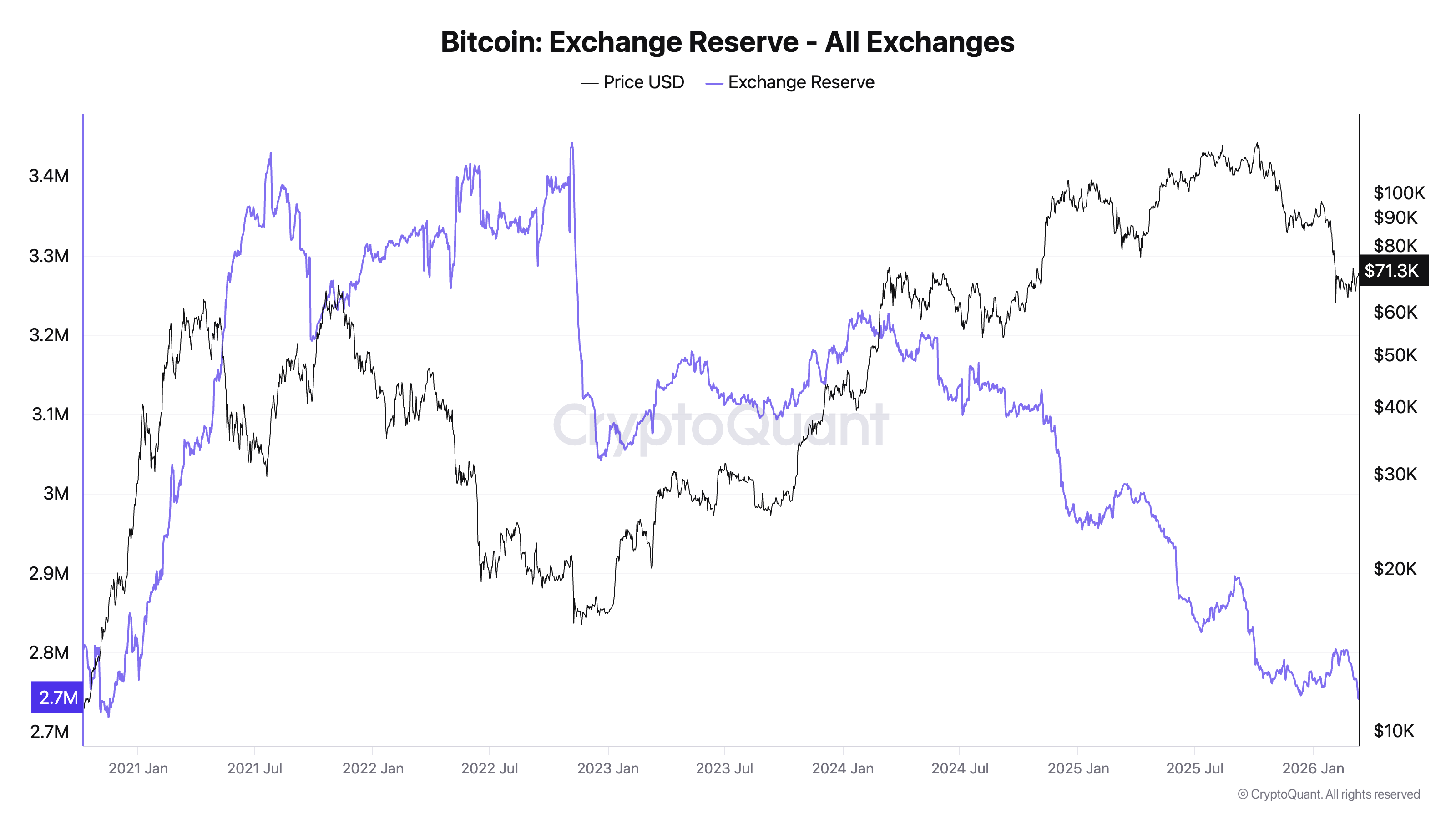
The broader exchange picture supports this trend. CryptoQuant data shows centralized exchanges now hold roughly 2.7 million BTC, the lowest level since late 2020.
Bitcoin Whale Activity Signals Confidence
At the same time, on-chain data points to rising accumulation among large holders. 20,031 wallets now hold at least 100 BTC, a new record high. At today’s prices, a wallet holding 100 BTC is worth at least $7.15 million.
Santiment also reported that alongside the record number of whale wallets, about 954,000 wallets hold between 1 and 100 BTC, and about 57.6 million wallets contain 1 BTC or less. This distribution highlights both a concentrated group of large holders and broad participation by smaller accounts.
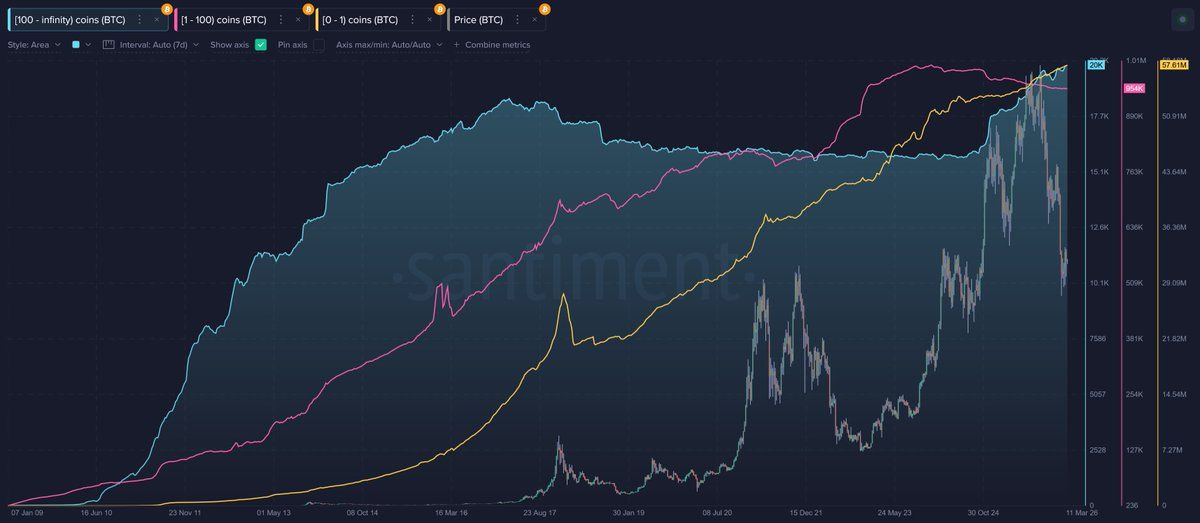
The growth of whale wallets has accelerated amid price weakness. BTC is down roughly 43% from its October peak, yet large holders have continued accumulating.
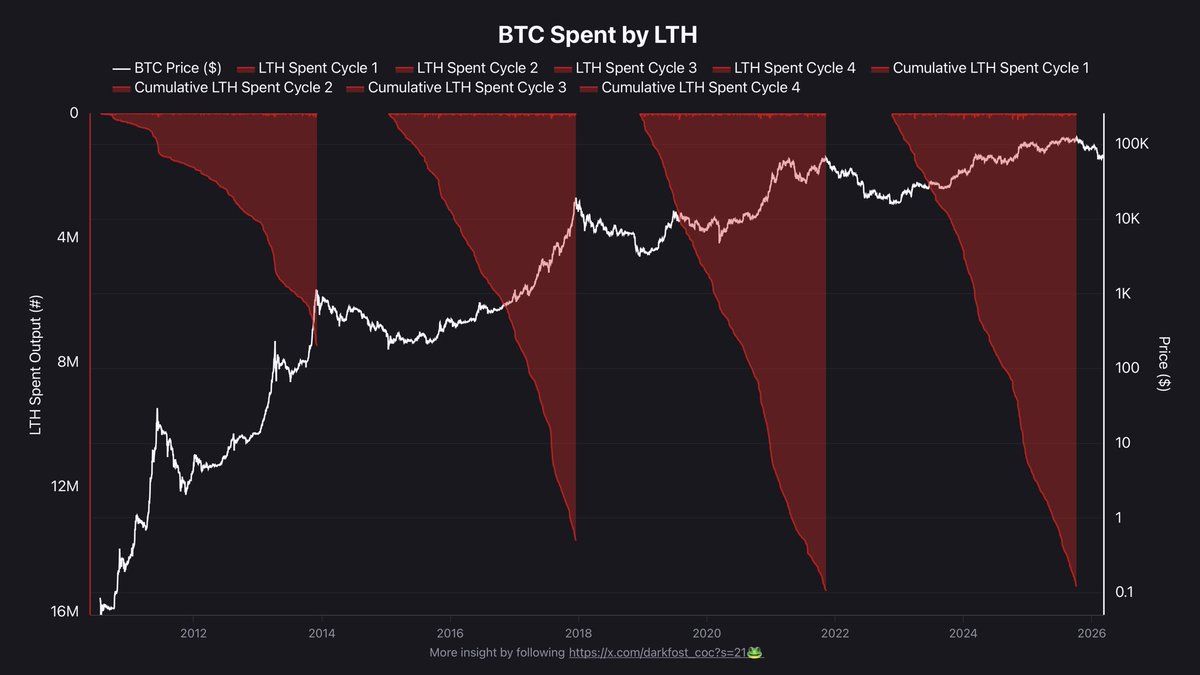
Meanwhile, on the selling side, analyst Darkfost noted that contrary to expectations, long-term holders (LTHs) did not sell as much during the 2025 cycle. Data indicates that LTHs spent about 15.1 million BTC during the 2025 cycle.
This is below the 15.3 million BTC spent in the 2021 cycle, the highest selling volume so far. Previous cycles saw LTH spend at 7.3 million and 13.6 million BTC. Thus, 2025 levels are high but not record-breaking.
“This data contradicts some charts that were distorted by internal movements from certain entities. For example, Coinbase moved around 800,000 BTC, most of which was categorized as LTH supply (removed here),” Darkfost said. “As more entities operate in the market, these kinds of internal transfers have also increased, which appears to be a structural feature of this cycle. In reality, LTHs likely spent even less BTC than what is shown here, because the very structure of what constitutes an LTH has started to change.”
The rise of institutional Bitcoin ownership is changing what qualifies as a long-term holder. While early holders and miners remain active, ETFs and treasuries show new holding patterns.
Darkfost said ETFs need to maintain “a certain level of reserves” to meet investor demand, while DAT firms like Strategy Inc. take a long-term view without legal requirements to do so.
“Over time, their growing presence could stabilize LTH selling pressure as more of these entities enter the market. It is therefore possible that the current definition of LTH may eventually become inadequate as Bitcoin’s ownership structure continues to evolve,” the analyst added.
With rising scarcity, record whale accumulation, and slower long-term holder selling, Bitcoin’s supply is tightening. Whether this trend supports a price rally will depend on how demand and the market conditions evolve in the months ahead.
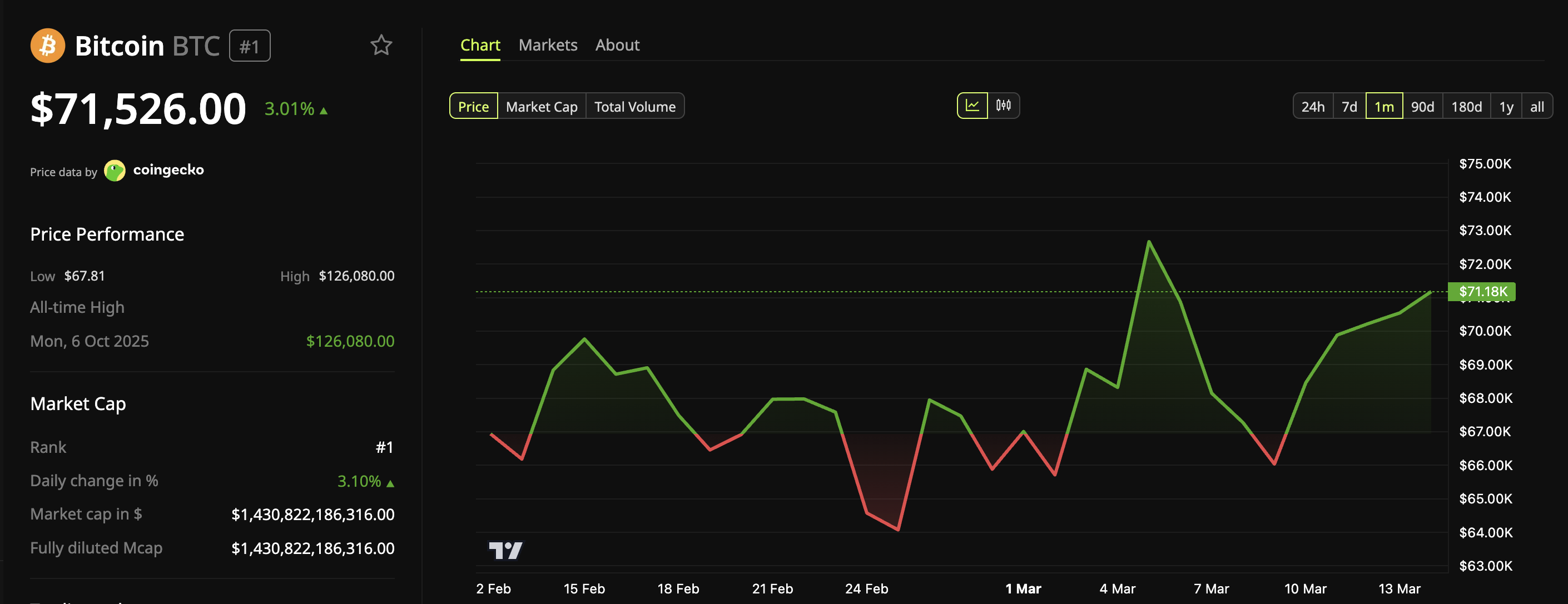
For now, Bitcoin has risen amid a broader market rally. BeInCrypto Markets data showed that the cryptocurrency traded at $71,526, up 3% over the past day.
Subscribe to our YouTube channel to watch leaders and journalists provide expert insights
