

The World Gold Council (WGC), the organization that helped launch the first US gold-backed exchange-traded fund (ETF) in 2004, proposed a shared infrastructure framework on March 19 designed to standardize the tokenized gold market currently dominated by Tether and Paxos.
The initiative, detailed in a white paper co-authored with Boston Consulting Group (BCG), introduces “Gold as a Service,” an open platform connecting physical gold custody with digital issuance systems. If adopted, it could reshape a $4.9 billion market that crypto-native firms built from scratch.
Tether Gold’s Head Start May Not Be Enough Anymore
Tokenized gold has grown entirely through individual issuers solving their own custody issues.
- Tether houses reserves for Tether Gold (XAUT) in a Swiss vault that once operated as a Cold War-era nuclear bunker.
- Paxos parks reserves PAX Gold (PAXG) in London through vaults managed by the security firm Brink’s.
These arrangements work, but they create fragmentation. Each product has its own custody pipeline, audit process, and redemption framework. That limits fungibility across products and raises the barrier to entry for new issuers.
The WGC’s platform would standardize those processes, including custody coordination, reconciliation, compliance, and redemption, into a shared backend that any issuer can plug into.
Seeing the WGC’s standard on a gold token would signal to investors that it has verified physical backing.
A $163 Billion Track Record
The WGC is not a newcomer to making gold accessible. It helped establish SPDR Gold Shares (GLD) in 2004, the first US-listed ETF backed by physical gold. GLD now carries a market cap of $163 billion.
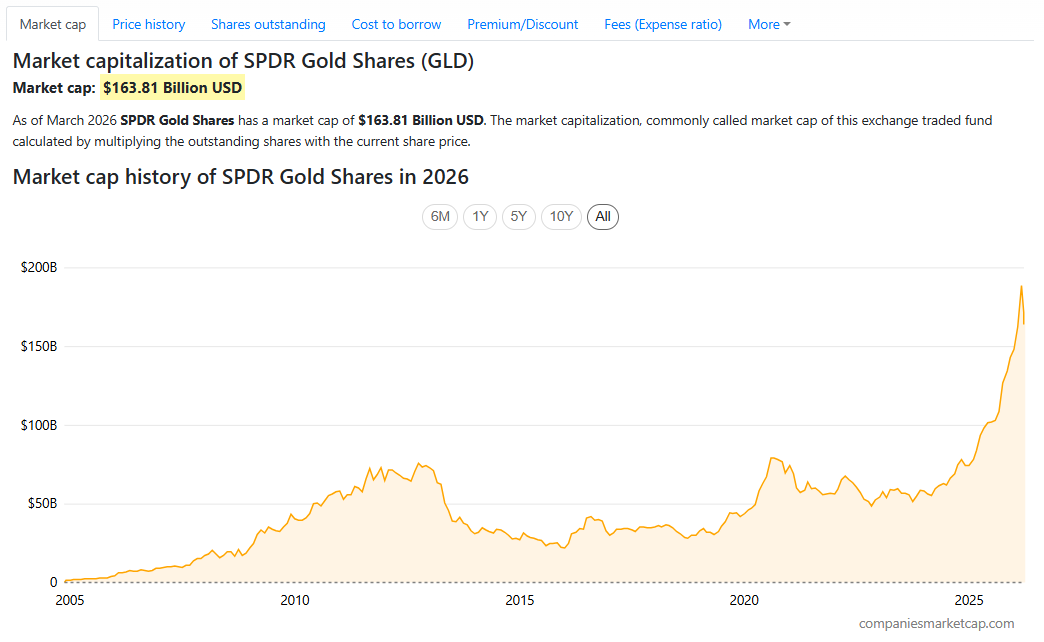
Tokenized gold, by contrast, remains small. XAUT ($2.6B) and PAXG (2.2B) have a combined market cap of $4.9 billion after five years on the market, according to CoinGecko.
The gap between the two formats reflects structural barriers that the WGC believes its platform can remove.
Gold does not generate income while in storage, unlike cash and US Treasuries that back stablecoins. Vault costs, insurance, and logistics make it expensive to launch each new tokenized product independently.
The WGC argues that shared infrastructure changes the math.
What It Means for Tether and Paxos
The WGC’s framework does not target XAUT or PAXG directly. It positions itself as a complementary infrastructure for new entrants.
However, standardization inherently challenges first movers who built competitive advantages through proprietary systems.
If hundreds of issuers can launch gold tokens using the WGC’s backend, the custody moats that Tether and Paxos built become less defensible.
Continuous audits, interoperability across platforms, and consistent redemption rights built into shared infrastructure would raise the floor for the entire market.
The WGC has 29 member companies across the gold mining industry and describes itself as a neutral convener.
It called on “innovators and market participants from inside and outside the gold industry” to help build the platform.
No timeline or implementation roadmap was disclosed. The proposal remains conceptual, and its success depends on industry-wide adoption and alignment across jurisdictions.
BCG Managing Director Matthias Tauber framed the challenge directly. The question, he said, is no longer whether gold will go digital.
“The question is no longer whether gold will be digital; it’s how it can participate in modern financial systems without compromising physical integrity. Together with the World Gold Council, we explored what it takes to build trusted rails for digital gold, at market scale,” read an excerpt in the press release, citing Tauber.
For Tether and Paxos, the answer to that question will determine whether their five-year head start becomes a lasting advantage or a legacy system.
