

Bitcoin is approaching a key macro event as US lawmakers race to avert another federal government shutdown before the January 30 funding deadline. The market enters this period under pressure, following a failed January rally and a sharp shift in sentiment.
Historically, Bitcoin has not behaved as a reliable hedge during US government shutdowns. Instead, price action has tended to follow existing market momentum.
Why a US Shutdown Is Back on the Table
The renewed shutdown risk stems from Congress failing to finalize several FY2026 appropriations bills. Temporary funding is set to expire on January 30, and negotiations remain stalled, particularly around Department of Homeland Security funding.
Unless lawmakers pass either a new continuing resolution or full-year funding before the deadline, parts of the federal government would begin shutting down immediately. Markets are now treating January 30 as a binary macro event.
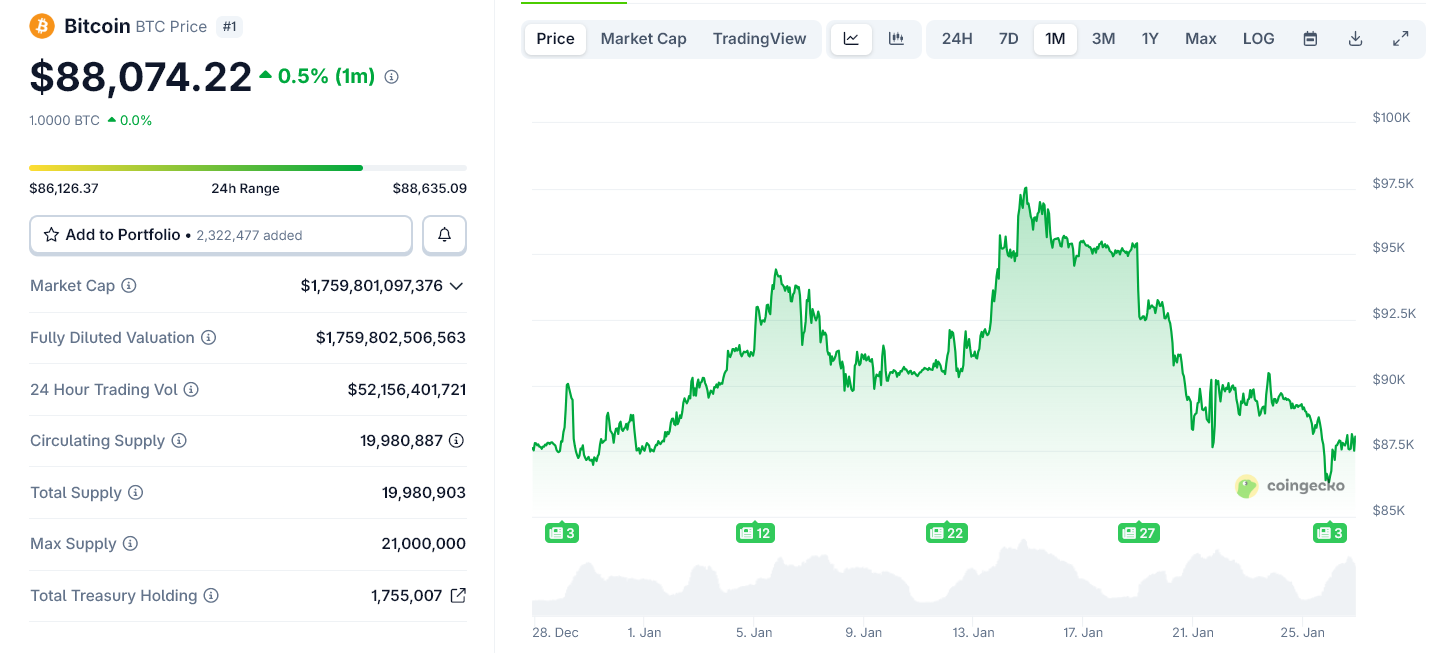
Bitcoin’s price action throughout January 2026 has already reflected growing fragility. After briefly pushing toward the $95,000–$98,000 range mid-month, BTC failed to hold those levels and reversed sharply.
Shutdown History Shows a Clear Bitcoin Pattern
Bitcoin’s historical performance during US government shutdowns provides little support for a bullish narrative.
During the past four shutdown events over the last decade, Bitcoin declined or extended existing downtrends in three cases.
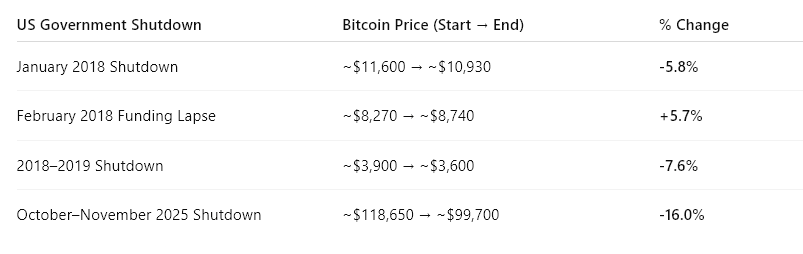
Only one shutdown, a brief funding lapse in February 2018, coincided with a rally. That move occurred during a technical oversold bounce rather than as a response to the shutdown itself.
The broader pattern is consistent. Shutdowns tend to act as volatility catalysts, not directional drivers. Bitcoin typically amplifies its existing trend rather than reversing it.
Miner Data Shows Stress, Not Strength
Recent on-chain data adds another layer of caution. According to CryptoQuant, several major US-based mining firms sharply dropped production in recent days as winter storms forced power grid curtailments.
Daily Bitcoin output fell materially across firms such as CleanSpark, Riot Platforms, Marathon Digital, and IREN. While reduced production can temporarily limit sell-side supply, it also signals operational stress within the mining sector.
Historically, miner supply constraints have not been enough to offset broader macro-driven selling unless demand conditions are strong. Current demand signals remain weak.
Realized Losses Are Rising
Net Realized Profit and Loss (NRPL) data further supports a defensive outlook. Recent weeks have seen a rise in realized losses, with fewer large profit-taking spikes than earlier in 2025.
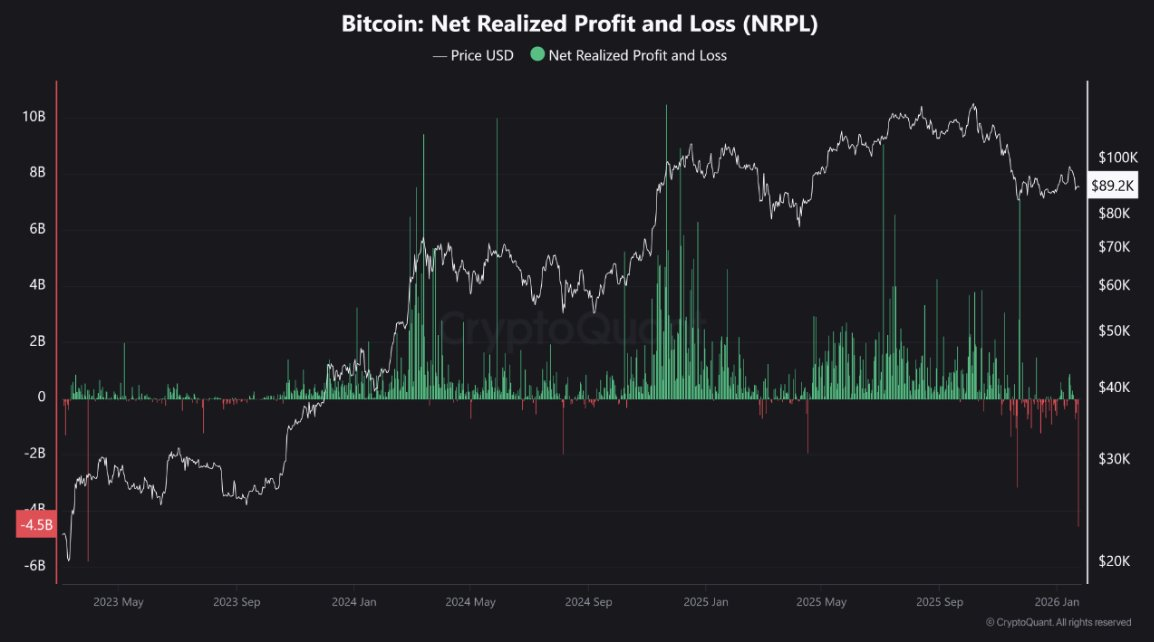
This suggests investors are exiting positions at unfavorable prices rather than rotating capital confidently. Such behavior typically aligns with late-cycle distribution and de-risking phases, not accumulation.
In this context, negative macro headlines tend to accelerate downside volatility rather than spark sustained rallies.
How Bitcoin May React on January 30
If the US government enters a shutdown on January 30, Bitcoin is more likely to react as a risk asset than a hedge.
The most probable outcome is a short-term volatility spike with downside bias. A sweep of January lows would align with historical shutdown behavior and current market structure. Any rebound would likely be technical and short-lived unless broader liquidity conditions improve.
A sharp upside move driven solely by shutdown headlines appears unlikely. Bitcoin has rarely rallied on shutdowns without simultaneous positive flow and sentiment shifts, which are absent today.
Bitcoin does not face the shutdown risk from a position of strength. ETF outflows, rising realized losses, miner stress, and rejected resistance levels all point to a cautious setup.
As January 30 approaches, the shutdown risk may act as a stress test of already fragile market confidence.
For now, history and data suggest Bitcoin’s response will reflect existing momentum rather than defy it.
