

Tron Inc. (TRON) has crossed 686 million TRX tokens in its corporate treasury after months of daily purchases, fueling comparisons to MicroStrategy’s Bitcoin accumulation model.
The Nasdaq-listed company, which transformed from toy manufacturer SRM Entertainment through a mid-2025 reverse merger, now sits at the center of a coordinated narrative campaign led by Justin Sun and crypto influencers.
Tron Moves From Toy Maker to Token Treasury
SRM Entertainment, a Florida-based supplier of theme park merchandise, rebranded as Tron Inc. in July 2025 after receiving a $100 million equity injection paid in TRX tokens.
Sun joined as a strategic advisor, with the deal, facilitated by Dominari Securities, valuing the full package at up to $210 million including warrants.
Since the rebrand, Tron Inc. has followed a rigid accumulation plan. The company purchases roughly $50,000 in TRX daily, targeting 360 consecutive days.
As of March 16, 2026, total holdings stood at approximately 686.8 million TRX, worth roughly $206 million at current prices near $0.30.
In December 2025, Sun injected an additional $18 million through an equity investment via Black Anthem Limited, acquiring restricted common stock at $1.3775 per share.
The company has described these moves as efforts to become the largest publicly traded holder of TRX.
“Building the largest TRX treasury in the public markets is not symbolic; it is strategic. We are executing a deliberate accumulation strategy that reflects our confidence in TRON’s scalability, real-world utility, and long-term value creation,” said CEO Rich Miller in a February 2026 press release.
Sun’s Circle Comparison and the $3.3 Billion Claim
In a recent post, Tron founder Justin Sun said that Wall Street had been asking about a cheaper, more profitable alternative to Circle Internet Group (CRCL), the issuer of USDC. He pointed to Tron Inc. as the answer.
“Wall Street has been asking lately: What is the Chinese version of CRCL? Because they want to invest in a “CRCL” that is more efficient, lower-valued, and more profitable. The answer is here now: TRON,” wrote Sun.
His argument rested on three points:
- The TRON blockchain processes stablecoin issuance at a scale comparable to Circle.
- The network generated $3.3 billion in protocol-level profit over the past year.
- Tron Inc. trades at roughly one-seventieth of Circle’s market capitalization, which currently stands at roughly $35.12 billion.
The profitability claim requires careful context.
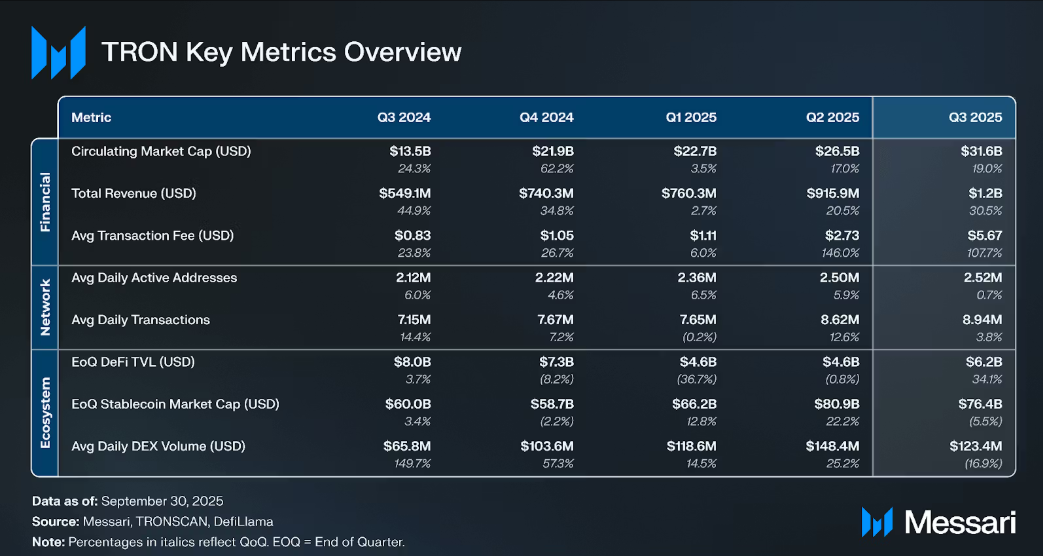
TRON protocol revenue, driven primarily by USDT transfer fees, reached $1.2 billion in Q3 2025 alone, according to a Messari research report.
Meanwhile, a Kaiko analysis from March 2026 found that TRON was the only major Layer-1 blockchain turning a net profit after accounting for token inflation costs.
These are network-level metrics, however, not earnings of Tron Inc. the publicly traded entity.
Circle, for its part, posted a full-year 2025 net loss of $70 million. That figure was heavily impacted by $424 million in non-cash stock-based compensation tied to its June 2025 IPO.
The company earned $133 million in Q4 2025 net income on $770 million in revenue. Adjusted EBITDA for the quarter grew 412% year over year.
Comparing TRON network fee revenue to Circle’s corporate earnings conflates two fundamentally different measurements. Tron Inc. holds TRX tokens on its balance sheet but does not directly capture the protocol’s transaction fee stream.
The MicroStrategy Parallel and Its Limits
May, a crypto KOL, amplified the narrative by drawing a direct line between Tron Inc. and Strategy, formerly MicroStrategy. The KOL noted that Strategy’s market cap was approximately $1.2 billion when it first purchased Bitcoin in August 2020, and that it grew roughly 100-fold over five years.
Tron Inc., at around $400 to $500 million, starts from an even smaller base.
“History is always repeating itself! TRON Inc. is recreating MSTR’s growth legend,” wrote May.
The analogy has structural appeal.
- Both companies use public equity markets to accumulate a native digital asset.
- Both rely on treasury value as their primary investment thesis.
- Both founders maintain outsized public influence over both the asset and the company.
However, key differences complicate the comparison.
- Strategy accumulated Bitcoin, an asset with broad institutional demand, deep liquidity, and no single controlling entity.
- Tron Inc. accumulates TRX, a token created by the same individual who advises the company.
- Justin Sun founded the TRON blockchain, chairs its foundation, and maintains influence over Tron Inc. through a layered network of affiliated entities.
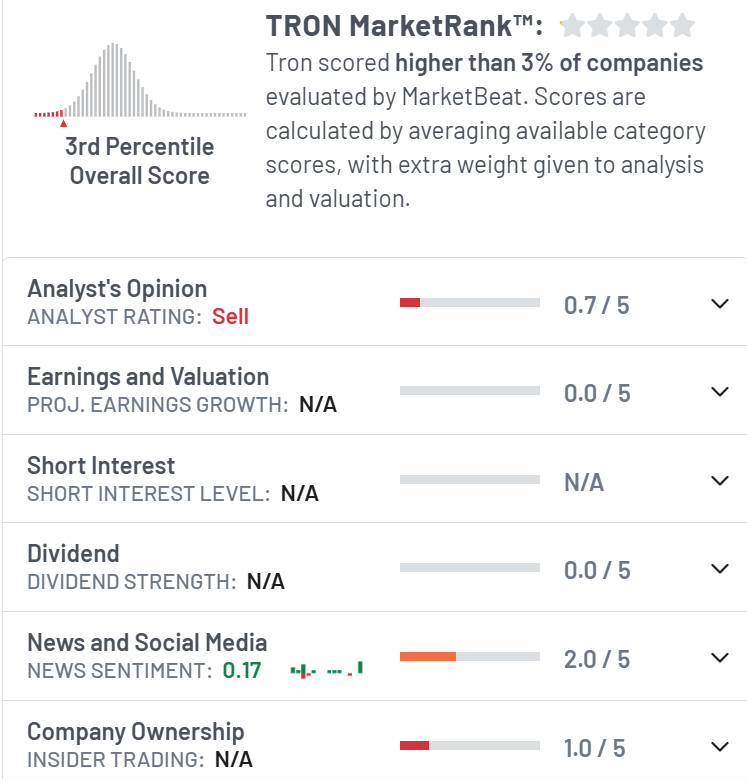
That overlap has drawn scrutiny. Weiss Ratings issued a “sell” rating on Tron Inc. stock in December 2025. The stock carries a beta of 13.83 and a negative price-to-earnings ratio.
Only one analyst covers the name, with a consensus sell recommendation, meaning the “consensus” is just one firm’s opinion presented in MarketBeat’s standard consensus format.
Additionally, the SEC reached a settlement with Rainberry Inc., a TRON-affiliated entity, in March 2026.
Rainberry agreed to pay $10 million and accepted a bar on future securities violations, resolving allegations of unregistered token sales and wash trading stemming from a 2023 lawsuit.
What the Market Is Pricing
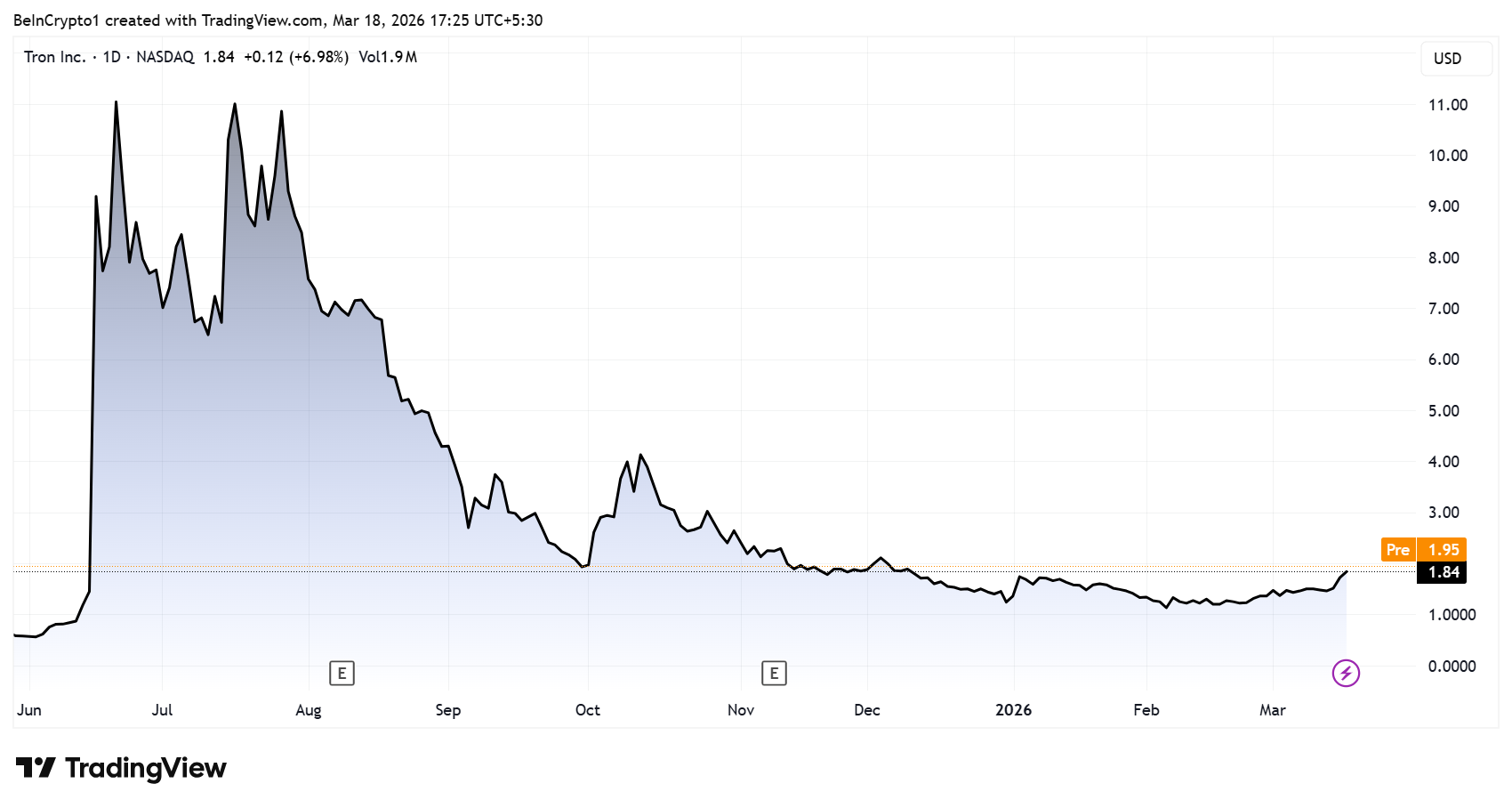
Tron Inc. stock traded near $1.84 as of this writing, giving it a market capitalization of roughly $517 million. That represents a steep decline from its all-time high of $12.80 in July 2025, shortly after the reverse merger.
The company’s TRX holdings are worth approximately $206 million, meaning the stock trades at a premium to its net asset value.
Whether that premium reflects confidence in the accumulation strategy or speculative momentum remains an open question.
If the playbook succeeds, it could establish a new template for Layer-1 ecosystems seeking public market exposure.
If it falters, it will serve as an example of the risks of concentrated token treasury strategies built around a single founder’s influence.
