

Tether emerges as one of the world’s most aggressive gold buyers, rivaling and in some quarters surpassing central banks.
It comes as the crypto firm progressively converts stablecoin profits into physical gold at a sovereign scale.
Central Banks Are No Longer the Biggest Buyers as Tether Turns Stablecoin Yield into Sovereign-Scale Gold
In the fourth quarter (Q4) of 2025 alone, the stablecoin issuer said it added roughly 27 metric tons of gold to its reserves. This pace of accumulation places Tether among the top global buyers during the period.
Tether’s Q4 purchases were broadly in line with its Q3 buying, estimated by analysts at around 26 tons. In a late November report, BeInCrypto indicated that Tether outbought all central banks, amassing 116 tons of gold in 2025.
With final central bank data still pending, Bitwise CIO Matt Hougan said the company is likely to rank among the top three buyers globally for the quarter.
“Who’s the central bank now? Tether bought more gold than any central bank in Q3 2025, according to official data. It’s going to be close in Q4 — we’re still waiting on final data — but the company will be top 3,” Hougan wrote on X.
The scale of buying is striking against a backdrop of surging gold prices. Spot gold rose 18% year-to-date on top of a 64% gain in 2025. With this, it broke successive psychological thresholds at $3,000, $4,000, and $5,000 per ounce.
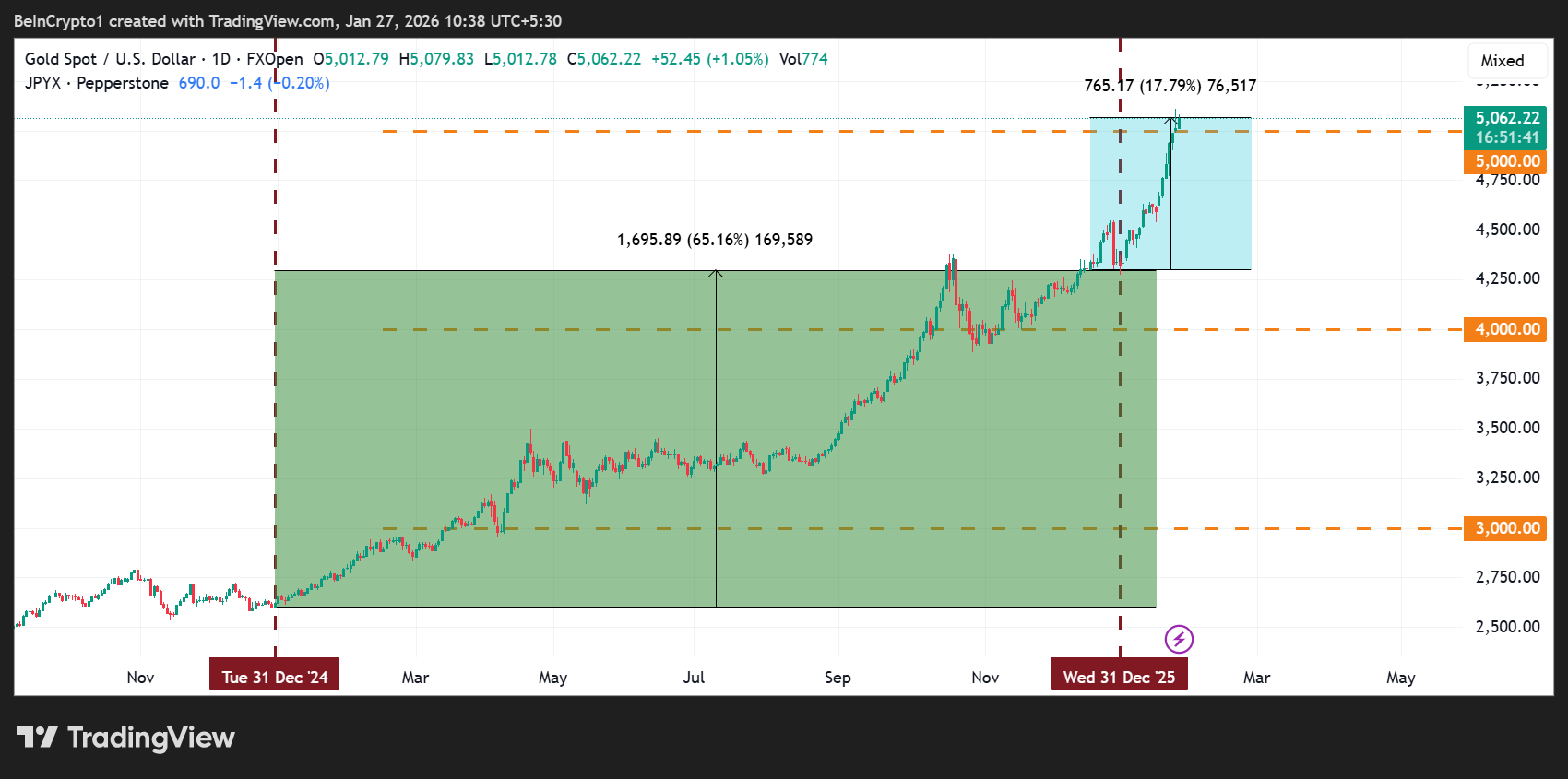
Tether’s purchases, currently valued at about $4.4 billion, have made it a significant marginal source of demand in an already tight market.
Unlike sovereign buyers, however, Tether’s gold accumulation is not driven by monetary policy or balance-of-payments considerations.
The company funds its purchases primarily by using profits from backing USDT, its dollar-pegged stablecoin, with interest-bearing assets such as US Treasury bills.
With roughly $187 billion in USDT in circulation, that yield has become a powerful engine of asset accumulation.
From Stablecoin Issuer to Sovereign-Scale Gold Holder
This has effectively turned Tether into a hybrid entity:
- Part stablecoin issuer
- Part asset manager, and
- Increasingly, a de facto gold accumulator.
Its Q3 reserve disclosure showed gold holdings worth $12.9 billion as of the end of September—equivalent to roughly 104 tons at the time. However, gold represented just 7% of USDT’s backing, with US Treasuries dominating the reserve mix.
Tether’s gold strategy is also closely tied to its tokenized gold product, XAUT. The company said XAUT now accounts for around 60% of the global gold-backed stablecoin market, which expanded from roughly $1.3 billion to more than $4 billion in 2025.
As of December 31, Tether held 520,089 fine troy ounces of gold to back XAUT on a strict 1:1 basis. The reserves are stored in Swiss vaults compliant with London Good Delivery standards.
“We are operating at a scale that now places the Tether Gold Investment Fund alongside sovereign gold holders, and that carries real responsibility,” Tether CEO Paolo Ardoino said in a statement.
He added that XAUT is designed to “remove ambiguity at a time when confidence in monetary systems is weakening.”
For comparison, Poland’s central bank, the most active official-sector buyer reporting its activity, added 35 tons of gold in Q4, bringing its total reserves to 550 tons.
That a private company is now operating in the same league highlights a broader shift. As stablecoins scale, they are becoming a new, structural source of gold demand, running parallel to and increasingly rivaling nation-states.
The bigger question now facing markets is not just how much gold Tether will buy next. Rather, it is what it means when private issuers of digital dollars begin setting their own rules for monetary credibility.
Meanwhile, while Tether’s gold strategy is rational and opportunistic, scale changes the stakes. What works as reserve diversification begins to resemble shadow monetary policy, without the safeguards central banks rely on.
As Tether accumulates bullion, the question is not intent; it is whether private balance sheets can absorb sovereign-sized shocks.
