


The private credit market is facing mounting pressure, as investors grow increasingly concerned about how AI will disrupt software companies’ revenue streams.
Experts suggest that AI-driven job losses, rising private credit stress, and tightening lending conditions could ultimately leave the government with little choice but to print money, a scenario that could have significant implications for Bitcoin (BTC).
Signs of Stress Mount Across the Private Credit Market
Morgan Stanley forecasts that default rates in direct lending could climb to 8%, driven by artificial intelligence disruption in the software industry.
At the same time, Fitch Ratings’ US Private Credit Default Rate (PCDR) has climbed to 5.8%. This marked the highest reading recorded since August 2024. Stock prices for major private credit managers have also fallen sharply.
BeInCrypto also reported that five of the largest private credit fund managers have capped or restricted investor withdrawals since late February. Adding to the concern, the US Business Development Companies Index (MVBDC) dropped to a multi-year low in late February. These signals point to deepening stress across the sector.
The Case For Bitcoin
Macro analyst Luke Gromen suggested that the US financial system may be forced to print money within three to six months. The pressures he cites include AI-driven job losses, private credit stress, and shrinking liquidity in lending.
“I know the whole system’s highly levered, and I know that we are as a government, as a federal government with receipts at all-time highs. We are barely covering entitlements plus interest expense. Any kind of recession will force us into default on the treasuries or entitlements or print the money. And they’ll print the money,” he said.
If more money is printed, Bitcoin may stand to be one of the beneficiaries, as investors rotate into scarce, non-sovereign assets to escape currency debasement. What makes this moment particularly interesting is that Bitcoin isn’t just a theoretical hedge anymore. It’s already proving itself in real time.
While traditional markets have struggled under the weight of geopolitical tensions, BTC has gained 10.87% since the Iran conflict escalated on February 28, outperforming the S&P 500, Nasdaq 100, gold, and silver over the same period.
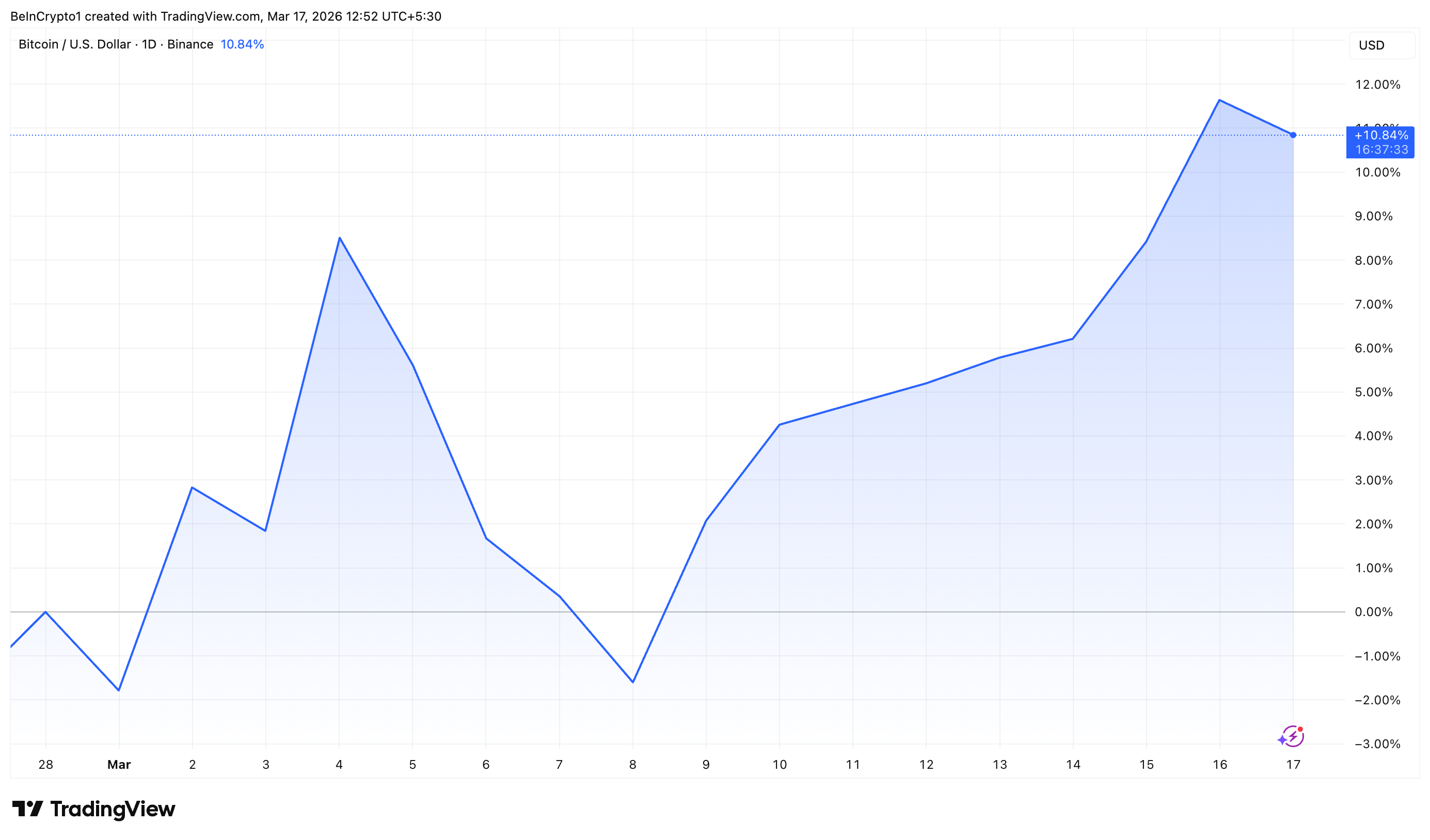
With both a potential liquidity crisis and geopolitical instability on the table, the setup for Bitcoin looks increasingly compelling.
