

MicroStrategy (Strategy) released its Q4 2025 earnings report and, along with it, disclosed an extreme downside scenario that would begin to strain its Bitcoin treasury model.
The CEO’s remarks provided rare insight into how far the market could fall before the company’s capital structure comes under serious pressure.
MicroStrategy Finally Reveals What Would Be Its Breaking Point as Bitcoin Price Drops
During its latest earnings discussion, MicroStrategy CEO Phong Le said that a 90% decline in Bitcoin’s price to roughly $8,000 would mark the point where the firm’s Bitcoin reserves roughly equal its net debt.
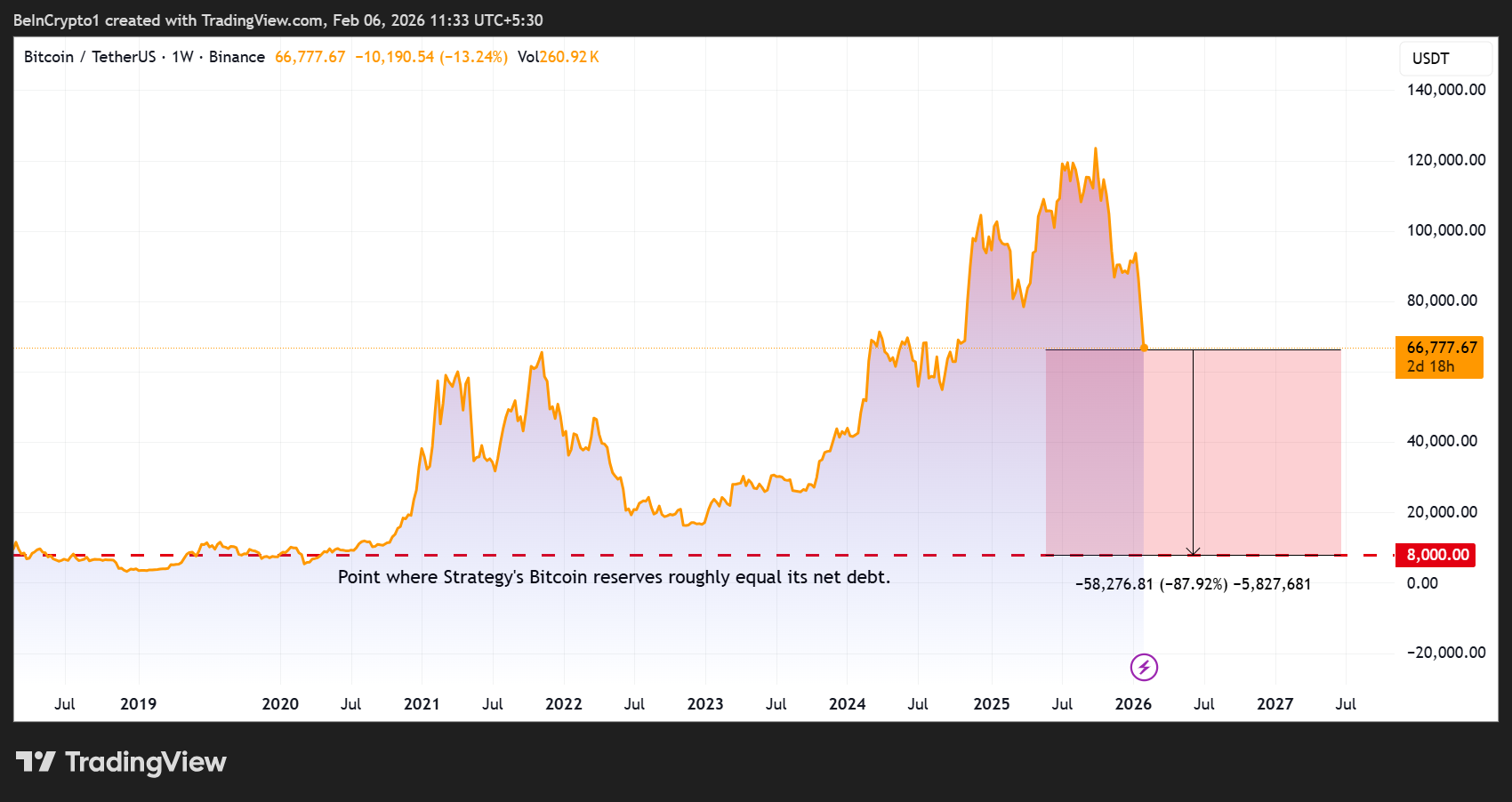
At that level, the company would likely be unable to repay convertible debt using its BTC holdings alone. As a result, it may need to consider restructuring, issuing new equity, or raising additional debt over time.
Leadership emphasized that such a scenario is viewed as highly improbable and would unfold over several years, giving the firm time to respond if markets deteriorated significantly.
“In the extreme downside, if we were to have a 90% decline in Bitcoin price to $8,000, which is pretty hard to imagine, that is the point at which our BTC reserve equals our net debt and we’ll not be able to then pay off of our convertibles using our Bitcoin reserve and we’d either look at restructuring, issuing additional equity, issuing an additional debt. And let me remind you: this is over the next five years. Right, So I’m not really worried at this point in time, even with Bitcoin drops,” said Le.
Meanwhile, it is worth noting that Le’s remarks come only months after the Strategy executive admitted a situation that would compell the firm to sell Bitcoin.
As BeInCrypto reported, Phong Le cited a Bitcoin sale trigger tied to mNAV and liquidity stress.
Speaking on What Bitcoin Did, CEO Phong Le outlined the precise trigger that would force a Bitcoin sale:
- First, the company’s stock must trade below 1x mNAV, meaning the market capitalization falls below the value of its Bitcoin holdings.
- Second, MicroStrategy must be unable to raise new capital through equity or debt issuance. This would mean capital markets are closed or too expensive to access.
Therefore, the latest statement does not contradict Phong Le’s earlier position but adds another layer of risk.
Previously, a Bitcoin sale depended on stock trading below mNAV and capital markets’ closing. Now, he clarifies that in an extreme 90% crash, the immediate issue would be debt servicing, likely addressed first through restructuring or new financing—not necessarily selling Bitcoin.
Massive Bitcoin Exposure Comes with Large Losses
Strategy remains the world’s largest corporate holder of Bitcoin, reporting 713,502 BTC as of early February 2026. The company acquired the holdings at a total cost of about $54.26 billion, according to its fourth-quarter financial results.
However, Bitcoin’s decline during the final months of 2025 significantly impacted the balance sheet. The firm reported $17.4 billion in unrealized digital-asset losses for the quarter and a net loss of $12.4 billion. This highlights the sensitivity of its financial performance to market swings.
At the same time, Strategy continued to raise substantial capital. The company said it raised $25.3 billion in 2025, making it one of the largest equity issuers in the US.
Meanwhile, they also reportedly built a $2.25 billion USD reserve designed to cover roughly two and a half years of dividend and interest obligations.
Executives argue that these measures strengthen liquidity and provide flexibility, even during periods of market stress.
Bitcoin Volatility Brings the Risk Into Focus
The disclosure comes amid heightened volatility in crypto markets. Bitcoin traded near $70,000 in early February before extending successive legs lower to an intraday low of $60,000 on February 6. This shows how quickly price movements can reshape the outlook for highly leveraged treasury strategies.
Strategy’s capital structure relies heavily on debt, preferred equity, and convertible instruments used to accumulate Bitcoin over multiple years.
While this approach has amplified gains during bull markets, it also magnifies losses during downturns, drawing increasing scrutiny from investors and analysts.
However, the company’s leadership maintains that the long-dated nature of much of its debt provides time to manage through cycles. This, they say, reduces the risk of forced liquidations in the near term.
Saylor Doubles Down on Long-Term Thesis
Elsewhere, executive chair Michael Saylor reiterated his conviction in Bitcoin despite recent losses, describing it as the “digital transformation of capital” and urging investors to “HODL.”
Saylor and other executives argue that Bitcoin remains the hardest form of money and that the company’s long-term strategy is built around holding the asset indefinitely, rather than attempting to time market cycles.
The firm has also expanded its financial engineering efforts, including scaling its Digital Credit instruments and preferred equity offerings. According to management, these are designed to reduce volatility and diversify funding sources while continuing to accumulate Bitcoin.
Investors Split on the Risks Ahead
Market reaction to the earnings disclosures and downside scenario has been mixed. Supporters argue that Strategy’s massive Bitcoin reserves, ability to issue equity, and multi-year debt maturities provide sufficient flexibility to navigate even severe downturns.
Critics, however, warn that a prolonged bear market could still force difficult choices. Potential risks cited by investors include shareholder dilution, pressure on the capital structure, or the possibility of selling Bitcoin if funding conditions tighten.
“The company is currently facing a whopping -$7.3 billion loss on their Bitcoin investments,” said Jacob King.
For now, Strategy appears committed to its high-conviction approach. However, by acknowledging that its Bitcoin reserves would merely match its debt, the company has made clear that even the most aggressive corporate Bitcoin strategy still has a theoretical breaking point, one defined not just by market prices but by the limits of leverage itself.
