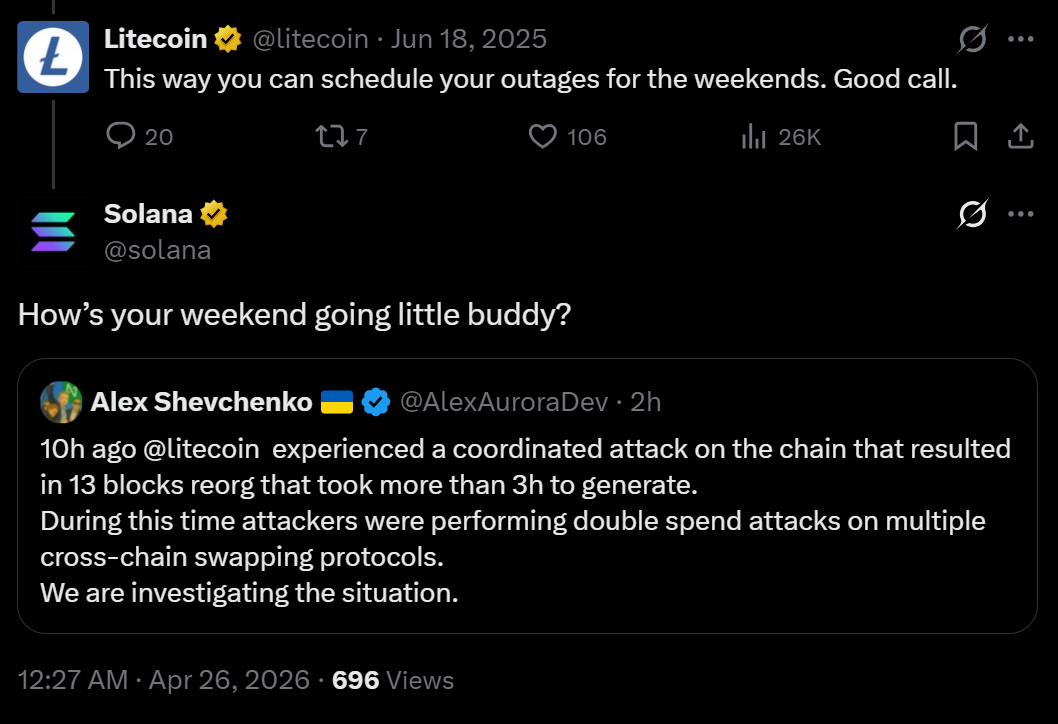
Litecoin’s emergency 13-block reorganization to reverse a zero-day attack has reignited debate about whether transaction finality can be trusted and whether the network is truly secure.
The incident reveals an uncomfortable truth: blockchain immutability is conditional, not absolute.
Transaction Finality Is Not Guaranteed
For years, crypto advocates have marketed blockchains as immutable ledgers where transactions cannot be reversed. Yet the Litecoin network just demonstrated that a coordinated attack, combined with unpatched nodes, can force it to rewrite its history.
While developers justified the reorg because the blocks contained invalid transactions, the question remains unsettling: how many confirmations make a transaction feel secure if a single bug can erase 13 blocks?
Unpatched Litecoin Nodes Created the Vulnerability
The zero-day attack succeeded because many Litecoin nodes ran outdated software that improperly validated MWEB transactions. This created a two-tier network in which different participants operated under distinct consensus rules.
Bitcoin and Litecoin have no mandatory update mechanism. Nodes can run old software indefinitely. While philosophically important, this freedom created the exact vulnerability exploited in the attack.
Miners and exchanges running unpatched software became unintended participants in enabling the exploit.
The zero-day specifically targeted MWEB, Litecoin’s privacy feature. Privacy adds complexity, and complexity creates attack surfaces. MWEB is still young, and this exploit suggests it needs further hardening before users should trust large-value transfers.
Finality Problem for Investors
Litecoin’s smaller hash rate and lower security budget make it more vulnerable to both bugs and future attacks. A 13-block reorg represents roughly 2.5 hours of history. On Bitcoin, reversing such a depth would cost billions and require controlling 51% of the network.
Users should consider how many confirmations they feel safe with, given this reality. Six confirmations may not be sufficient if a buggy client release can trigger a 13-block reorg.
Can Litecoin restore trust?
Technically, Litecoin developers have fixed the issue. But the incident exposes how dependent decentralized networks are on coordinated node updates and careful operator behavior. The network recovered, but it did not emerge unscathed.
For casual transactions, Litecoin likely remains safe. For long-term wealth storage, the incident raises legitimate questions about finality and whether transaction history can be rewritten at scale.