


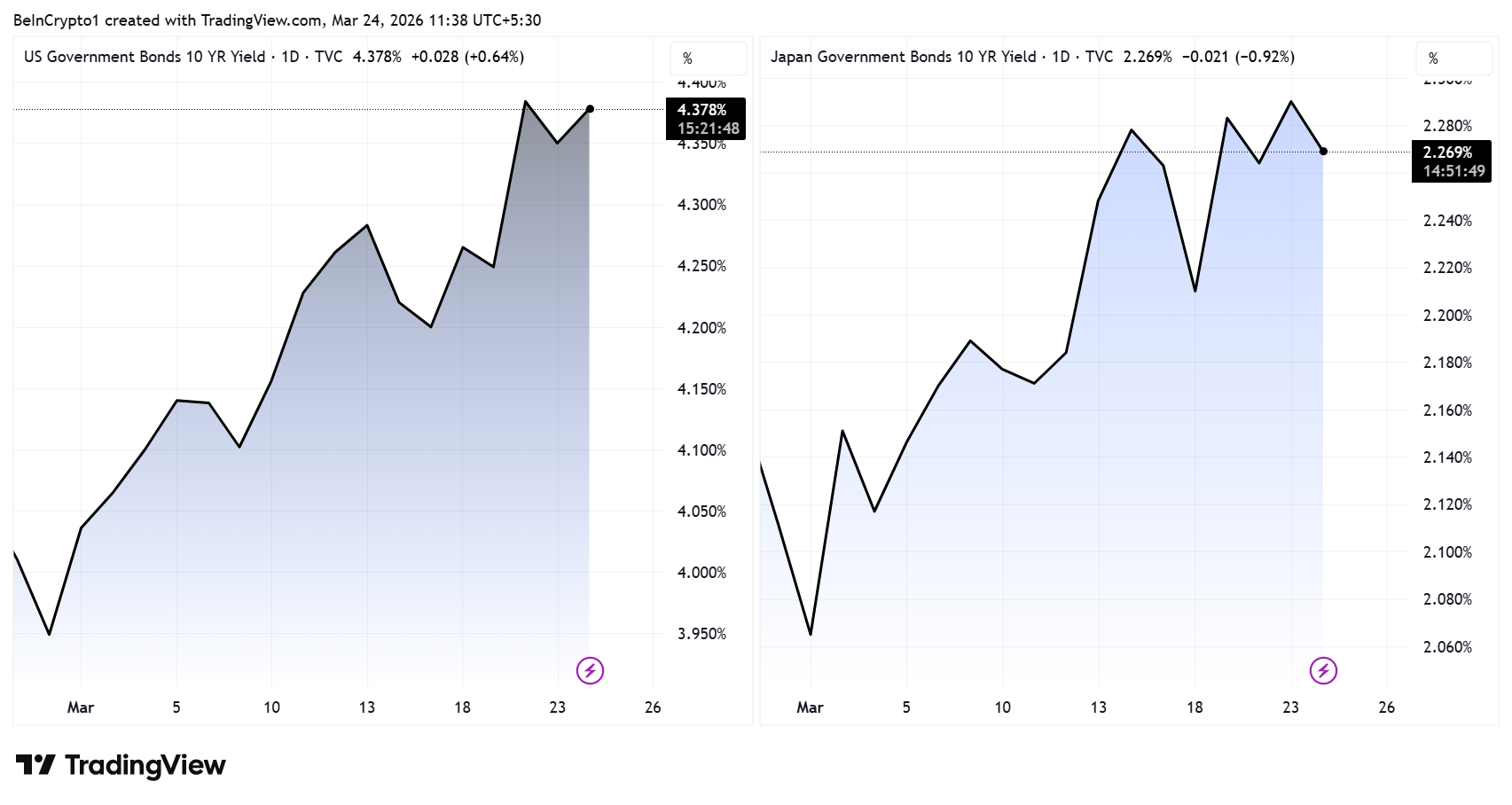
Japan’s 10-year government bond yield (JP10Y) has surged to 2.30%, surpassing its 2008 financial crisis peak, amid oil-driven inflation and geopolitical tensions that are rippling through global markets. At the same time, the US 10-year Treasury yield (US10Y) is hovering near 4.40%, with both benchmarks rising in tandem on what analysts describe as a war-induced energy shock.
The parallel move is forcing crypto investors to confront a key question: which bond market poses the greater threat to Bitcoin?
Japan’s Yield Surge Raises Immediate Liquidity Risks
Attention is increasingly turning to Japan, with analyst Shanaka Anslem warning that the most dangerous number in global finance is not the price of oil. Rather, it is the entire Japanese yield curve, pointing to sharp increases across long-dated bonds.
Japan’s ultra-low rates have long underpinned the global yen carry trade, where investors borrow cheaply in yen to fund higher-yielding positions across equities, bonds, and crypto.
That dynamic is now reversing.
As yields rise, borrowing costs increase. This forces investors to unwind leveraged positions and repay yen-denominated debt. This process often results in rapid selling of risk assets.
Bitcoin Has Already Reacted to BOJ Tightening
Recent cycles highlight the impact.
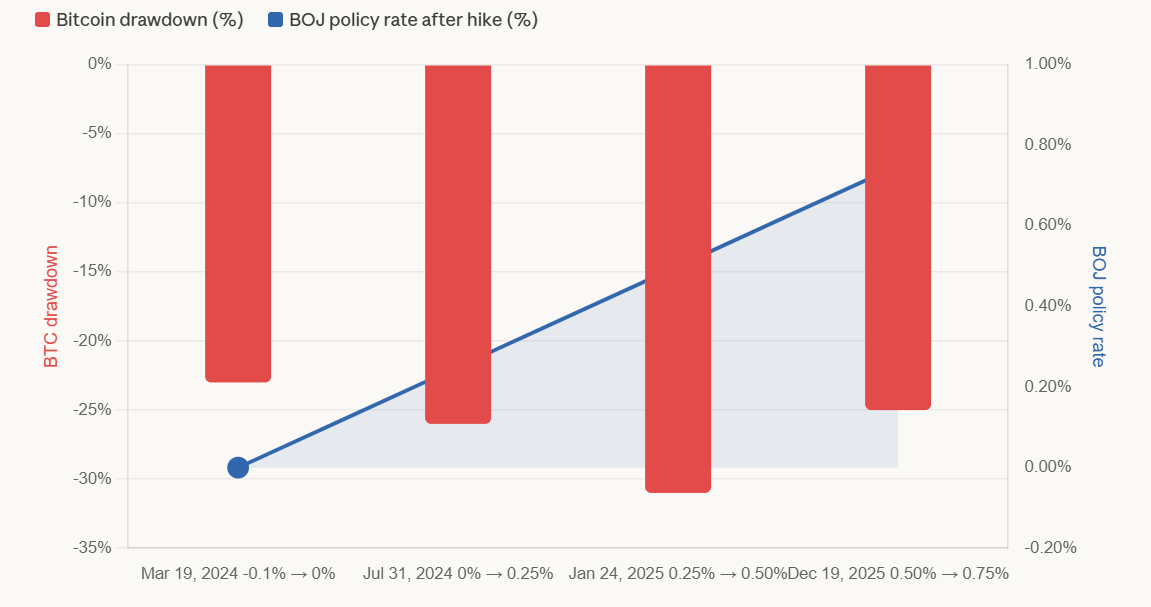
Each Bank of Japan tightening phase since 2024 has coincided with Bitcoin drawdowns of roughly 20% to 31%, driven largely by forced deleveraging rather than gradual market repricing.
- BOJ Rate Hike 1 – March 19, 2024 BOJ raised rates from -0.1% to 0%-0.1% (first hike since 2007).
Bitcoin fell roughly 23%, with some analysts measuring a slightly larger decline of ~27% depending on the window.
- BOJ Rate Hike 2 – July 31, 2024 BOJ raised rates from 0%-0.1% to 0.25%.
Bitcoin dropped around 26-30% MEXC. The yen appreciated from 160 to below 140, triggering a trillion-dollar global asset sell-off with BTC plunging from $65,000 to $50,000. The Nikkei crashed 12% in a single session on August 5.
- BOJ Rate Hike 3 – January 24, 2025 BOJ raised rates to 0.50%.
BTC slid more than 30-31%, the largest drawdown of the three episodes.
- BOJ Rate Hike 4 – December 19, 2025 BOJ raised rates to 0.75%, the highest in 30 years.
Bitcoin fell by 26% in eight days after the July 2024 hike and declined by 25% over 20 days after the January 2025 hike. After December’s hike, BTC also experienced a drawdown, though the exact percentage varied by measurement window.
This makes Japan’s yield moves structurally different from those in the US.
Repatriation Could Drain Global Liquidity
The risk is amplified by the scale of Japanese capital abroad.
Japanese life insurers hold an estimated $5 trillion in foreign assets. As domestic yields rise, particularly at the long end, these institutions are incentivized to bring funds back to Japan.
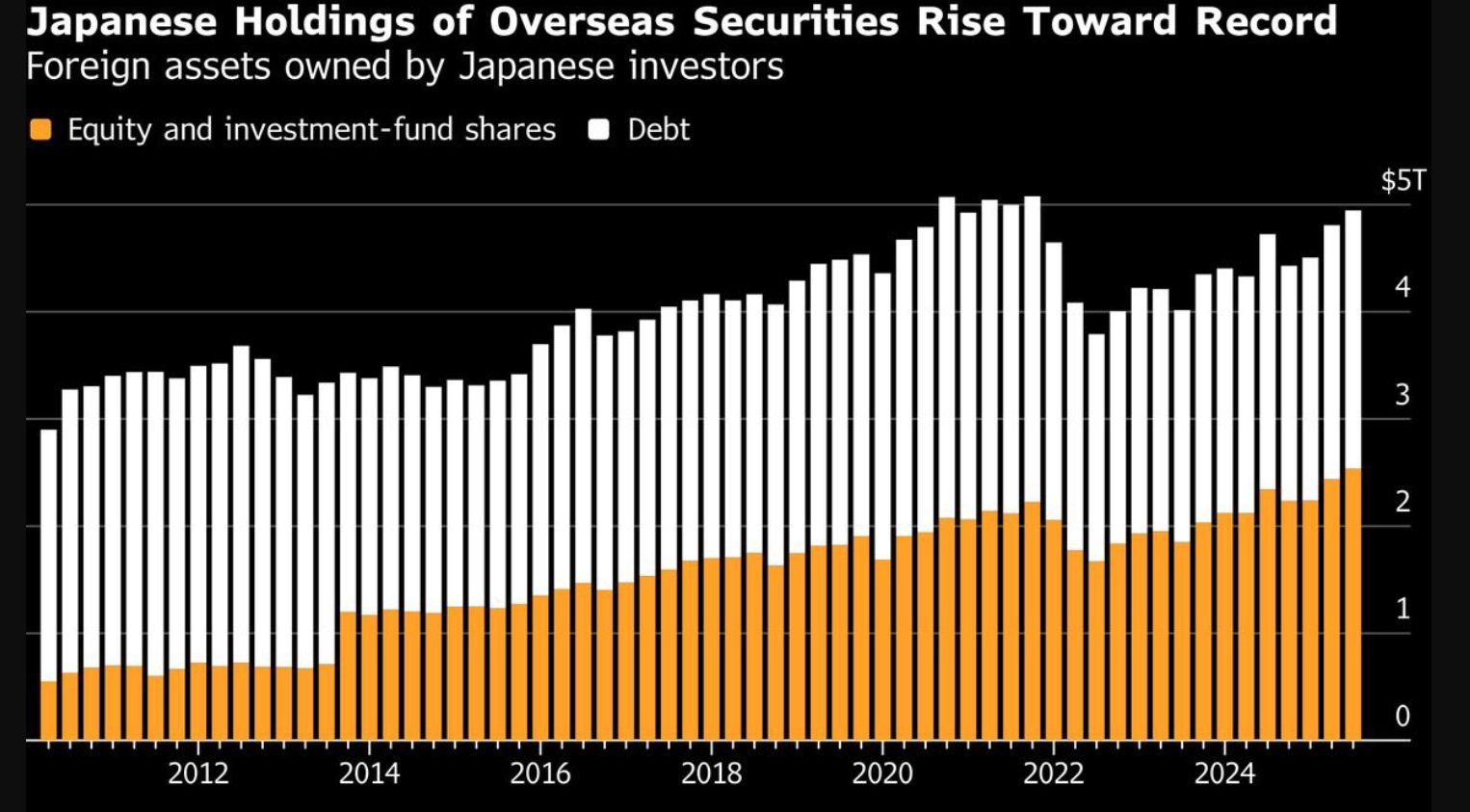
That shift involves selling overseas holdings, including US Treasuries and other global assets, reducing liquidity across markets that have historically supported crypto.
US Yields Add Pressure, But in a Familiar Way
The rise in US Treasury yields still matters.
Higher yields increase the opportunity cost of holding non-yielding assets like Bitcoin, strengthen the dollar, and tighten financial conditions.
However, analysts note that this is a more gradual and familiar headwind, one that crypto markets have historically absorbed over time.
Unlike Japan, the US yield surge does not directly trigger large-scale leveraged unwinds tied to a global funding trade.
Oil Shock Limits Policy Response
Both yield moves are being driven by rising energy prices linked to geopolitical tensions.
Japan, heavily reliant on imports, is already preparing to release state oil reserves, while policymakers monitor currency weakness near intervention levels.
At the same time, inflation near 2.7% in the US limits the Federal Reserve’s ability to cut rates, leaving both central banks constrained.
So, Which Yield Matters More for Bitcoin?
In the current market structure, Japan’s 10-year yield poses the greater and more immediate risk to Bitcoin.
The reason is not the level of yields, but the mechanism behind them.
- US10Y pressures Bitcoin through macro conditions like higher rates and a stronger dollar
- JP10Y pressures Bitcoin through forced liquidations, driven by carry trade unwinds and capital repatriation
That distinction is critical.
While rising US yields can weigh on crypto over time, Japan’s yield surge has historically triggered sharp, sudden drawdowns as leveraged positions unwind.
Bottom Line
Both bond markets are tightening global financial conditions, but they are not equally impactful.
The US sets the macro environment.
Japan triggers the liquidity shock.
For Bitcoin and crypto markets, that makes Japan’s yield curve the more dangerous variable to watch in the near term.