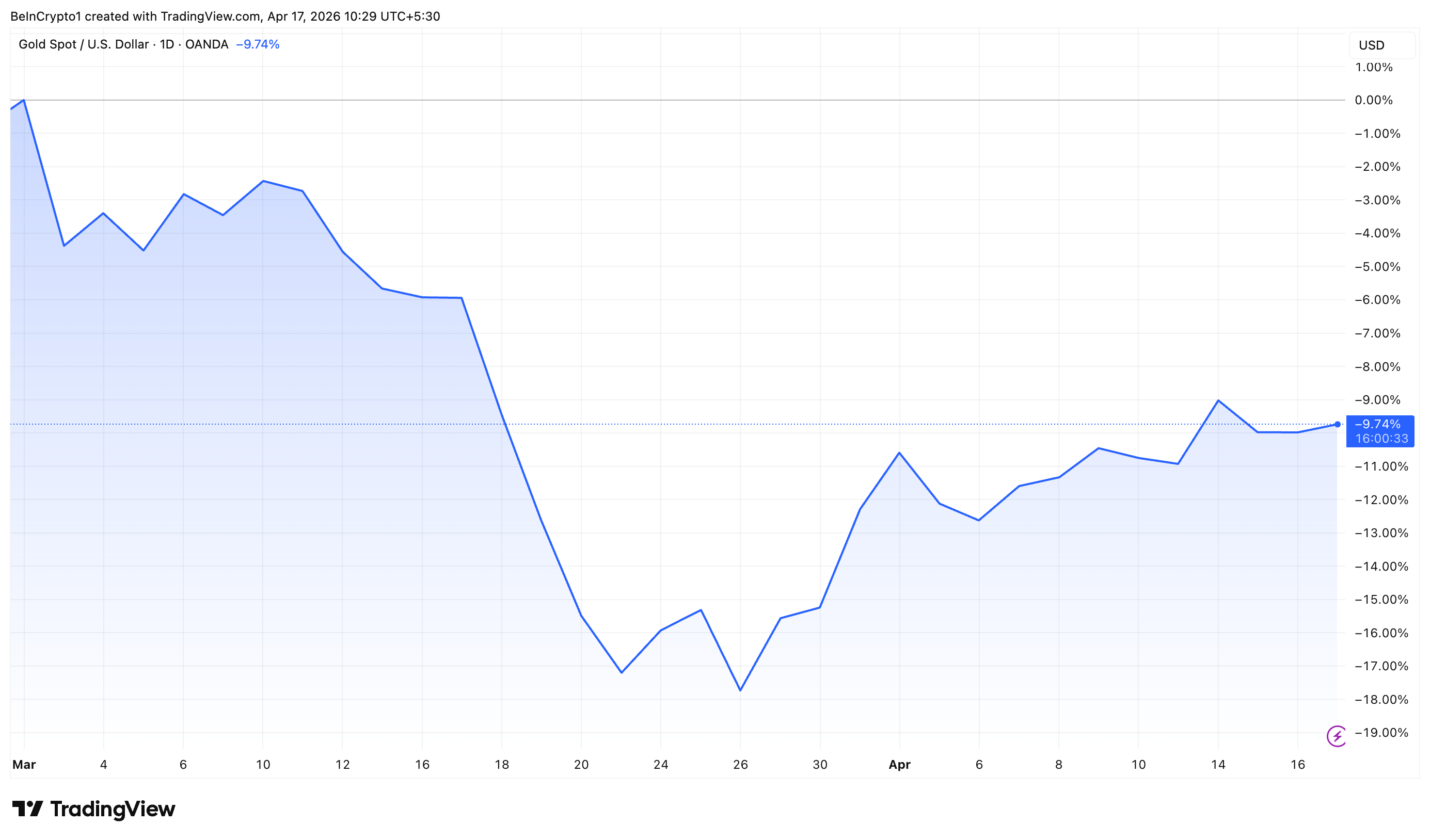
Gold has dropped nearly 10% since the US-Iran war erupted, as rising oil prices sidelined investors. However, strong emerging market demand is keeping the market grounded.
Data from The Kobeissi Letter shows that emerging economies have accounted for roughly 70% of global gold demand over the past decade. Within this, China and India alone accounted for nearly half of global purchases, highlighting their outsized influence on the market.
Follow us on X to get the latest news as it happens
China and India Drive Structural Gold Demand
China remains the largest contributor, accounting for 27% of global gold demand. According to the World Gold Council, the People’s Bank of China extended its gold-buying streak to a 17th consecutive month in March.
It increased reserves by 5 tonnes to 2,313 tonnes, about 9% of its total foreign reserves. Overall, China added 7 tonnes of gold in the first quarter.
“The plummeting local gold price did not interrupt Chinese investor appetite for gold ETFs. In March, the CSI300 stock index fell 6% and the local currency depreciated by 0.8% against the dollar; these factors, combined with safe-haven demand prompted by the US-Israel-Iran war, and continued regional geopolitical tensions, supported local gold ETF buying. We also witnessed some dip buying during the first half of the month,” the blog read.
India ranked as the second-largest contributor, accounting for 21% of global demand. According to ASSOCHAM, Indian households hold gold valued at approximately $5 trillion, exceeding the combined reserves of the world’s top 10 central banks.
Separately, the World Gold Council estimates that Indian household and temple holdings total around 25,000 tonnes, worth roughly $2.4 trillion.
This represents nearly 56% of India’s projected nominal GDP for 2026, highlighting the metal’s deep cultural and financial significance in the country.
Outside Asia, North America and Europe contributed 11% and 12% of global gold demand, respectively, indicating a comparatively smaller role in shaping long-term consumption trends.
On the supply side, mine production remains the dominant source, accounting for 74% of total global output. Africa leads global supply with a 26% share, followed by Asia at 19%. The Commonwealth of Independent States (CIS), Central and South America each contribute around 15%, while North America accounts for 14%.
Thus, while geopolitical tensions and oil prices have pressured gold in the short term, underlying demand from emerging markets, particularly China and India, remains a strong structural foundation.
Subscribe to our YouTube channel to watch leaders and journalists provide expert insights