

Traders are moving beyond altcoins into oil amid the Middle East conflict. At this stage, the question of whether traditional finance and crypto will converge may already be answered.
The convergence appears to be underway, with tokenized assets emerging as one of the clearest examples of how global markets are increasingly blending with blockchain-based infrastructure.
Tokenized Assets Gain Traction as Geopolitics Drive On-Chain Commodity Trading
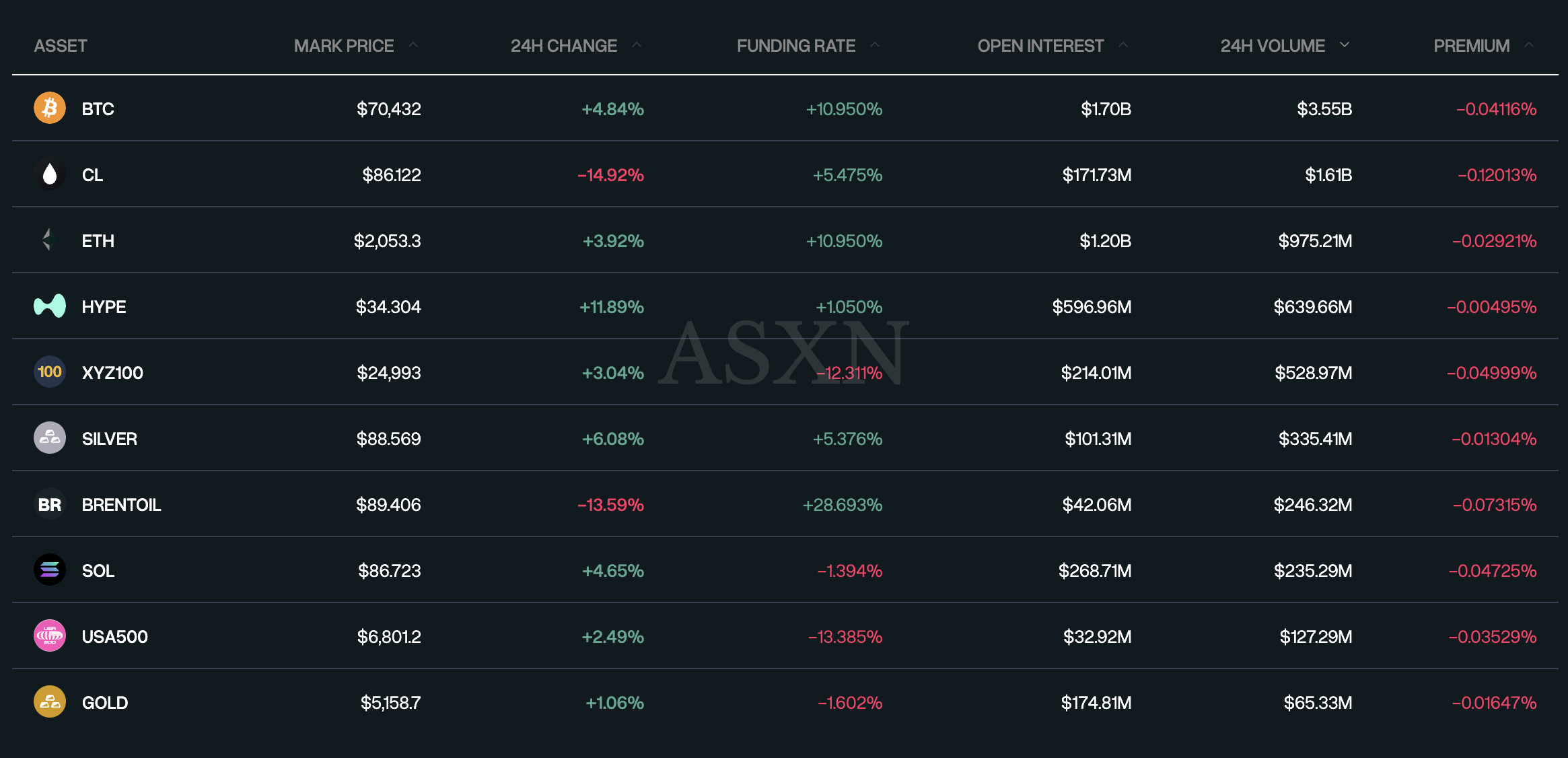
Market data highlights the scale of this growing demand. According to HyperScreener, the perpetual futures contract tied to West Texas Intermediate crude oil (WTI) recorded more than $1.6 billion in trading volume in the past 24 hours.
Moreover, the CL-USDC contract has quickly climbed the ranks and now trails only Bitcoin (BTC) as the most actively traded market on Hyperliquid.
Follow us on X to get the latest news as it happens
Oil’s rise on Hyperliquid reflects a pattern already seen with other commodities on the exchange. Contracts linked to Silver transformed into high-volume macro trading instruments as investors sought alternative hedges.
The surge in on-chain commodity trading comes as oil prices draw renewed market attention. The prices surged to nearly $120 per barrel on Monday.
The rise came as supply concerns tied to the US-Israel-Iran conflict grew. However, prices later retreated after the US President Donald Trump suggested the war could end soon, easing market concerns.
The growing traction for tokenized assets highlights a broader shift in how traders access global markets. Bitwise Chief Investment Officer Matt Hougan recently highlighted that traders turned to crypto-based rails as global markets were closed after President Trump announced a military strike on Iran.
That episode illustrated a structural gap, and users took note. Thus, for crypto-natives, tokenized commodities offer a key advantage: direct exposure to global macro assets without leaving on-chain markets. Analyst Martin commented on the shift in trader focus.
“Gold went up, then silver, then oil. Those assets are attractive. Luckily, I also found a reason for the dump in my crypto portfolio. It only dropped because people were interested in something else. It didn’t drop because it was useless. Thank goodness,” he said.
Meanwhile, traditional financial infrastructure is accelerating to meet the demand. Nasdaq has partnered with Payward (the parent company of crypto exchange Kraken) to build a system that “connects tokenized equity capital markets with decentralized blockchain networks.”
“Both organizations believe tokenization has the potential to transform capital markets, modernizing how securities are traded and settled while enabling greater global access, programmability, and operational efficiency across financial infrastructure,” the announcement read.
Thus, the current trend points to changing trader interests and market maturity. Whether this reflects a short-term rotation driven by commodity price momentum or a more durable structural change in how crypto markets function remains an open question.
