


Crypto hedge funds are sharply pulling back from the market, raising cash levels as risk appetite deteriorates across digital assets.
The move away from the market comes as experts suggest Bitcoin (BTC) is facing an “identity crisis.”
Institutional Retreat From Bitcoin Accelerates
Major crypto hedge funds have shifted their portfolios in early 2026. According to Nic Puckrin, co-founder of Coin Bureau, the average cash balance has risen to levels not seen since early 2025.
Furthermore, for the first time, some crypto hedge funds report zero exposure to both Bitcoin and Ethereum, assets that traditionally made up the core of institutional crypto portfolios. This marks a fundamental reassessment of digital asset strategies among professional money managers.
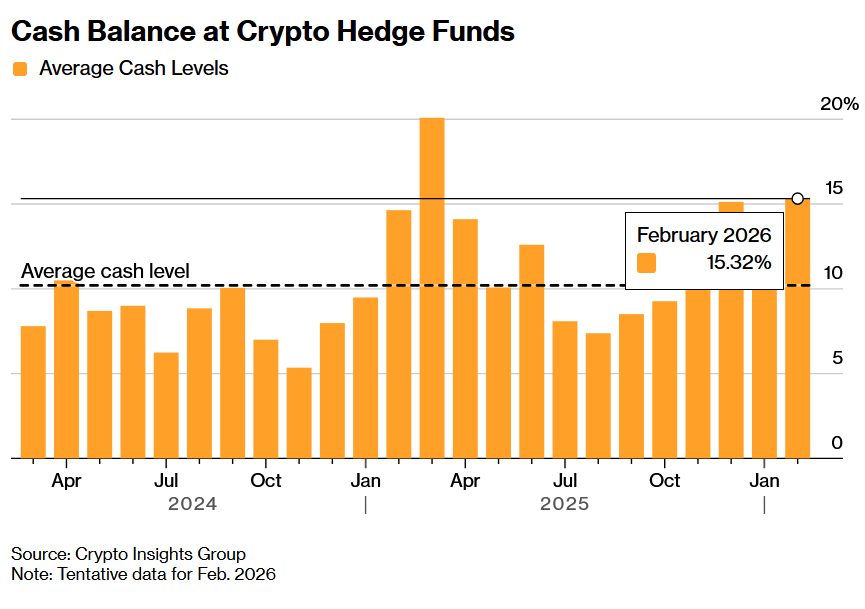
The analyst attributed the defensive stance to several factors:
- Lower reward-to-risk: The current upside potential in Bitcoin and Ethereum appears limited relative to volatility and downside exposure, weakening the overall risk-adjusted return profile.
- Unprofitable basis trade: A basis trade typically involves buying spot BTC and shorting BTC futures. When funding rates compress and futures premiums decline, the arbitrage yield becomes unattractive.
- Shift toward crypto-linked equities: Some capital has rotated into publicly traded companies, offering indirect exposure through traditional equity markets.
- Uncertain macroeconomic backdrop: Ongoing concerns around inflation, interest rates, and geopolitical risks are contributing to a broader risk-off stance in digital assets.
The slowdown in institutional demand is also reflected in flows into spot Bitcoin exchange-traded funds (ETFs). BeInCrypto reported that since the start of 2026, the funds have recorded nearly $4.5 billion in outflows.
This was only partially offset by just $1.8 billion in inflows during the first and third weeks of the year. Furthermore, since a record high in October, balances across spot Bitcoin ETFs have fallen by more than 100,000 BTC.
The price pressure has also weighed on corporate holders and miners. Recently, Bitcoin miner Bitdeer sold all its BTC holdings amid declining mining profitability.
A recent report from Matrixport points to early warning signs dating back to late 2025. Despite a price rally at the time, Bitcoin futures positions on CME Group remained significantly lower than levels typically associated with such price appreciation.
This divergence suggested that the rally was not driven by new institutional inflows, signaling weakening institutional conviction even before 2026 began.
Bitcoin’s “Identity Crisis” Deepens
The shift away from Bitcoin comes as Bloomberg highlighted that the world’s largest cryptocurrency is facing a $1 trillion “identity crisis,” trading more than 40% below its recent peak.
“Washington has never been more accommodating. Institutional adoption has never been deeper…That means the defining struggle of this crypto era isn’t about price. It’s about purpose. And this selloff is forcing a question Bitcoin hasn’t needed to answer when prices were rising: if it isn’t the best hedge, the best payment rail or the best speculation — what, exactly, is it for?,” Bloomberg noted.
The key issue is that its three dominant narratives are simultaneously under pressure:
- Digital gold (macro hedge)
- Payment rail
- Speculative asset
During recent macro uncertainty, investors rotated into traditional safe-haven assets instead. Gold-focused ETFs recorded strong inflows, while Bitcoin investment products saw capital exit. The divergence has raised questions about Bitcoin’s role as a reliable hedge against inflation or geopolitical stress.
In the payments space, stablecoins have gained traction as a more practical solution for cross-border transfers and dollar-linked transactions.
“If anything, stablecoin activity could be correlated with activity on Ethereum or on other chains. And stablecoins are for payments. I don’t think anybody today sees Bitcoin as a payment mechanism,” Carlos Domingo, co-founder and CEO of Securitize, a tokenization platform, told Bloomberg.
At the same time, some retail speculative activity has migrated to prediction markets offering event-driven contracts.
“The prediction markets are becoming the next craze for the same DIY investors who enjoy the speculative nature of crypto. That could mean less overall interest in crypto..It could also mean a shift to more long-term, serious investors,” Roxanna Islam, head of sector and industry research at ETF shop TMX VettaFi, said.
As capital steps back, the next phase for Bitcoin will likely hinge on whether it can redefine its value proposition in a shifting financial space.