


Corporate treasury teams are replacing bank wires with stablecoin settlements, as USD Coin (USDC) overtakes Tether (USDT) in transfer volume and total stablecoin activity reaches record levels.
The shift reflects a broader structural change in how businesses move money, one driven by speed, cost, and institutional demand for regulated dollar-denominated rails.
Stablecoin Volume Hits Records as USDC Flips Tether
Total stablecoin transaction volume reached $1.8 trillion in February 2026, according to Leon Waidmann, head of research at Lisk.
More notably, USDC surpassed USDT in transfer volume, a reversal that had not occurred during Tether’s stablecoin years of dominance.
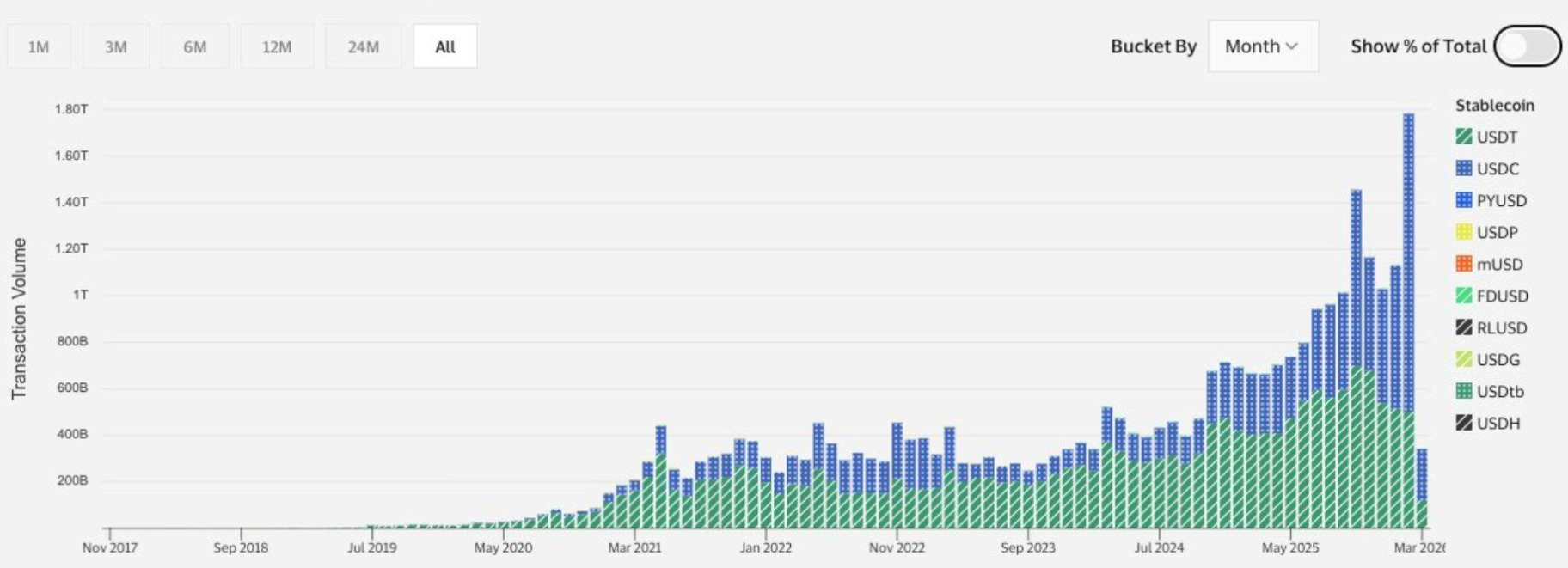
Waidmann attributed the flip to a clear preference among institutional participants for regulated, compliant digital dollar infrastructure.
The data suggests institutions, not retail traders, are now the primary force behind stablecoin activity.
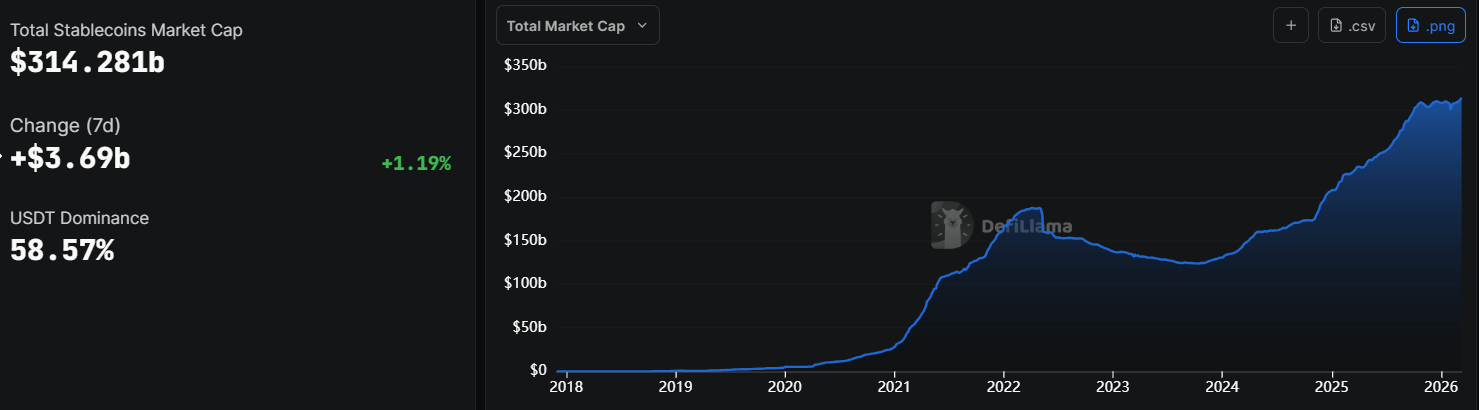
The broader market reflects the same trend. The total stablecoin market capitalization has grown to $314 billion, up from $131 billion in January 2024, according to data.
$33 Trillion Processed in 2025, Twice Visa’s Volume
Reece Merrick, an executive at Ripple, noted that stablecoins processed $33 trillion in transactions in 2025, roughly double the annual volume processed by Visa.
Transaction volume grew 72% year-over-year, while active users rose 146% across 106 countries.
Cross-border business-to-business payments were the fastest-growing use case, surging 733% to $226 billion in global stablecoin flows.
Merrick also highlighted remittances, payroll automation, and inflation hedging in emerging markets as key adoption drivers.
Regional adoption is also accelerating. Turkey’s currency volatility has fueled demand for dollar-denominated stablecoins across the Middle East and North Africa.
Nigeria processes $59 billion in annual remittances, with stablecoins increasingly displacing legacy transfer services.
The United Arab Emirates has approved a dirham-backed stablecoin, DDSC, for institutional settlements, targeting a $170 billion addressable market.
Circle Settles $68 Million in 30 Minutes as Infrastructure Scales
The corporate treasury use case became tangible when Circle Internet Group used USDC and its Circle Mint platform to settle $68 million across eight internal entities in under 30 minutes.
The same transfers would have required one to three days via conventional bank wires.
Circle CEO Jeremy Allaire said the workflow completed roughly 90% of the company’s intercompany transfer-pricing settlements in a single day, significantly compressing the monthly close process.
The system operates continuously, outside banking hours, and maintains full auditability and role-based approvals.
Speaking during the company’s earnings call, Allaire framed the exercise as proof that stablecoin settlement can be integrated into existing corporate treasury infrastructure without rebuilding financial workflows from the ground up.
Meanwhile, Coinbase is building the infrastructure to support that kind of adoption at scale. Chief business officer Shan Aggarwal said the exchange has developed a vertically integrated stablecoin stack.
It covers issuance, settlement through its Base Layer-2 (L2) network, and wallets for both consumer and institutional use.
USDC balances across Coinbase products reached $17.8 billion at the end of Q4 2024.
Bernstein Backs Circle as Competition Intensifies
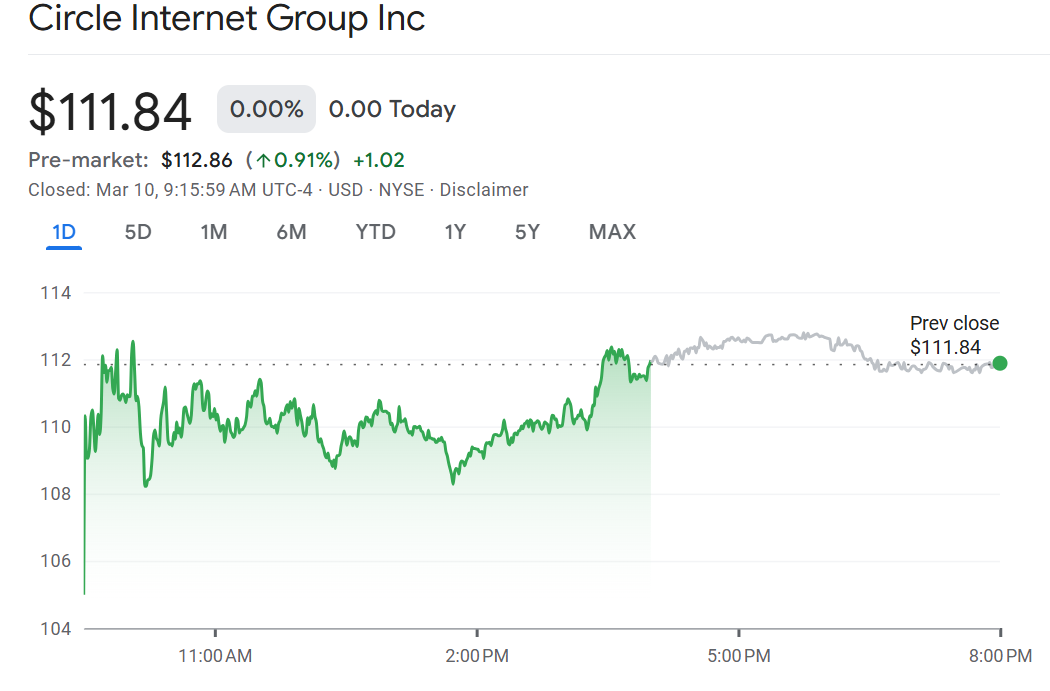
Elsewhere, analysts at Bernstein rated Circle stock as outperform, forecasting a 71% rally to $190 from its then-current price of $111.
The firm described Circle as a “long-term category winner,” citing:
- Its regulatory compliance
- Strategic partnerships
- Liquidity position, and
- Technology stack
According to Bernstein analysts, these are competitive moats that rivals would struggle to replicate.
Circle recorded $2.7 billion in revenue in 2025, a 64% increase over 2024. Transaction revenue was the fastest-growing segment, rising 112% year-over-year, driven by USDC adoption across prediction markets and other applications.
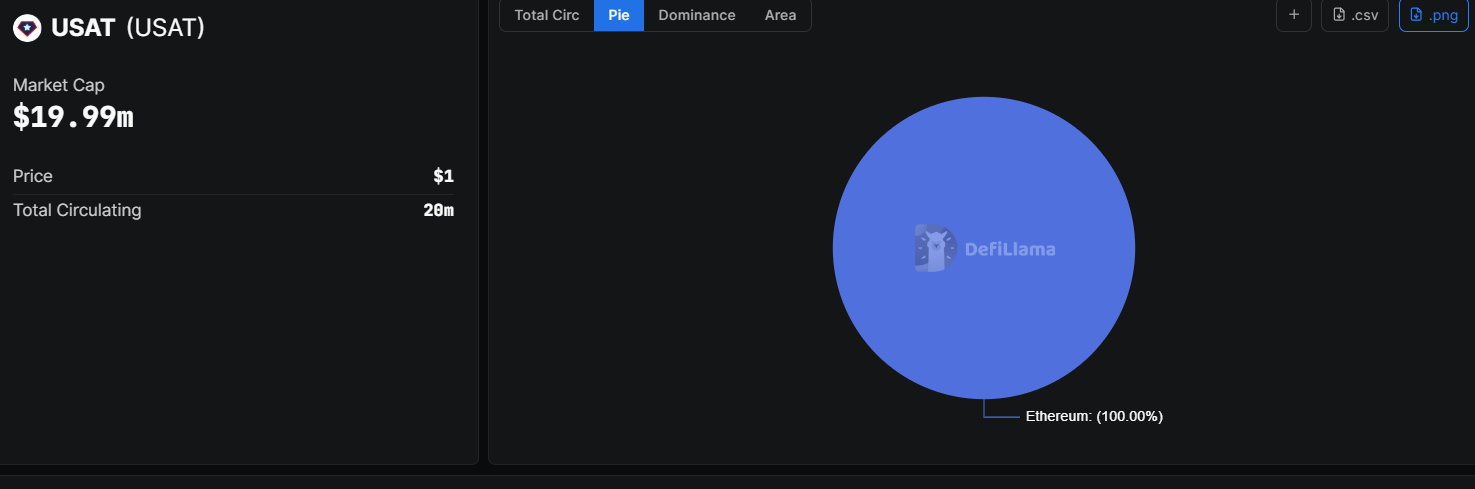
However, competition is mounting. Tether launched USAT, a federally regulated, dollar-pegged stablecoin, in January 2026 to re-enter the US market, where Circle has held a dominant position.
As of this writing, USAT issuance stood at just under $20 million, according to DefiLlama.
Separately, fintech firms including PayPal, Stripe, and Klarna, along with several banks, have announced stablecoin initiatives of their own.
Can Circle maintain its lead as the stablecoin market expands across corporate treasury, AI-enabled payments, and emerging market corridors?
It may all hinge on how quickly its regulated infrastructure scales against a growing field of entrants.
