


Bitcoin (BTC) has remained relatively steady amid geopolitical tensions. Still, the largest cryptocurrency’s drawdown has caused it to miss various experts’ price forecasts, with many even lowering long-term targets as uncertainty gripped markets last year.
Despite this, Bitwise CIO Matt Hougan argues that Bitcoin could reach $1 million per coin, highlighting “conservative assumptions” that could drive the asset to a seven-figure valuation.
Store-of-Value Market Expansion Drives Bitcoin Projection
In a recent memo, Bitwise CIO Matt Hougan laid out his argument, which uses a dynamic view of the store-of-value market. He explained that many who dismiss a seven-figure Bitcoin price make what Hougan calls a “pretty basic mistake.”
Hougan noted that the store-of-value market currently sits just under $38 trillion, with gold accounting for $36 trillion and Bitcoin making up $1.4 trillion. On that basis, Bitcoin represents just under 4% of the total market.
“This is why $1 million per bitcoin sounds unreasonable to many, and why I dismissed it for years. Given the current market size, bitcoin would need to capture more than 50% of the store-of-value market to reach $1 million. That is a very high bar,” he shared.
However, according to him, this framing ignores the fact that the store-of-value market is not “static.” Gold’s market capitalization has grown from approximately $2.5 trillion in 2004 to nearly $40 trillion today.
Follow us on X to get the latest news as it happens
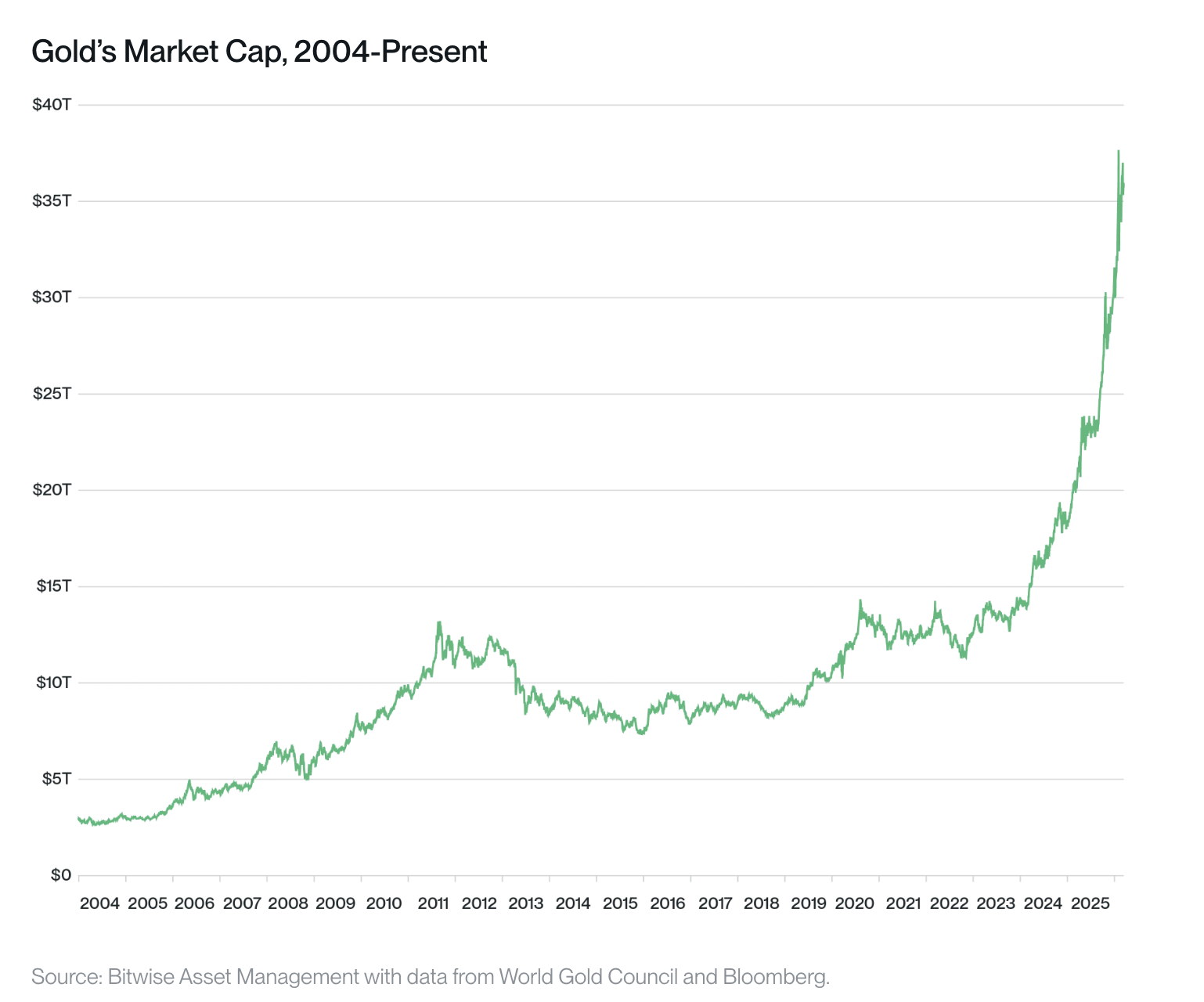
This represents a roughly 13% compound annual growth rate, fueled by rising government debt, geopolitical instability, and prolonged easy monetary policy.
If that trajectory holds, Hougan projects the combined store-of-value market will swell to approximately $121 trillion within ten years. In a market that size, Bitcoin would need just a 17% share to justify a $1 million price tag.
“That’s still a lot of growth—from ~4% to ~17%—but it feels well within reach when you reflect on all the progress bitcoin has made recently,” he said.
Institutional Momentum Supports the Case
Hougan also pointed to institutional adoption as evidence for Bitcoin’s potential market growth. He highlighted that US Bitcoin exchange-traded funds (ETFs) have become the fastest-growing ETFs of all time.
BTC is held by entities as varied as the Harvard endowment and the Abu Dhabi sovereign wealth fund. BeInCrypto reported that institutions added approximately 829,000 BTC in 2025.
Meanwhile, long-term volatility has declined enough that many professional investors now consider allocating 5% to Bitcoin. Just a few years ago, 1% was the ceiling. That shift reflects a structural change in how institutions view the asset. According to Hougan,
“There are still miles to go, but with these undercurrents, capturing one-sixth of the store-of-value market in 10 years doesn’t seem extreme. It seems more like a continuation of recent trends.”
Risks and Upside Scenarios
Hougan also flagged two specific downside risks. First, the past two decades were quite turbulent, spanning the global financial crisis, the invention of quantitative easing (QE), and extended low-rate environments.
Those conditions powered gold’s growth and may not repeat. A calmer macro backdrop could slow the expansion of the store-of-value market.
Second, Bitcoin could simply fail to gain market share. Regulatory setbacks, technological risks, or a loss of narrative momentum could stall adoption despite favorable macro conditions.
“But I think there’s equal risk that these projections are too conservative—that the store-of-value market will grow faster in the future,” he added.
On the upside, Hougan suggested that if government debt concerns reach “crisis levels,” it could accelerate demand for non-sovereign stores of value. In that scenario, Bitcoin could capture far more than 17% of the market over the next decade.
“As I see it, the base case—that the store-of-value market will continue to grow as it has, and bitcoin will continue to gain market share as it has—leads you to much, much higher prices than we have today,” the CIO wrote.
Nonetheless, there is also a deeper structural question. While Hougan frames BTC’s path around the store-of-value thesis, recent market episodes have complicated that narrative.
During periods of macro stress, Bitcoin has tended to trade more like a high-beta tech stock than a safe haven. Capital flowed toward traditional safe havens during the tariff crash, not toward BTC. Thus, while the store-of-value market may grow, whether Bitcoin will grow with it remains to be seen.
Subscribe to our YouTube channel to watch leaders and journalists provide expert insights
