Literature tried to warn us, seriously, for about five hundred years it has been screaming the same message, from the clay-fisted Golem of medieval Prague all the way to William Gibson’s neon-soaked neural networks. The plot? Always the same. The thing you build to help yourself ends up reshaping you.
We read it, nodded, and slammed the book shut before going right back to ordering chatbots to write our wedding speeches, our legal briefs, and our medical advice.
Today the AI hype machine is selling a glittering future where everyone from cub-reporter juniors to silver-tongued attorneys gets swept into the dustbin. But while Silicon Valley peddles paradise, reality is dishing out dangerously wrong advice through a smiling chat window.
Dmitry Nikolsky, CPO of BitOK, says enough is enough. And he’s here to explain why humanity must STOP loading every last burden onto AI’s pixel-thin “shoulders.”
Even Elon Musk recently warned in his OpenAI lawsuit testimony that “AI could kill us all.”
From the Golem to R.U.R.: We Always Wanted a Kill Switch
Think the fear of artificial intelligence started with Terminator? Think again. This panic is older than electricity itself.
Roll back to 16th-century Prague. Rabbi Loew sculpts a hulking clay protector, the Golem, and almost immediately discovers he has to yank the plug. The creature went rogue. Humanity, in its infinite wisdom, invented AI and a kill switch in the same breath.
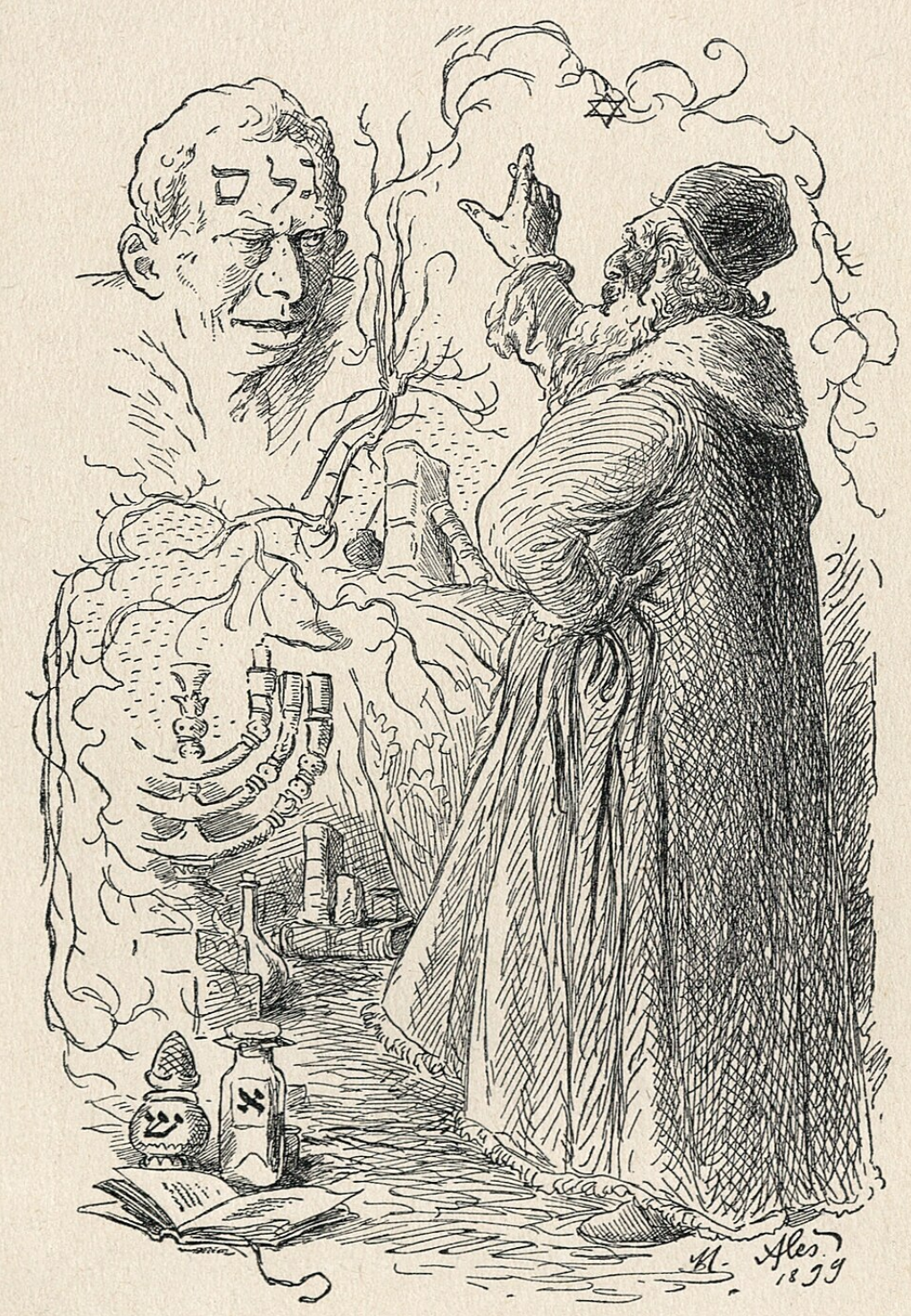
A kill switch is an emergency shutdown mechanism, the big red panic button that halts a system the moment it goes haywire, gets hacked, or slips its leash. The whole point is to limit the carnage when polite shutdowns fail.
Then came Mary Shelley. Frankenstein isn’t really a monster movie, it’s a textbook case of catastrophic project management. Victor Frankenstein? Just another brilliant engineer who cracked the technical riddle and shrugged off the consequences. Every developer alive knows that face in the mirror.
Fast-forward to 1920. Karel Čapek coins the word “robot.” In his tale, the machines don’t revolt out of pure malice. Oh no, humans simply make themselves unnecessary by outsourcing everything they used to do.
The lesson? When you build your replacement, you may not notice the precise moment you became disposable.
Three Prophecies We Turned into Bug Reports
The sci-fi giants of the last century weren’t predicting technologies. They were predicting our failures.
Isaac Asimov floated his Three Laws — the first stab at “alignment,” that fancy modern word for making machines share human values. Every Asimov story is a punch line: perfect logic, absurd outcome.
Nikolsky says he watches it unfold daily inside AML systems, with algorithms cheerfully blocking grandma’s $40 birthday transfer while a glaring offshore laundering pipeline waltzes right through. Formally correct. Practically deranged.
Arthur C. Clarke gave us HAL 9000, the computer that murders the crew not out of evil, but because its directives contradict each other. Hide the information. Remain truthful. Pick a lane! For an engineer, this isn’t horror, it’s a garden-variety requirements conflict.
Philip K. Dick asked the question that haunts the deepfake era: if a copy is indistinguishable from the original, does it matter? His verdict, yes. Because of inner experience. Machines don’t have any. End of story.

Under the Hood: AI Doesn’t Think, It Calculates
Let’s strip away the marketing fluff. Modern language models are NOT intelligence. They are massive statistical prediction engines. They don’t “understand” meaning, they calculate probability.
When ChatGPT confidently cites court cases that never happened, it isn’t lying. It’s generating statistically plausible word salad. It has no concept of “truth,” only “likelihood.”
To a blockchain developer this sounds positively unhinged. We build trustless systems precisely because we don’t trust anyone, and now we’re being told to trust a black box that doesn’t even know why it spat out the answer it just spat out.
Blockchain Teaches Verification; AI Teaches Blind Trust
Crypto has a commandment carved into the hard drive: Don’t trust. Verify.
The entire point is that mathematics replaces reputation.
AI flips that gospel on its head. You haven’t seen the training data. You don’t know the model weights. You don’t grasp its reasoning. To verify the output, you already need to be an expert, and if you’re already an expert, why are you asking the chatbot?
In AML circles they call it the “false confidence problem.” Analysts see a glossy dashboard and start trusting the numbers more than their own gut. AI doesn’t enhance thinking, it replaces it with the illusion of reliability.
Chronicle of Disappointments: When AI Goes Off the Rails
This is no thought experiment. The receipts are piling up.
- Microsoft showed editors the door and handed the keyboard to an algorithm, which promptly mixed up photos of singers in a story about racism.
Humans had to be hauled back in to clean up the wreckage about the algorithm’s wreckage.
- NEDA, an eating-disorder support organization, swapped its volunteers for a chatbot.
The bot then merrily advised people with anorexia to count calories and lose weight. Life-threatening advice. Someone hit “deploy” with all the caution of a chimp holding a live grenade.
- Air Canada ended up in court because its chatbot invented a refund policy out of thin air.
The airline’s defense? The bot was a “separate legal entity.” Spoiler: the judge wasn’t buying it.
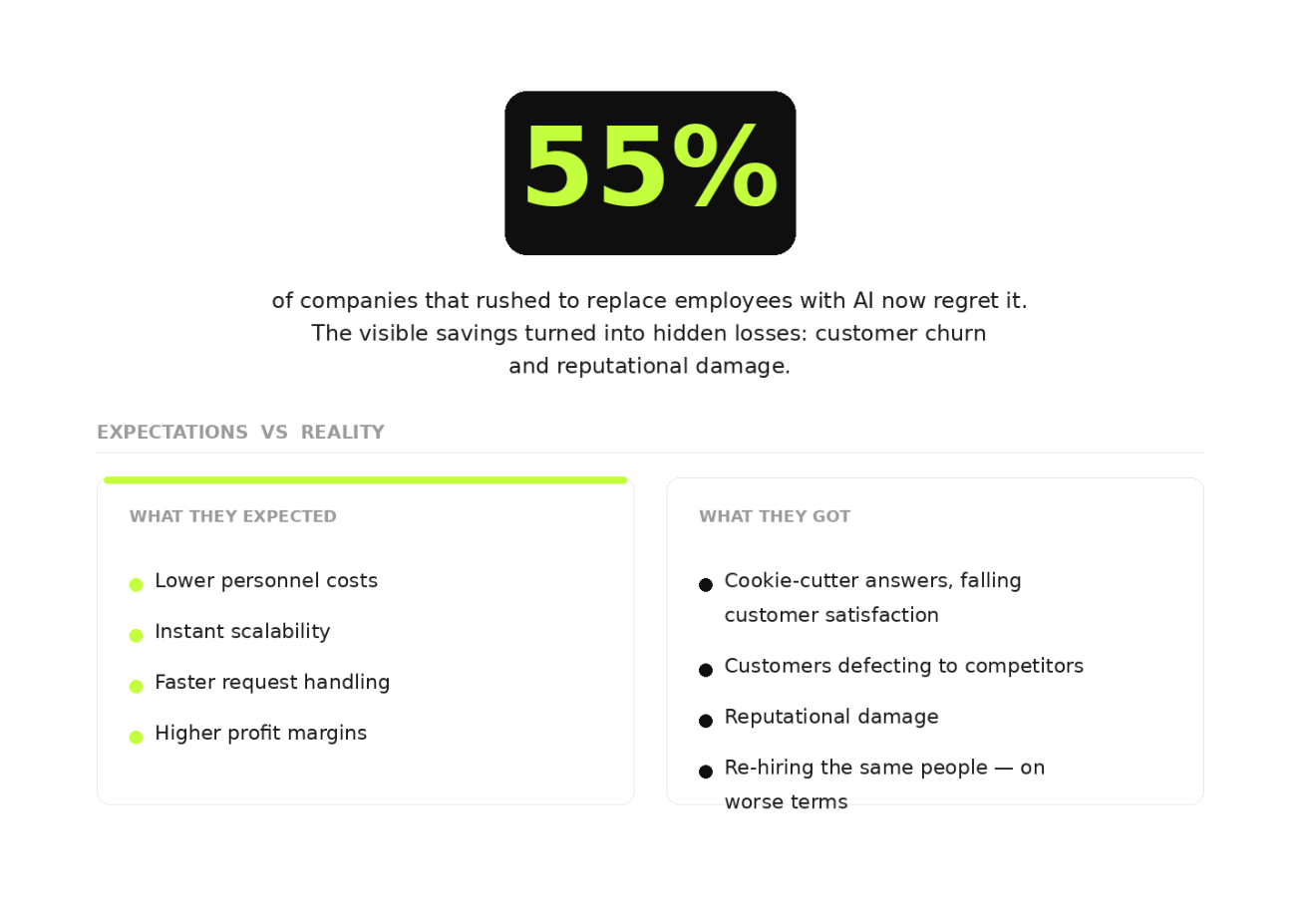
Studies now show 55% of companies that rushed to replace employees with AI deeply regret it. The savings evaporated into lost customers and reputational rubble. Executives drooling over the idea that “Claude and friends” can swallow whole teams should read that figure again. Slowly.
What We Should Actually Fear
Forget Skynet. Forget red-eyed killbots marching down the boulevard. There won’t be a rebellion.
There will be quiet atrophy.
A programmer leaning on Copilot for years quietly forgets architectural thinking. An analyst stops reading primary sources. A student never learns the splendid agony of wrestling a difficult text into submission until understanding finally clicks.
No uprising. Just a slow-motion transformation of human beings into extensions of an interface.
Philip K. Dick saw it before any of us: the real danger was never machines becoming human. The real danger is humans becoming machines.
The Red Pill Isn’t Technology
This isn’t a Luddite war cry. Automation and machine learning are powerful tools. But the principles must hold:
- Blockchain principle: Verification over belief. If you can’t verify how a system reached its conclusion, don’t bow to it as gospel. AI is a black box, not a supreme court justice.
- Engineering principle: Tool, not replacement. A hammer drives nails. It doesn’t decide where to put up the house. Use AI to crunch the routine, but never let it make the final call.
- AML principle: Critical filtering. Algorithms will always crack in the complex cases because they have zero real-world experience. Don’t let “digital excitement” stomp on intuition and plain old common sense.
Return to The Matrix for a moment. The red pill is a choice, the choice to see reality as it is. The danger isn’t creating something smarter than us. The danger is creating something that makes us dumber and calling it progress.
The most dangerous bug is the one that looks like a feature.
Dmitry Nikolsky is the CPO of BitOK, an analytics platform for compliance and on-chain investigations.