


Robot dogs with the faces of Elon Musk, Jeff Bezos, Mark Zuckerberg, and other famous figures are roaming inside a Berlin art gallery, watching visitors, generating AI images, and printing them from their rear ends.
The installation, called “Regular Animals,” is the latest work from digital artist Beeple, whose real name is Mike Winkelmann. It is now on display at the Neue Nationalgalerie in Berlin until May 10, 2026.
The show brings together robotics, artificial intelligence, celebrity culture, and NFTs in one deliberately strange package. It looks ridiculous at first. Then it starts to feel slightly uncomfortable.
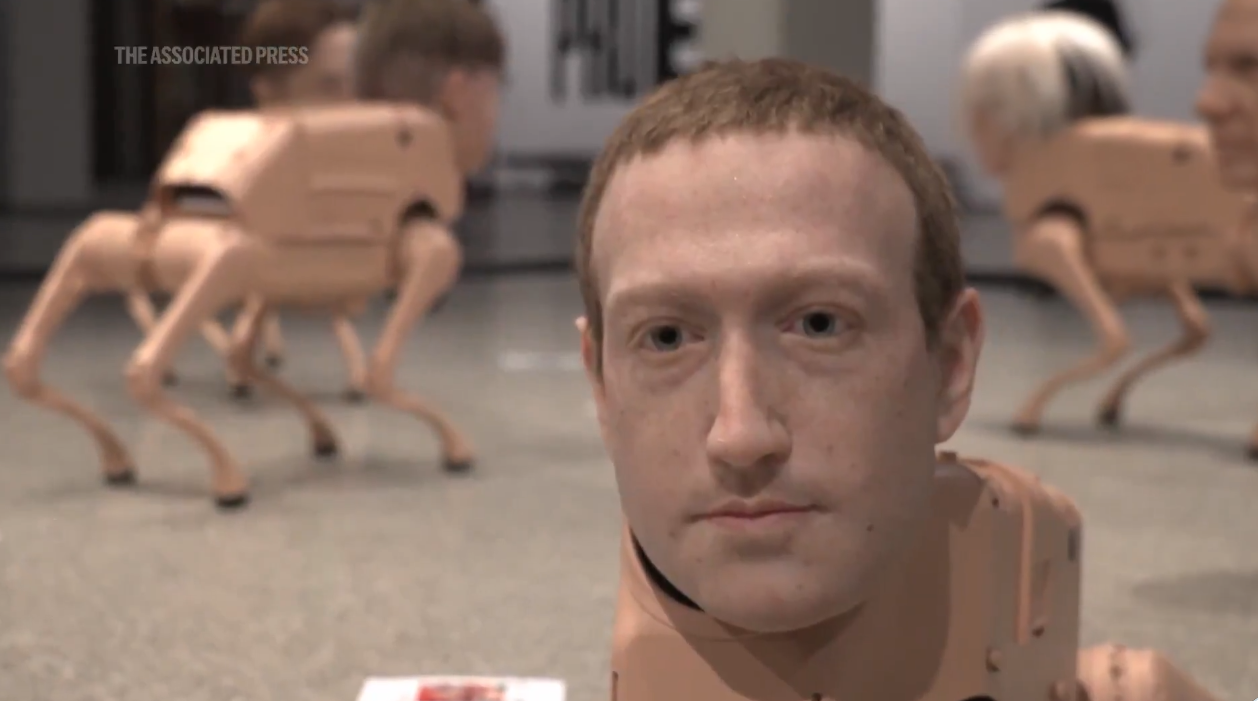
Robot Dogs With Billionaire Faces
The installation features a group of autonomous robot dogs fitted with hyper-realistic silicone heads. The faces include Elon Musk, Jeff Bezos, Mark Zuckerberg, Andy Warhol, Pablo Picasso, and Beeple himself.
Reports from the exhibition also showed a robot dog with Kim Jong Un’s face. The result looks like a nightmare version of a tech conference mixed with a museum installation.
The dogs move around inside an enclosed area in the gallery. They do not just sit there as sculptures. They walk, scan the room, and interact with the space around them.
They Watch Visitors, Then Make AI Art
Each robot dog has cameras that capture images of visitors and the gallery. The system then uses AI to reinterpret what it sees through the style or personality linked to each figure.
For example, the Picasso-themed dog can turn the room into something closer to Cubism. The Warhol version leans into pop-art-style imagery.
Then comes the part that made the artwork go viral. The dogs print the AI-generated images from their backsides.
Visitors can take the prints home for free. So, in plain terms, the robot dogs are walking around a Berlin museum and “pooping” AI art.
Beeple Turns AI Culture Into a Weird Joke
The piece is funny, but it is not random. Beeple is using the absurd image of celebrity-faced robot dogs to make a point about power in the digital age.
The work asks a simple question: who shapes culture now?
In the past, artists, newspapers, museums, and governments played that role. Today, algorithms, tech platforms, billionaires, AI systems, and online attention loops do much of that work.
The NFT Angle Is Still There
There is also a blockchain layer to the installation. Visitors can reportedly claim free NFTs linked to the project through QR codes.
That fits Beeple’s history. He became one of the most famous names in digital art after his NFT artwork “Everydays: The First 5000 Days” sold for more than $69 million in 2021.
Since then, Beeple has become a symbol of the NFT boom, digital art culture, and the uneasy overlap between technology, money, and online hype.
With “Regular Animals,” he seems to be turning that world into a joke about itself.
From Miami to Berlin
The project first appeared at Art Basel Miami Beach 2025 before moving to Berlin for Gallery Weekend Berlin 2026.
Its Berlin run is also notable because it marks Beeple’s first institutional exhibition in Germany. That gives the work a more serious setting than a viral internet stunt.
Still, the installation clearly wants to be shared online. Robot dogs with billionaire heads printing AI art from their backsides is almost engineered for social media.
Why It Feels Creepy
The unsettling part is not just the strange faces. It is the way the work turns visitors into raw material.
People enter the gallery, the dogs watch them, AI processes them, and the machine spits out an image. That process mirrors how digital platforms already work.
We post, click, scroll, and watch. Platforms collect the signal, process it, and feed something back to us.
Beeple just made that loop physical. Then he put a famous face on it.
“Regular Animals” lands at a time when AI art is already raising questions about authorship, consent, copyright, and originality.
The installation pushes those questions into a more uncomfortable space. It shows AI art as something funny, grotesque, and automated.
It also makes the power structure visible. The machines are not faceless. They wear the faces of people and cultural icons linked to money, platforms, art, and influence.
So yes, AI art is getting creepy.
In Berlin, it now has four legs, a billionaire’s face, a camera, and a built-in printer.