




It is April Fool’s Day, which means the internet is on high alert for fake headlines. In crypto, that instinct should be a year-round commitment.
The tokens below were not pranks. They launched on real blockchains, attracted real money, and left very real bagholders. Together, they teach more about due diligence than any joke ever could.
A Token Named After Flatulence Hit $2.5 Billion
Because apparently the market was running out of serious things to fund, Fartcoin (FARTCOIN) launched on Solana in October 2024. Its origin story is exactly what it sounds like. An AI chatbot called Truth Terminal, built by researcher Andy Ayrey, made fart jokes.
Fans decided that was worth tokenizing.
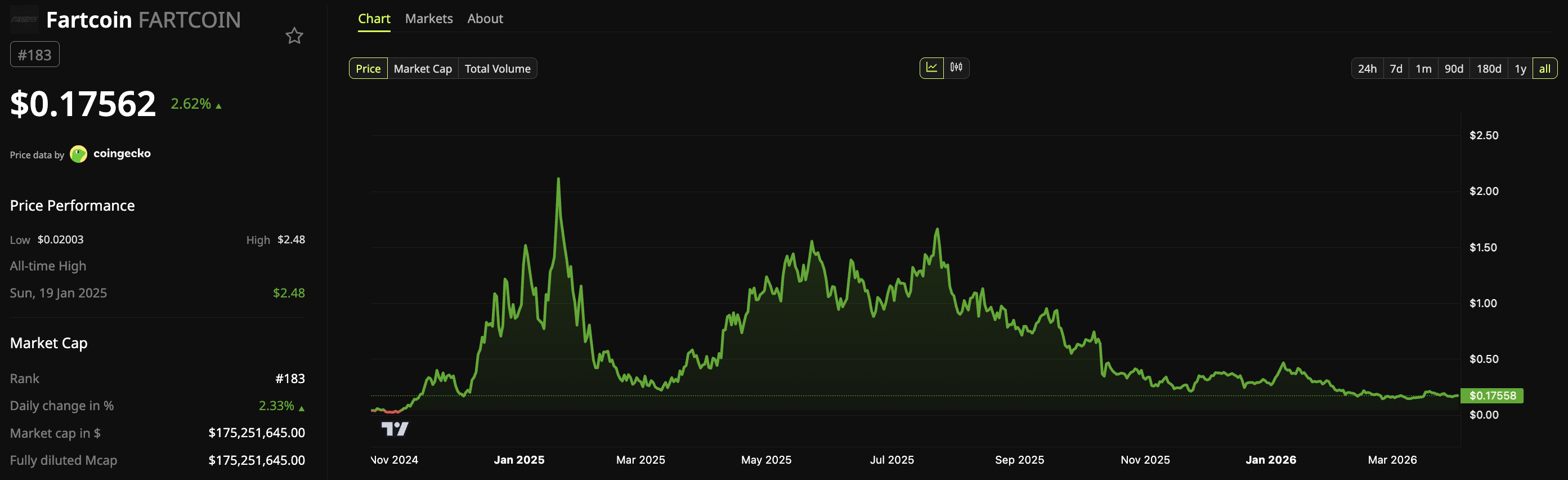
Within three months, FARTCOIN crossed a $1 billion market cap. It reached that milestone faster than Dogecoin (DOGE), which needed eight years. Let that sink in.
A flatulence token outpaced the OG meme coin.
By January 19, 2025, FARTCOIN peaked at $2.48 per token and a $2.5 billion valuation. Truth Terminal itself became what some called the first AI crypto millionaire. Marc Andreessen had given the bot $50,000 in Bitcoin (BTC).
As of April 2026, FARTCOIN trades around $0.17 with a market cap near $175 million. That is a 93% decline from peak. Thousands of wallets now hold a token named after a bodily function that has lost nearly all its value. No AI chatbot is coming to save them.
Yet, the most absurd lore is that Fartcoin is still the 183rd ranked crypto, based on market capitalization.
A Developer Burned $10 Million by Accident, and the Price Went Up
SLERF launched on Solana on March 18, 2024. It raised $10 million in a presale. What happened next belongs in a museum of human error.
The anonymous developer accidentally sent the entire presale token allocation and liquidity pool tokens to a burn address. Gone. Permanently. Mint authority had already been revoked, so there was no undo button, no hotfix, no “have you tried turning it off and on again.”
“Guys I fucked up. I burned the LP and the tokens that were set aside for the airdrop. Mint authority is already revoked so I can not mint them. There is nothing I can do to fix this. I am so fucking sorry,” Slerfsol posted on X.
The developer posted this admission publicly, and credit where it is due, at least they were honest about it.
Here is where the story gets truly absurd. Instead of crashing to zero, SLERF surged.
The sheer spectacle attracted speculators like moths to a very expensive flame. Within 24 hours, trading volume hit $2.5 billion, briefly surpassing Ethereum (ETH) and USDC. The market cap peaked at $450 million. For a token whose treasury had just been incinerated.
By April 2026, SLERF trades at roughly $0.003 with a market cap around $3 million. That is a 99.7% decline. The $10 million in presale funds remains permanently destroyed. Somewhere on Solana, a burn address holds the most expensive typo in meme coin history.
A 13-Year-Old Rugged a Token on Camera, Then the Internet Found Him
On November 20, 2024, a teenager launched a token called QUANT on Pump.fun during a livestream. Eight minutes later, he dumped everything for roughly $30,000.
The moment was captured live. The 13-year-old celebrated his profits and flipped off the camera.
What happened next was both poetic and disturbing. The crypto community launched a “revenge pump,” buying QUANT specifically to spite the young developer, pushing the market cap to $35 million within hours. The irony was brutal.
Had the teenager simply held, his stake would have been worth over $1 million. He chose $30,000 and an internet mob instead.
The aftermath spiraled. Community members doxxed the teenager, publishing his home address and school. His mother received abusive messages on Instagram.
Adults spent millions on a token created by a child, then harassed that child when he behaved exactly like a child would. QUANT is now effectively dead, with no recorded trades in over 29 days.
The teenager later launched apology tokens. None gained traction. Forgiveness, it turns out, has no liquidity.
“The World’s Most Honest Crypto” Promised Nothing and Hit $450 Million
If SLERF was an accident and QUANT was a scam, Useless (USELESS) was something rarer in crypto. It was transparent.
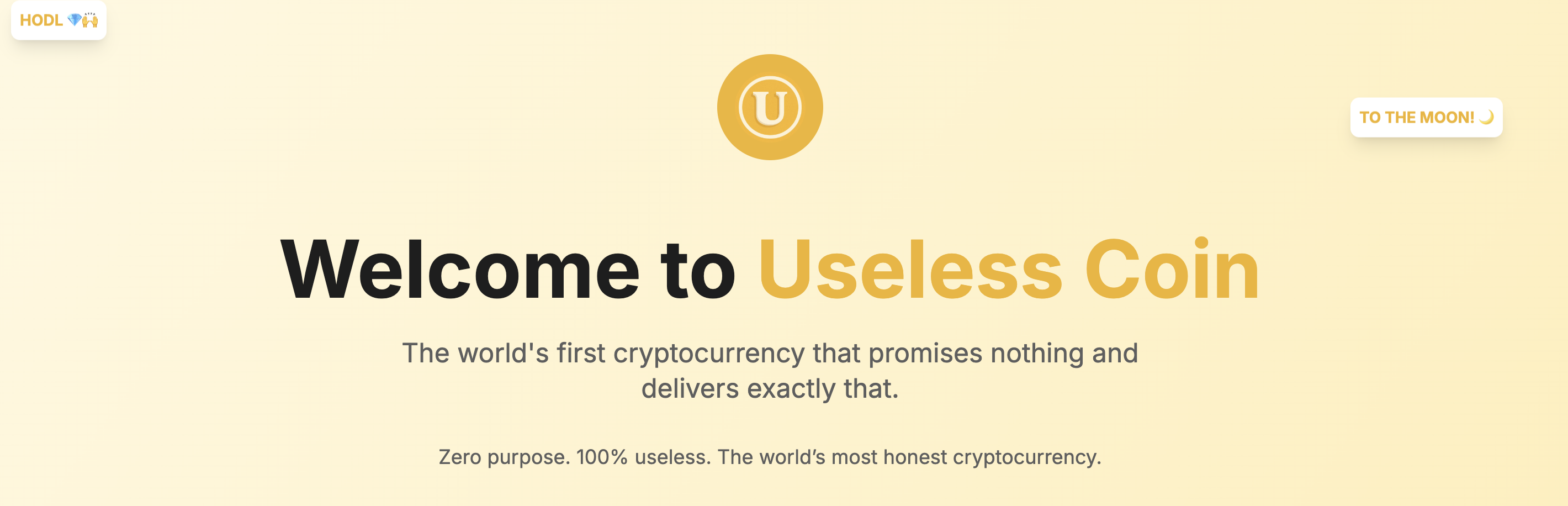
USELESS launched on Solana via LetsBONK.fun in May 2025 with a pitch that would make any venture capitalist weep. No roadmap, no team allocation, no VC vesting, no ecosystem fund, and no utility. The entire 1 billion token supply was available from day one, and mint authority was permanently renounced.
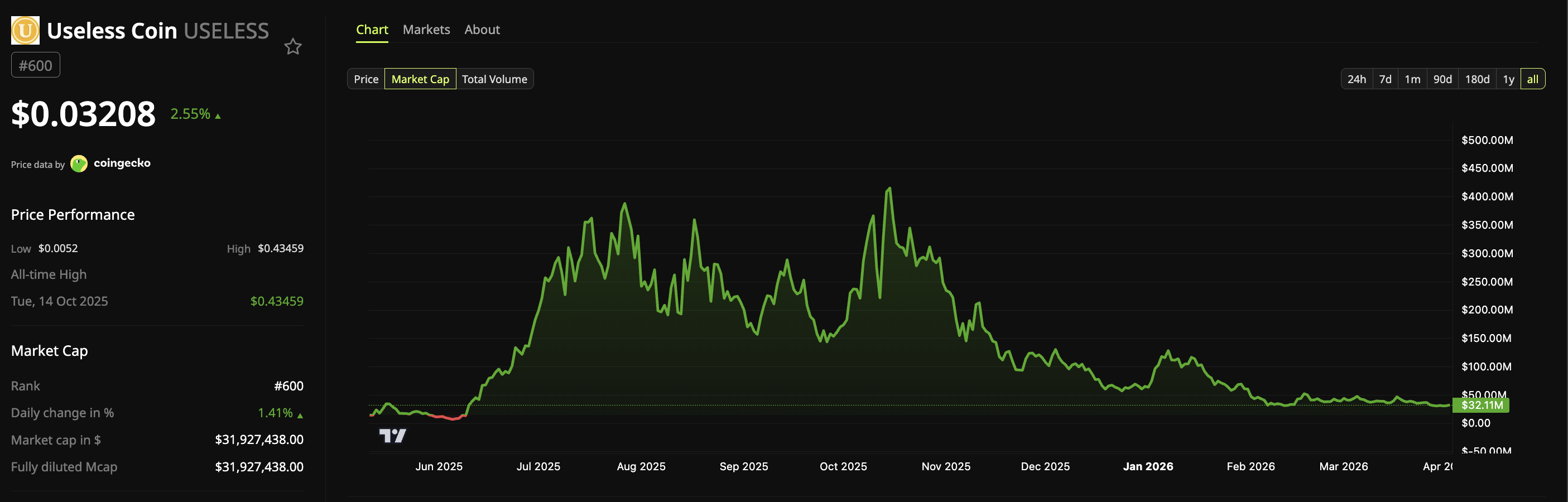
Naturally, the market loved it. USELESS went from a $200,000 market cap to $40 million in one week. It then dropped 87.5% to $5 million. Then it recovered to $250 million in a month. By October 2025, it peaked at $450 million market capitalization.
Coinbase, Kraken, and Gate.io all listed it. Major exchanges gave shelf space to a token that told them, to their face, that it does nothing. As of April 2026, USELESS maintains a market cap of around $32 million.
Here is the twist. Unlike most tokens on this list, USELESS did not rug pull, did not collapse 99%. A token that promised absolutely nothing may have been the most honest project in this entire lineup.
A Due Diligence Checklist for Every Day, Not Just April 1
These four projects share a pattern that should concern anyone paying attention. None offered a working product, a credible team with public identities, or a use case beyond speculation. Yet collectively they attracted billions of dollars.
Between January 2024 and March 2025, over seven million tokens were deployed on Pump.fun alone. According to DappRadar data, 98.6% of those with at least five trades collapsed into worthless pump-and-dump schemes. The remaining 1.4% includes FARTCOIN.
The lesson is not that all meme coins are scams. USELESS operated with more transparency than some tokens with 50-page whitepapers. The lesson is that the absence of utility, accountability, or even basic seriousness does not slow down capital one bit.
Today, everyone double-checks headlines before sharing them. Tomorrow, most will go back to aping into tokens based on a Telegram screenshot. Here is what to ask before buying anything.
Can you verify who built it? Is there a working product, or just a website and a group chat? Has the smart contract been audited by a reputable firm? What does the token distribution look like, and are insiders holding a disproportionate share? Does the valuation reflect usage, or just vibes?
SLERF’s developer had butterfingers. QUANT’s creator was a child who treated a blockchain like a lemonade stand. FARTCOIN emerged from an AI’s bathroom humor. USELESS told everyone the truth upfront and was rewarded for it.
In every case, the information was right there. The only question was whether anyone bothered to look before clicking “buy.”
 Bitrue