1inch is a leading DeFi aggregator that aims to make crypto trading more efficient and user-friendly. Its Swap product combines liquidity from multiple sources to get you the best token prices and offers multiple ways to trade, including across different blockchains.
This guide explains how 1inch Swap works, how its current Swap, Trade, and Pro flows differ, where Fusion and Fusion+ fit in, and what risks you should check before you confirm a trade. You will also learn about 1inch’s security stack and why it sees itself as a step up from conventional aggregators and DEX platforms.
KEY TAKEAWAYS
➤ 1inch Swap supports simple token swaps, advanced Trade/Pro tools, limit orders, and cross-chain swaps on supported networks.
➤ Fusion and Fusion+ enable gasless, MEV-protected, and bridge-free cross-chain swaps where supported.
➤ 1inch includes security checks such as risky-token alerts, address screening, scam protection, and smart contract audits.
➤ Swaps can still fail or face liquidity, resolver, fee, and network risks.
Swap options on 1inch
1inch gives you multiple ways to swap tokens. It offers a simple Swap experience for quick token exchanges and more advanced trade tools for limit orders, price charts, route details, and trade history. The right option depends on how fast you want the trade to be, how much control you need, and whether you want a simple swap form or a more detailed trade screen.
The 1inch interface has evolved over time, and continues to do so. The exact buttons and options in the app may change across app versions, networks, or interface paths. So, in this section, we focus on what each option does, rather than the exact button name.
Here’s a quick overview of the main modes, as of mid-2026:
Swap

The Swap experience is built for fast token exchanges. You choose the token you want to swap, choose the token you want to receive, review the expected output, and confirm the transaction from your wallet.
This option focuses on ease of use. You do not need to compare routes manually or adjust advanced settings before every trade. Depending on the route, 1inch may use Fusion for gasless token swaps or Fusion+ for cross-chain swaps.
Swap may suit you if you want:
- A faster token exchange
- Fewer manual controls
- Gasless execution, where supported
- Cross-chain swaps, where supported
- A cleaner interface without charts or order tools
Note that gasless does not necessarily mean fee-free in every case. Some routes can still require network fees, especially swaps that involve Solana, native tokens, or very small trades routed through the DEX aggregator.
Market swaps
A market swap lets you exchange tokens at the current available rate. On 1inch, this can mean a standard swap through the main Swap screen or a more detailed market swap inside the advanced trade area, depending on the interface path you use.
Market swaps may suit you if you want the trade to execute now instead of at a future target price. Before you confirm, check the expected output, route, price impact, slippage, and any network fee shown in the interface.

The main risk is price movement between the quote and execution. If the market moves or liquidity changes, the final output may differ from the first quote you saw.
Limit orders

A limit order lets you set the price at which you want to buy or sell a token. Instead of accepting the current market price, you define the rate you want. The order can fill if market conditions match your selected price.
On 1inch, limit orders can be useful when you do not want to watch the market manually. You can place an order and let it remain active until it fills, expires, or you cancel it.
Limit orders may suit you if you want:
- A specific entry or exit price
- More control than a normal market swap
- No need to accept the live rate immediately
- Partial fills, where supported
- A way to place an order without locking funds in advance
Limit orders also come with risks. Your order may never fill if the market does not reach your selected price. It may also remain unfilled if the order is not profitable for takers, the token has low volume, or you move the required funds from your wallet after you place the order.
How intent-based swaps work: Fusion and Fusion+
Fusion and Fusion+ are 1inch’s intent-based swap systems. Fusion handles supported same-chain swaps through resolver competition, while Fusion+ applies a similar model to cross-chain swaps without a standard bridge.
Instead of directly pushing a swap through one route yourself, you sign an order that tells 1inch what you want to swap and the minimum amount you are willing to receive. Resolvers then compete to fill that order.
The 1inch Fusion protocol: Intent-based gasless swaps
One of 1inch’s most powerful aspects is the Fusion protocol, which introduced intent-based, gasless swaps to DeFi.
In Fusion mode, you can swap tokens without paying gas fees or dealing with miner extractable value (MEV) attacks — a major advantage for on-chain traders.
Fusion allows users to create an “order intent” that specifies what they want to trade and under what conditions (instead of executing a swap directly through a DEX at the current price).
This intent functions like a flexible limit order with a price range and time window. Once signed, the order is passed to resolvers — professional market makers — who compete to fill it.
Resolvers pay the gas fees to complete the swap on-chain, so users don’t need native chain tokens like ETH or BNB to cover gas. Fusion uses a Dutch auction model to determine pricing.
Initially, the price favors users, and over time it shifts toward the resolver’s price target. This design incentivizes resolvers to fill orders early. This encourages resolvers to act early to secure a better profit margin, while still honoring the user’s price limits.
If the order reaches the end of the time window without being filled at acceptable terms, it expires without execution.
When resolvers do execute, they pull liquidity from DEXs, centralized exchanges, and internal inventory, thereby giving users access to deep, distributed liquidity. Even large orders can be filled in parts by multiple resolvers to reduce slippage.
Gasless execution is a key benefit. Resolvers bundle your trade into their own transactions and earn arbitrage or spread, while you only pay the swap amount and a small fee included in the rate.
MEV protection
MEV (Maximal Extractable Value) refers to the profit a validator or miner can gain by reordering, inserting, or excluding transactions within a block. This often results in front-running or sandwich attacks that worsen trade outcomes for regular users.
Fusion also protects users from MEV attacks like front-running or sandwiching. Because the order is filled by a resolver and submitted as a private, bundled transaction, MEV bots in the mempool never see it.
Some resolvers use private execution channels to further prevent any manipulation. This ensures a fairer trading environment, even for large swaps.
Fusion vs. Classic swaps
Before Fusion, 1inch swaps used a “classic” model, where trades were executed immediately and the user paid gas. Classic mode is still available and useful when instant, guaranteed execution is needed.
However, the Fusion protocol has become the default option for Simple mode because it often provides better outcomes after factoring in gas and MEV.
1inch’s in-house analysis claims that users save around 9.5% compared to competitor swaps using Fusion — primarily due to gas savings and execution optimization.
Cross-chain swaps with Fusion+
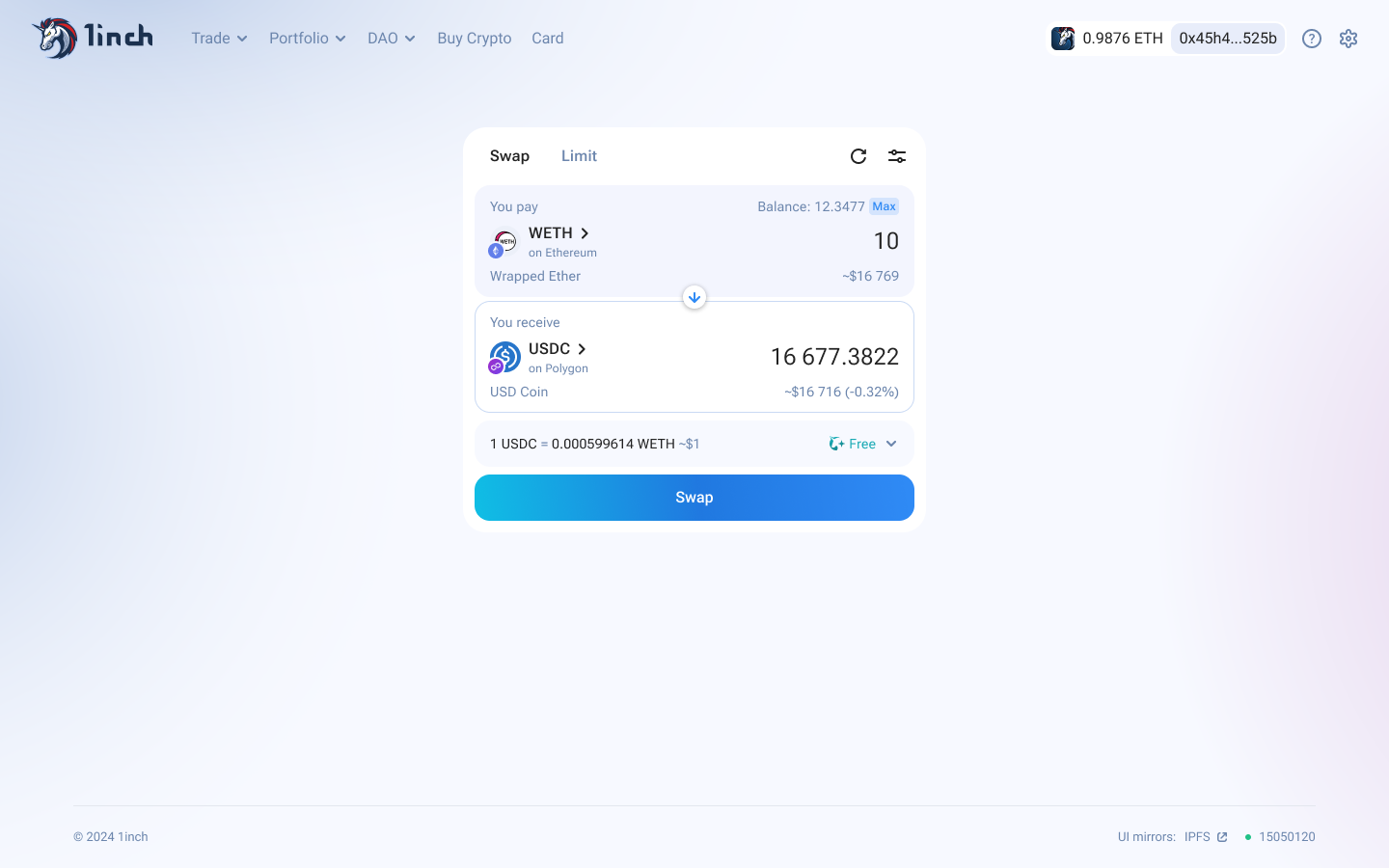
Cross-chain interoperability has long been a challenge in DeFi. Traditionally, swapping tokens across chains required using bridges or centralized exchanges — both of which were slow, somewhat expensive, and introduced custodial risks.
Fusion+ changes that by enabling relatively easy, bridgeless cross-chain swaps within the platform.
You can swap tokens from one chain to another (e.g., Ethereum to BNB Chain) in a single step without relying on third-party bridges or custodians. Importantly, you retain full self-custody at all times.
The process is atomic, meaning the swap either completes in full or fails with a refund — no partial outcomes.
How Fusion+ works
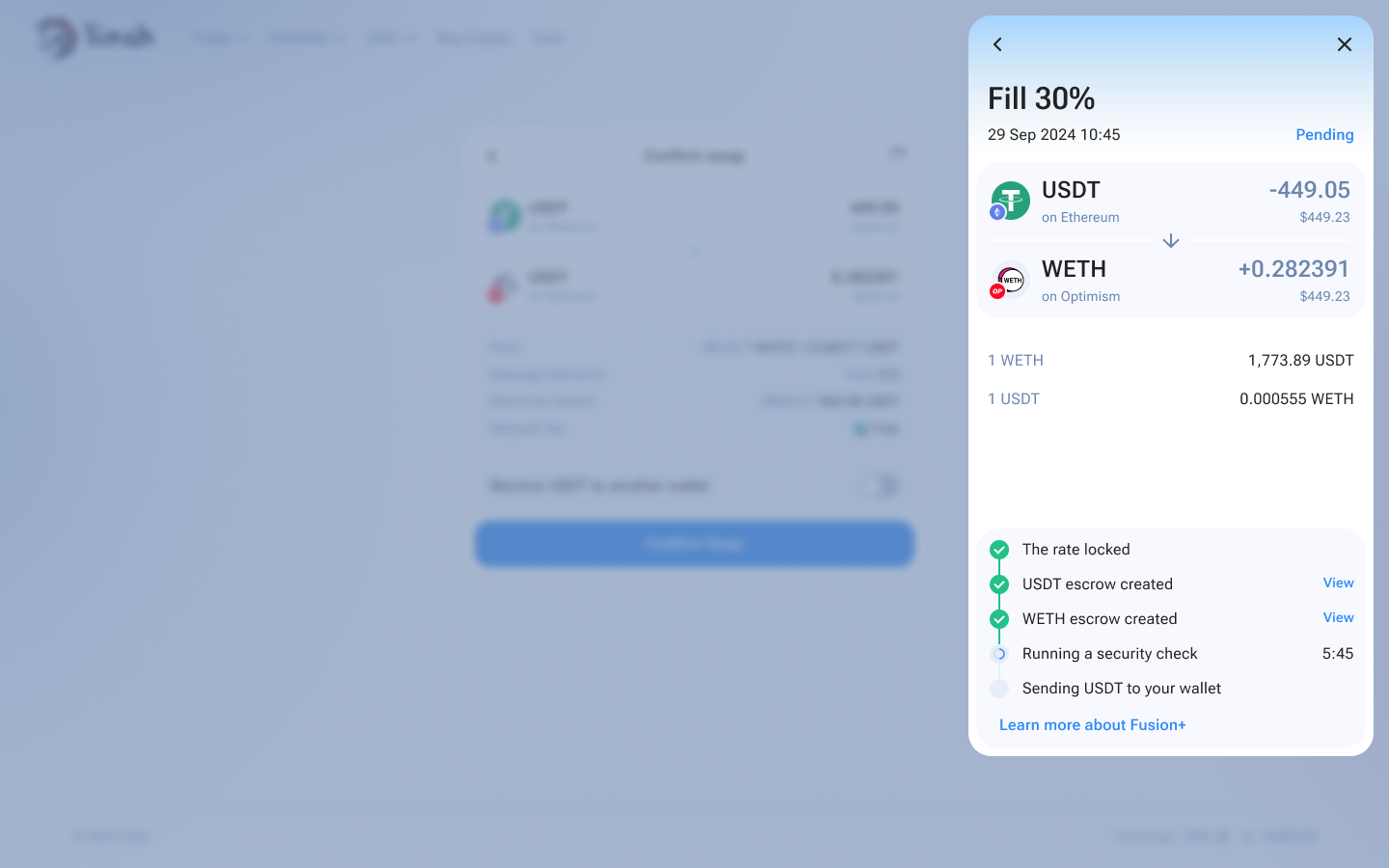
Fusion+ is built on atomic swap principles using 1inch smart contracts and resolvers. You sign an order intent specifying the token destination chain and acceptable rate when initiating a cross-chain swap.
The intent is shared with resolvers, who monitor a Dutch auction where the price gradually drops over time. They monitor the auction with the aim of filling the order as soon as the price meets their profit target. The first resolver to accept the terms wins the auction and locks your tokens into an escrow contract on the source chain.
Simultaneously, the winner locks the target-chain tokens (from their own funds) into a second escrow on the destination chain. Both escrows use a shared secret hash and a time lock.
Once both escrows are confirmed, the “secret” is revealed, which then allows the resolver to claim the tokens on one chain and send you the tokens on the other. The entire process is coordinated to be completed securely and atomically.
Timelock and safety
If something goes wrong — for instance, if the resolver fails to deliver — the swap cancels automatically after a set time window.
Funds are returned to the original owners. Resolvers also post a small security deposit that they forfeit if they fail to follow through. This mechanism is there to protect you from incomplete or failed swaps.
Fusion+ brings the reliability of atomic swaps into a user-friendly format, offering the same trustless guarantees but through a DeFi interface accessible to any user.
Why Fusion+ can be a game-changer
With Fusion+, 1inch delivers a somewhat unique and practical feature in DeFi: cross-chain swaps that are secure, decentralized, and require no bridges.
The process is simple — no juggling apps, no managing gas on multiple chains, and no exposure to bridge vulnerabilities. For instance, swapping tokens from Ethereum to Polygon with Fusion+ is faster, safer, and cheaper than using a traditional bridge. You don’t pay gas on the source chain because resolvers handle gas costs on both ends. This makes cross-chain trading as easy as a standard token swap.
To cut a long story short, Fusion+ represents a major advancement in multi-chain DeFi infrastructure by removing reliance on custodial intermediaries and integrating atomic security.
Fusion+ remains under the radar for many users, yet it redefines what cross-chain trading can — and should — look like: trustless, gasless, and bridge-free.
1inch security: What protects you while swapping
The platform promises a comprehensive security stack to protect users from scams, hacks, and fraudulent activity at every step. This spans everything from smart contract audits to real-time address screening.
Here are some of the key layers of protection 1inch offers:
- Blocklist strategy: 1inch screens wallet addresses for risk, using data from TRM Labs, Etherscan, and its own investigation team. Suspicious wallets are blocked automatically.
- Transaction simulations: The wallet shows you exactly what will happen right before you sign a trade. You see what tokens leave your wallet, what comes in, and if anything looks sketchy.
- Scam protection: 1inch has teamed up with security platforms like Blockaid to detect threats such as malicious transactions, suspicious DApps, scam domains, and phishing attempts. You’ll get an alert before connecting to anything flagged as unsafe.
- Smart contract audits: Every contract used by 1inch has been audited multiple times. Put simply, they are also non-upgradable, so no surprise code changes can sneak in.
- Front-running protection: Fusion and Fusion+ prevent bots from manipulating your trade by hiding your order until it’s executed.
- AML compliance: Resolvers must pass KYC checks before operating. Transactions are also screened for links to money laundering, scams, or hacked funds.
- Brand protection: 1inch actively removes fake websites and social scams with help from Red Points and Phishfort. This way, you stay protected even outside the DApp.
Additional protection layers on 1inch:
- Downtime fallback: Fusion+ has a built-in recovery phase for stalled swaps.
- MEV resistance: Private order handling eliminates sandwich attacks.
- Behavioral risk analysis: User actions are monitored (anonymously) to detect signs of compromise.
1inch swap vs. alternatives
| Feature | 1inch Swap | Most other aggregators |
| Gasless swaps | Yes, through Fusion protocol | Not supported |
| Cross-chain swaps | Yes, bridgeless via Fusion+ | Usually require bridges |
| Swap modes | Simple, advanced, and limit orders | Often limited to basic swapping |
| Front-running protection | Yes, native MEV resistance | Mostly rely on slippage controls |
| Liquidity depth | Aggregates from 100+ sources | Aggregation limited to major DEXs |
| Security stack | Includes blocklists, AML, and scam detection | Not always transparent or available |
| User interface options | Beginner to pro-friendly settings | Often fixed or less customizable |
| Permit2 support | Fully supported | Rare or partially implemented |
| Governance model | Community-led DAO | Mostly centrally managed |
Potential drawbacks
While 1inch Swap comes packed with practical and efficient features, there are a few potential drawbacks depending on your use case:
- Delayed execution in Fusion mode: Because Fusion uses Dutch auctions, your swap might not execute instantly. If you need immediate execution, Classic mode may be better.
- Limit orders depend on taker interest: Your order might not fill if it isn’t profitable for resolvers or takers, especially with low-liquidity pairs.
- Gas fees in Classic mode: If you use Classic swaps, you still need native tokens like ETH or MATIC to cover gas.
- Cross-chain swaps are resolver-dependent: Fusion+ relies on resolvers to complete swaps. While protected by escrow and recovery mechanisms, it is not instant like native-chain swaps.
- Complexity for new users: Advanced settings, presets, and auction mechanics can feel overwhelming if you are used to simpler DEXs.
Is 1inch Swap the right fit for you?
As you can see, 1inch Swap offers far more than basic DEX aggregator functionality. If you are an active trader managing assets across chains, it can be a strong alternative to simpler platforms.
That said, the multiple modes and advanced settings may feel complex for some beginners who may prefer easier tools for basic swaps. Additionally, Fusion mode’s reliance on resolvers also introduces timing and pricing trade-offs. Overall, whether 1inch Swap suits your needs ultimately depends on how actively you trade and how much control you want.