


The cryptocurrency market may be entering a challenging phase as global money supply (M2) growth has fallen into negative territory for the first time this year.
At the same time, the likelihood of the Federal Reserve raising interest rates has been increasing in March. This trend is raising investor concerns and prompting earlier reactions.
7-Week M2 Growth Turns Negative for the First Time in 2026
Data from BGeometrics shows that global M2 growth, measured over a 7-week cycle, has turned negative for the first time since the beginning of 2026.
This development is concerning because M2—a measure of total money supply that includes cash, bank deposits, and highly liquid assets—often serves as a leading indicator. It has a strong correlation with the performance of risk assets, especially cryptocurrencies.
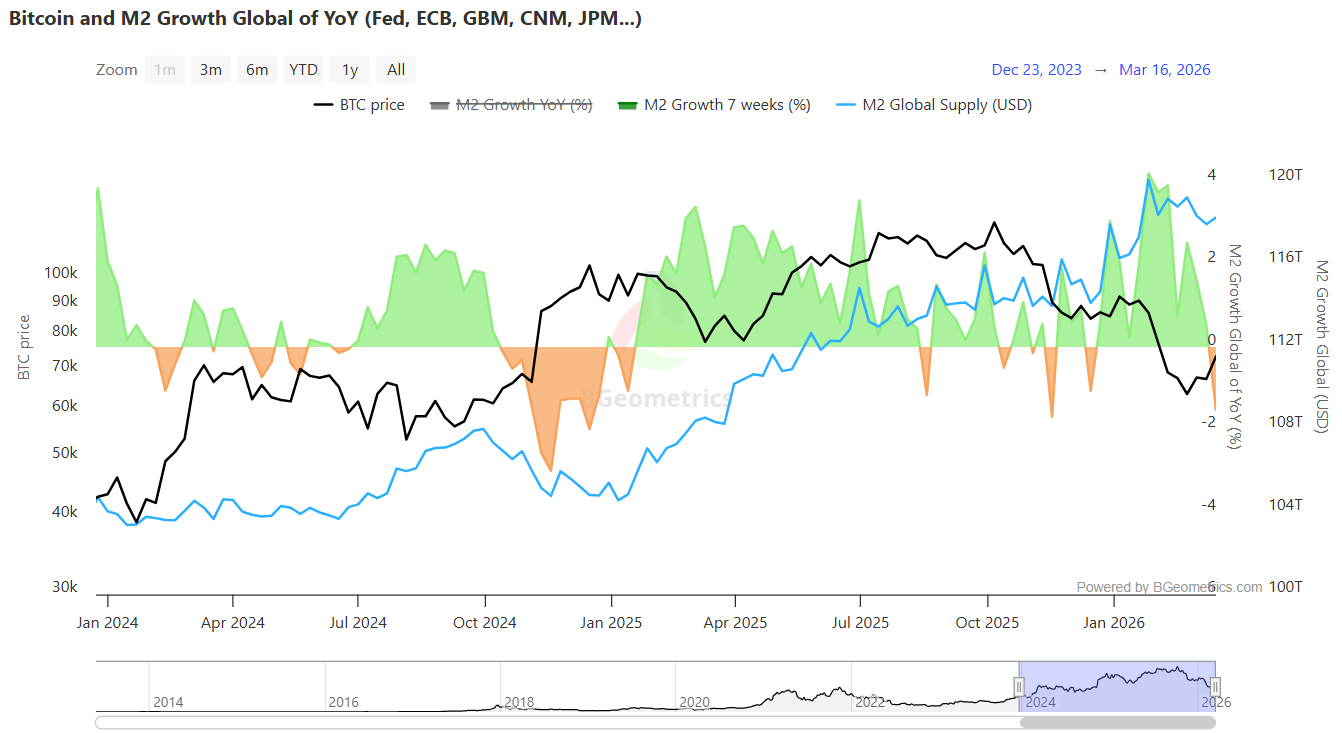
Year-over-year M2 growth remains positive, but it has also begun to decline.
“This means that, although global M2 is still growing compared to one year ago, the pace of expansion is slowing. In other words, liquidity creation across major economies is decelerating,” Alphractal, an on-chain and macro data platform, commented.
Notably, the sensitivity of major cryptocurrencies such as Bitcoin (BTC), Ethereum (ETH), and Solana (SOL) to global liquidity is currently higher than the long-term average.
According to data from Cross Border Capital, the correlation between these altcoins and macro liquidity flows has increased significantly over the past few years.
At the same time, crypto is becoming more “mature” as it integrates into the global financial system. However, this also means that these assets are more likely to react strongly to fluctuations in global capital flows.
It remains too early to confirm that global M2 supply has entered a sustained decline. However, a report by BeInCrypto explains that escalating tensions in the Middle East have pushed oil prices higher, reigniting inflation expectations.
As a direct consequence, the market is repricing the probability of US Federal Reserve interest rate cuts. The likelihood of rate hikes has even increased again recently. If this scenario materializes, it could push global liquidity into contraction.
In the past, analysts often observed a lag of around 2-3 months between changes in M2 supply and Bitcoin price movements. However, war and oil price shocks may act as new factors that accelerate the transmission of these effects.