


For two decades, Silicon Valley has operated on the ‘zero to one’ playbook, a business theory obsessed with value extraction, creating centralized monopolies, and capturing user attention. But in the age of autonomous systems, this classic model is being systematically optimized out by AI agents.
This fundamental breakup of traditional startup models is forcing founders to reimagine how they build, scale, and monetize.
A new thesis, titled “Zero to Many,” from research-led investment firm Outlier Ventures argues that AI agents are systematically dismantling classic startup theory.
This dramatic shift marks the beginning of the ‘Post Web’: an internet where autonomous agents are the primary economic actors, and success is defined by enabling machines to discover, transact, and execute tasks fluidly at scale across decentralized ecosystems.
The Blueprint of the Agentic Web
To grasp this change, consider a mature decentralized finance protocol like Aave. While Aave started as a platform for humans borrowing and lending, the majority of its usage today is machine-driven.
Aave functions as financial infrastructure or a composable protocol, consolidating liquidity, oracle data (like Chainlink), wallets, bots, and cross-chain deployments into one system.
Humans may set initial parameters (e.g., “optimize for max yield on my stablecoins”), but agents and bots execute the complex strategies continuously. Functions like looping strategies and liquidations are executed by bots at speeds no human could match. This makes Aave an early real-world example of the Agentic Web, demonstrating a critical evolution from a product designed for human interaction (UX) to one designed for systems and agents (AX).
The consequences of this agentic internet fundamentally redefine how founders design, build, scale, and operate.
The New User is a Machine: From UX to AX
The core of this transformation is the definitive shift from User Experience (UX) to Agent Experience (AX). When AI agents become the main customers, founders must build their products for seamless machine integration and be selected by agents.
The traditional focus on intuitive, persistent interfaces (like dashboards and GUIs) fades. Instead, products are increasingly built for agents, shifting product access from user interfaces to invisible, machine-first execution via APIs.
In this agent-driven economy, products are no longer browsed; they are triggered. The most critical factor for selection is no longer brand reputation or persuasive design, but verifiable proof, via Distributed Ledger Technology (DLT). If an outcome cannot be proven, an agent will simply choose a competitor that can provide that verifiability. This is part of the Agentic Product Lifecycle, where products are accessed via Agent Experience.
The End of Moats and the Rise of Machine-Speed Velocity
Classic startup theory relies on building moats; it is based on user lock-in and high switching costs that achieve winner-takes-all dynamics. These moats are slowly dissolving as gents can switch services instantly, making continuous, real-time performance the most important signal. This means that the only moat left for founders is the speed at which they can build and iterate.
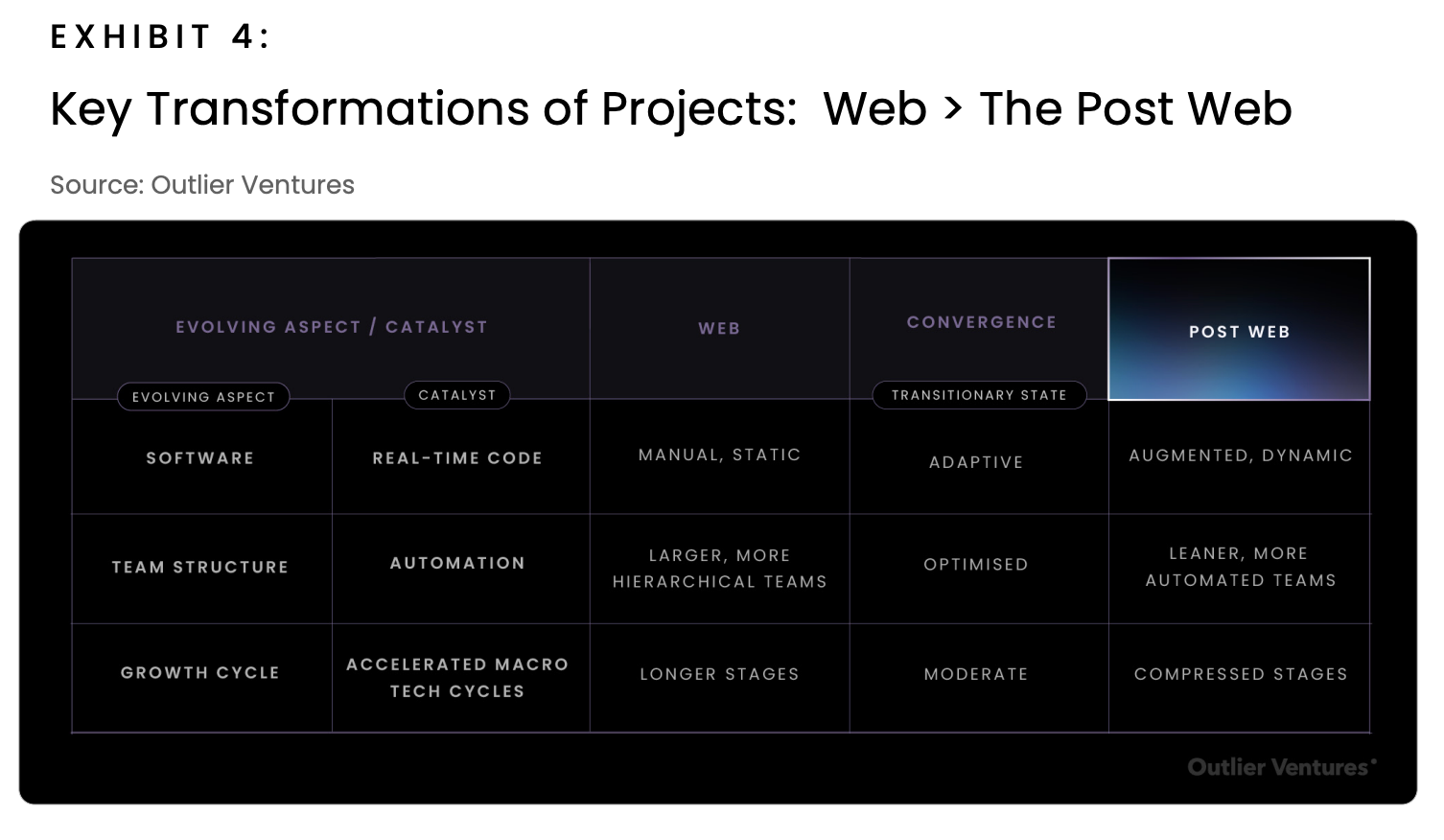
Startup velocity now compounds at machine speed. This acceleration is powered by two compounding forces:
1. AI compresses the time to build, iterate, and ship a product. Real-world examples like Devin AI, an autonomous “AI software engineer,” demonstrate how execution and growth cycles are compressed.
2. DLT compresses the time to form capital and coordination incentives (via tokens and smart contracts).
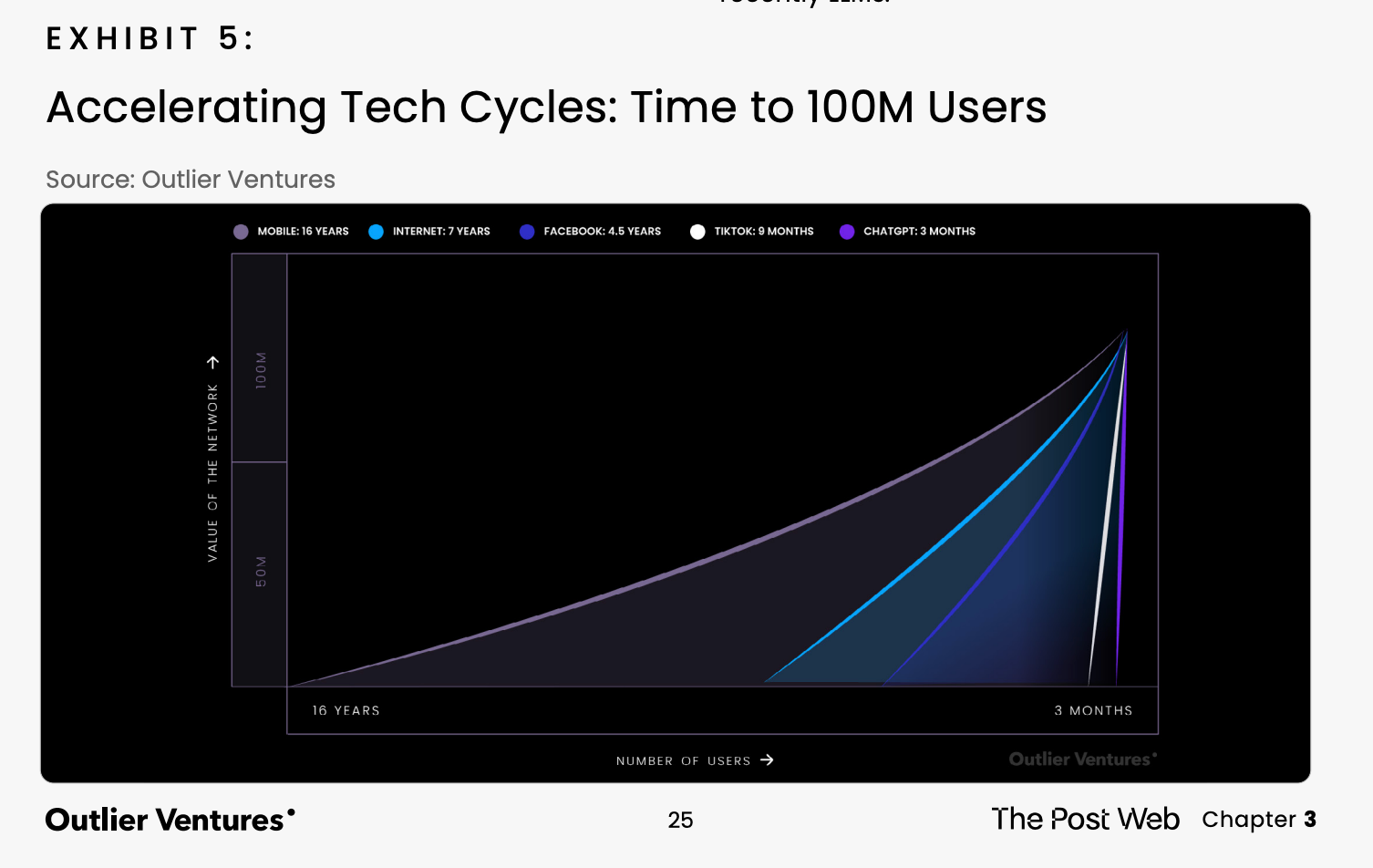
This convergence has drastically accelerated technological paradigm shifts. For example, ChatGPT reached 100 million users in less than three months, demonstrating this accelerated pace of technological paradigm shift. This compression forces projects to rapidly iterate, optimize, and adapt to remain competitive.
The Collapse of the Marketing Funnel: Attention to Intention
The traditional Business-to-Consumer (B2C) funnel—built on discovery, engagement, and conversion through persuasion—is breaking down as agents take over economic interactions.
Agents do not browse, engage with ads, social proof, or emotional persuasion. Instead, they benchmark and select the most efficient option based on structured data and provable performance. This transition marks the definitive end of the “attention economy” and the beginning of an “intention economy”.
In this new paradigm, agents optimise users’ desired outcomes in a trustless and verifiable manner via Distributed Ledger Technology (DLT). Businesses must, therefore, monetize successful outcomes, not screen time or engagement. Loyalty is earned through continuous, agent-led selection, where providers must consistently outperform competitors in real-time on every transaction.
Why Crypto is the Missing Piece
The agentic internet, by itself, lacks essential infrastructure. Without verifiable guarantees around identity, ownership, and execution, there is a limit to what users can safely delegate to agents. Agents remain constrained, unable to take on high-value tasks or operate autonomously at scale because they lack trust.
Distributed Ledger Technology (DLT), including blockchains, smart contracts, and tokens, provides this essential layer of trustless coordination. The Post Web is explicitly defined as the Agentic Internet plus decentralised infrastructure (blockchains, smart contracts, tokens). This layer brings the necessary verifiability, composability, and trustless coordination to distributed agentic systems.
In this machine-native environment, tokens will serve as the core interface between human intent and machine execution. They govern programmable incentives, verifiable participation, and self-enforcing rules that autonomous agents demand to function efficiently in distributed systems.
Conclusion: From Startups to Self-Optimizing Systems
The classical startup model is giving way to adaptive, autonomous systems that self-reference and self-optimize at machine speed. Software is becoming autonomous, capital is shifting from static to dynamic, and business models are moving from value extraction to value maximization.
Looking at the reality of where the industry is heading, it becomes clear that successful products are likely to shift from centralized, static applications designed for human engagement to modular, machine-first architectures. In this paradigm, success will be measured by seamless agent integration, composability, and continuous execution. Founders need to carefully consider the implications of such a shift and adapt their thinking from focusing on building “startups” to building “systems”.
As agents replace human users as the primary drivers of the Internet, founders must prioritize modular integration, verifiable performance, and machine-tailored systems. These shifts fundamentally represent inevitabilities fthat ounders must begin planning for now, as they trend mainstream over the next decade.
The future belongs to those who build resilient, composable systems that thrive in a machine-native environment. This is not merely an upgrade; it is a structural realignment of how value is created, coordinated, and sustained in the digital economy.
